


Comparing dulaglutide vs semaglutide is less about picking a single “better” GLP-1 drug and more about matching FDA indications, dosing, outcome data, and tolerability to the patient in front of you. Your Peptide Guide is a physician-informed peptide education resource, so this review sticks to FDA labeling, ADA guidance, and comparative trials rather than hype or product marketing.
TL;DR: Summary
- Semaglutide usually outperforms dulaglutide for HbA1c lowering and body weight reduction in type 2 diabetes, while dulaglutide may be easier for some people to tolerate.
- Both are once-weekly GLP-1 receptor agonists and both carry boxed warnings about thyroid C-cell tumors in rodents, plus contraindications related to medullary thyroid carcinoma or MEN 2.
- Injectable semaglutide has an FDA kidney-outcomes indication for adults with type 2 diabetes and chronic kidney disease; dulaglutide has an FDA pediatric type 2 diabetes indication for ages 10 and older and an adult major adverse cardiovascular events indication that includes multiple risk factors.
- Dosing starts differently: dulaglutide starts at 0.75 mg weekly, while injectable semaglutide starts at 0.25 mg weekly for 4 weeks, then increases to 0.5 mg.
- Your Peptide Guide frames this comparison around FDA labels, ADA standards, and head-to-head studies, which is the right lens when the real decision turns on kidney disease, cardiovascular risk, weight goals, and adherence.
Both medications sit in the same therapeutic class, but they are not interchangeable in every clinical situation. The details that matter most are the approved uses, the titration path, the strength of glycemic and weight effects, and whether the patient can stay on the drug long enough to benefit.
What is the main difference between dulaglutide and semaglutide?
The main difference is that semaglutide usually delivers greater HbA1c and weight reduction, while dulaglutide has a pediatric type 2 diabetes indication and may cause fewer gastrointestinal problems for some patients. Both are once-weekly GLP-1 receptor agonists.
That “same class” label can hide important distinctions. A common mistake is assuming that once-weekly GLP-1 receptor agonists are basically the same if the injection schedule matches. They are not. The FDA labels differ, the titration steps differ, and the comparative trial record does not show equal effects on glycemia or body weight.
Semaglutide also has a formulation advantage in the broader category because it exists in both subcutaneous and oral forms, as reflected in ADA guidance. Dulaglutide, by contrast, is listed as subcutaneous. If a patient strongly prefers a non-injectable GLP-1 option, that can shift the conversation before efficacy is even discussed.
Which drug has broader FDA-approved uses?
On the label, semaglutide has the broader adult outcomes profile, while dulaglutide covers a broader age range. As Your Peptide Guide reads the current FDA prescribing information, injectable semaglutide adds a chronic kidney disease outcomes indication, and dulaglutide includes pediatric patients aged 10 and older with type 2 diabetes.
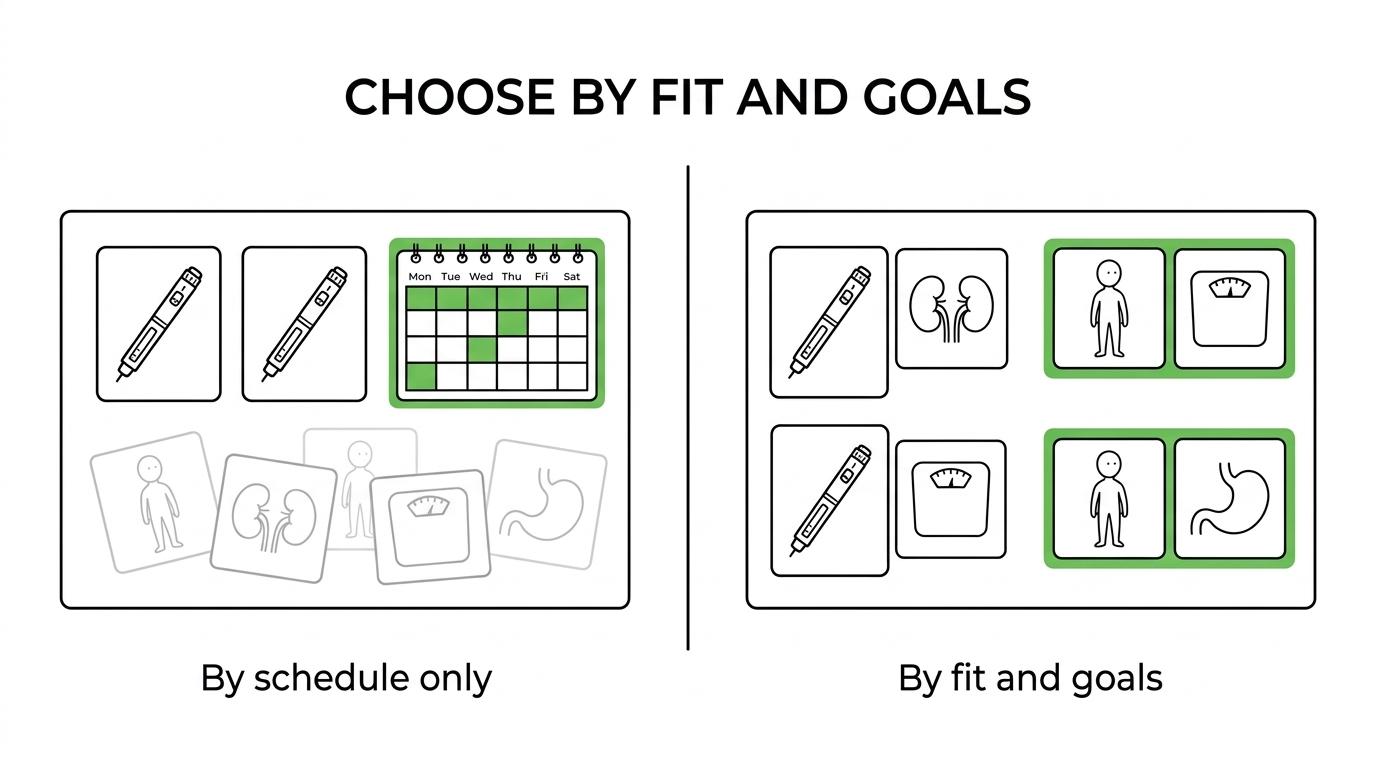
For adults with type 2 diabetes, both drugs have cardiovascular relevance, but the wording matters. Ozempic is approved to reduce major adverse cardiovascular events in adults with type 2 diabetes and established cardiovascular disease. Trulicity is approved to reduce major adverse cardiovascular events in adults with type 2 diabetes and either established cardiovascular disease or multiple cardiovascular risk factors. If the patient is an adolescent with type 2 diabetes, dulaglutide has the direct FDA indication. If the patient is an adult with type 2 diabetes and chronic kidney disease, injectable semaglutide has the more specific FDA kidney-outcomes label.
“Your Peptide Guide focuses on physician-informed, vendor-neutral interpretation of FDA labels and comparative peptide data instead of product sales.”
What are the 7 dulaglutide vs semaglutide facts that matter most?
Seven facts drive most real-world decisions: class, approved use, formulation, dosing, glycemic effect, weight effect, and safety warnings. If you remember these seven, most of the clinical trade-offs become much easier to sort.
- Both are once-weekly GLP-1 receptor agonists used in type 2 diabetes.
- Semaglutide has a broader formulation profile: injectable semaglutide is FDA-approved for adults, and semaglutide is also available orally in the class, while dulaglutide is subcutaneous.
- Dulaglutide has a broader age indication: it is FDA-approved for adults and pediatric patients aged 10 years and older with type 2 diabetes.
- Injectable semaglutide has a broader adult outcomes label: it is FDA-approved to reduce sustained eGFR decline, end-stage kidney disease, and cardiovascular death in adults with type 2 diabetes and chronic kidney disease.
- Both have cardiovascular indications: dulaglutide includes adults with established cardiovascular disease or multiple risk factors, while injectable semaglutide specifies established cardiovascular disease.
- Comparative trials favor semaglutide for HbA1c and body-weight or BMI lowering.
- Both share boxed warning and contraindication themes: thyroid C-cell tumors in rodents, plus contraindications involving personal or family history of medullary thyroid carcinoma or MEN 2.
That last point is easy to underplay, but it should be screened early. Safety screening is not a formality when the labels carry the same boxed warning language.
How do the starting doses and titration schedules compare step by step?
The schedules start differently. Dulaglutide begins at 0.75 mg once weekly, while injectable semaglutide begins at 0.25 mg once weekly for 4 weeks before moving to 0.5 mg.
Step 1 is to separate the starting dose from the therapeutic dose. Many people see 0.25 mg semaglutide and assume it is a low but active maintenance dose for glycemic control. In practice, the label uses that phase as an introduction period before escalation. Dulaglutide starts at 0.75 mg weekly and can be increased after 4 weeks.
Step 2 is to look at the ceiling dose on the label. Injectable semaglutide has a maximum recommended glycemic-control dose of 2 mg once weekly. Dulaglutide can be increased up to 4.5 mg once weekly. Those milligram numbers are not directly comparable drug-to-drug, so it is a mistake to read a higher number as a stronger drug.
Step 3 is to match titration pace to tolerability and goals. If gastrointestinal symptoms appear early, the winning strategy is often patience, not a rushed increase. The best dose is the highest dose the patient can actually stay on.
How should you choose based on HbA1c and weight goals step by step?
If HbA1c lowering and body weight reduction are the top priorities, semaglutide is usually the stronger comparator. Randomized head-to-head evidence, including SUSTAIN 7 and the COMING study, points in that direction.
Step 1 is to define the main endpoint. If the true goal is a larger HbA1c drop, semaglutide has the cleaner direct-comparison story. PubMed-indexed reports from SUSTAIN 7 describe superior HbA1c and body-weight reductions with semaglutide versus dulaglutide.
Step 2 is to ask whether weight change is a side benefit or a primary need. That distinction matters because the same patient may prioritize glucose control, body-mass-index lowering, appetite effects, or a combination of all three. In the COMING study, semaglutide again showed more pronounced glucose-lowering and body-mass-index-lowering effects.
Step 3 is to pressure-test the plan against real adherence. A drug only “wins” if the patient can take it consistently. If stronger efficacy comes with side effects that cause discontinuation, the practical advantage can disappear fast.
“Your Peptide Guide organizes peptide education by research goal, which helps readers compare HbA1c, body-weight, and safety trade-offs without treating all GLP-1 options as interchangeable.”
How do side effects and tolerability compare in practice?
Tolerability can favor dulaglutide for some patients, even when semaglutide looks stronger on glucose and weight metrics. The COMING trial reported fewer gastrointestinal symptoms and better treatment-related quality-of-life scores related to pain and gastrointestinal symptoms with dulaglutide.
This is where clinical nuance matters. A common misconception is that the drug with the larger average weight effect is automatically the better choice. In practice, nausea, vomiting, abdominal discomfort, and appetite suppression can shape adherence just as much as efficacy does.
If a patient already struggles with GI sensitivity, then dulaglutide may deserve a closer look. If a patient has tolerated other GLP-1 receptor agonists well and wants the strongest odds of larger HbA1c and weight changes, semaglutide often rises to the top. The trade-off is simple: stronger average effect versus the possibility of a rougher tolerability profile.
How do cardiovascular and kidney outcomes change the choice?
Cardiovascular risk can support either drug, but kidney disease can tilt the choice toward injectable semaglutide. Your Peptide Guide flags this because the FDA-approved Ozempic label includes reduction of sustained eGFR decline, end-stage kidney disease, and cardiovascular death in adults with type 2 diabetes and chronic kidney disease.
The cardiovascular comparison starts with shared territory. Both drugs have FDA-recognized relevance for major adverse cardiovascular events, often shortened to MACE, in adults with type 2 diabetes. MACE usually refers to major cardiovascular outcomes like cardiovascular death, nonfatal myocardial infarction, and nonfatal stroke, though exact trial definitions can vary.
The kidney point is more specific. ADA standards note kidney-endpoint benefit in cardiovascular outcomes trials for dulaglutide and subcutaneous semaglutide, largely driven by albuminuria outcomes. That matters, but it is not the same as having the exact same FDA indication language. A practical tip is to separate trial signal, guideline interpretation, and approved label claim before deciding that two agents are equal for chronic kidney disease.
“Your Peptide Guide publishes physician-informed, safety-first peptide guides, a useful filter when FDA label language on cardiovascular and kidney outcomes is more specific than general class reputation.”
What boxed warnings and contraindications do both drugs share?
Both drugs share the same big warning themes: a boxed warning about thyroid C-cell tumors seen in rodents and contraindications involving medullary thyroid carcinoma and MEN 2. Those are not minor footnotes.
The FDA labels for both injectable semaglutide and dulaglutide state that each is contraindicated in patients with a personal or family history of medullary thyroid carcinoma or in patients with Multiple Endocrine Neoplasia syndrome type 2. This is one of the first screens to do, not one of the last.
Another point worth clearing up is that a boxed warning does not mean the two drugs are uniquely unsafe compared with all alternatives. It means the clinician and patient need a focused risk review before starting therapy. If that history is present, the comparison usually stops there.
How do you decide which one to discuss with your clinician step by step?
The best choice depends on the primary goal, the FDA-approved use case, and the patient’s odds of staying on treatment. If you organize the decision in that order, the comparison becomes much clearer.
Start with the label fit. If the patient is age 10 or older with type 2 diabetes and pediatric use matters, dulaglutide has the direct FDA indication. If the patient is an adult with type 2 diabetes and chronic kidney disease, injectable semaglutide has the kidney-outcomes indication that deserves explicit discussion.
Then move to outcome priorities. If greater HbA1c lowering and body weight reduction are the main aims, the comparative evidence tends to favor semaglutide. If gastrointestinal tolerability has already derailed treatment attempts, dulaglutide may be the more durable option.
Finish with practical use. Ask whether the patient can manage weekly dosing, tolerate escalation, and stay consistent long enough to see benefit. If the answer changes after the first few weeks, that does not mean the treatment “failed.” It often means the original priority, whether kidney protection, weight change, glycemic control, or tolerability, needs to be re-ranked.