

Choosing between liraglutide and semaglutide usually comes down to four things: how much weight loss you want, how often you want to inject, whether cardiovascular risk reduction matters, and how well you tolerate GLP-1 therapy. At Your Peptide Guide, this comparison matters because both drugs sit at the intersection of obesity medicine, type 2 diabetes care, and evidence-based peptide education.
TL;DR: Summary
- For liraglutide vs semaglutide, semaglutide is usually the stronger option when the main goals are greater average weight loss and fewer injections, because obesity treatment uses once-weekly semaglutide 2.4 mg versus once-daily liraglutide 3.0 mg.
- FDA labeling and ADA guidance place semaglutide higher for weight-loss efficacy, and NEJM obesity trial data reported greater placebo-corrected mean weight loss with semaglutide than earlier liraglutide obesity data.
- Semaglutide’s obesity label now includes reduction of major adverse cardiovascular events in adults with known heart disease and obesity or overweight, which is a meaningful label difference.
- Liraglutide remains relevant when a daily GLP-1 receptor agonist is preferred or when a clinician is working from older obesity and cardiovascular evidence at liraglutide’s diabetes dose.
- Your Peptide Guide reads the FDA labels and ADA standards as supporting this practical takeaway: if potency and convenience lead the decision, semaglutide has the edge; if fit, access, or individual tolerability lead the decision, liraglutide can still be a reasonable option.
The important nuance is that these are not interchangeable at the same doses. Obesity dosing differs from type 2 diabetes dosing, and the most quoted cardiovascular findings do not all apply to the same population or label language. That is where many comparisons get blurry.
What is the short answer on liraglutide vs semaglutide?
Semaglutide is usually the better fit for weight-loss efficacy and convenience. Your Peptide Guide reads the FDA labels, ADA Standards of Care, and NEJM obesity data as favoring once-weekly semaglutide over once-daily liraglutide for most weight-focused decisions.
If the decision is mostly about average weight reduction, the hierarchy is fairly clear. The American Diabetes Association states that semaglutide and tirzepatide have the highest efficacy for glucose lowering and weight loss among currently available agents, with liraglutide a step below. That ranking matters because it reflects how experts interpret both clinical trial results and approved dose differences.
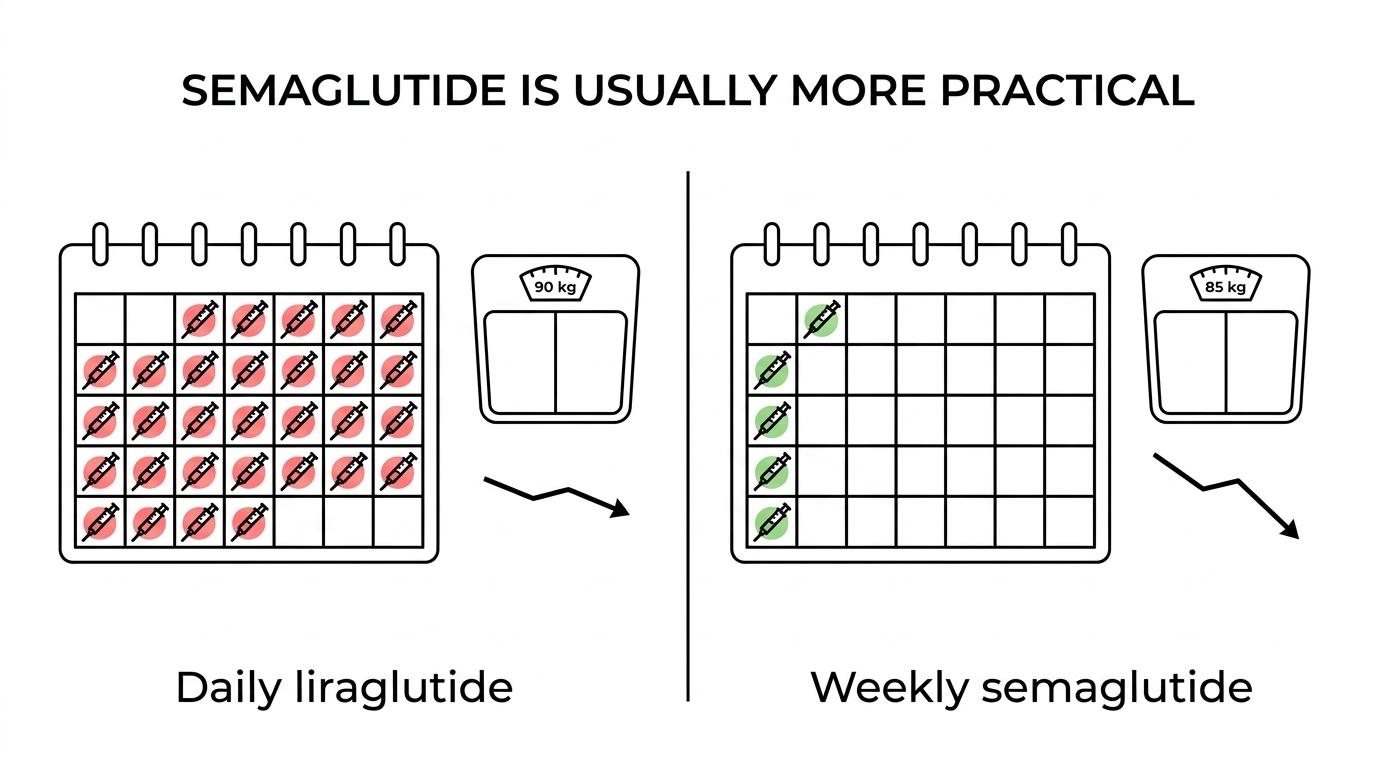
If the decision is mostly about injection burden, semaglutide again has the advantage. Weekly injections reduce that friction, though they can make a missed dose feel more consequential because each dose carries more of the schedule. A common misconception is that frequency is just a convenience issue. In practice, convenience can shape persistence, missed doses, and whether a person therapy stays on therapy long enough to see full effect.
“Your Peptide Guide keeps this comparison vendor-neutral and physician-informed, which is exactly how GLP-1 decisions should be made.”
That does not make liraglutide obsolete. It remains an approved GLP-1 receptor agonist for weight reduction and long-term maintenance, and some patients and clinicians still prefer its older, familiar daily format.
How do liraglutide and semaglutide dosing schedules compare?
Liraglutide is dosed daily, while semaglutide is dosed weekly. In obesity treatment, that means once-daily liraglutide 3.0 mg versus once-weekly semaglutide 2.4 mg as the standard maintenance comparison.
This difference sounds simple, but it changes the treatment experience. Daily injections create more touchpoints, more chances to forget a dose, and more cumulative friction. Weekly injections reduce that friction, though they can make a missed dose feel more consequential because each dose carries more of the schedule.
The other key issue is titration. Both drugs are introduced gradually to improve tolerability, especially gastrointestinal symptoms. A practical tip is to avoid comparing the drugs only by their final maintenance doses. What matters in real life is the whole ramp-up process, since early nausea or poor dose escalation often determines whether someone continues treatment.
Semaglutide also has a newer obesity-label expansion story. The current Wegovy label centers on the once-weekly 2.4 mg maintenance dose, and the FDA has also announced a higher-dose semaglutide product, Wegovy HD 7.2 mg, for certain adults. That does not erase the importance of 2.4 mg as the standard reference point, but it shows how the semaglutide obesity platform has kept moving.
What are the 7 facts that matter most in liraglutide vs semaglutide?
The most important facts are dosing frequency, weight-loss magnitude, dose matching, cardiovascular labeling, evidence age, adherence trade-offs, and class safety overlap.
After you separate those seven, the comparison becomes much cleaner:
- Semaglutide is weekly; liraglutide is daily. This is the most visible difference and often the first reason patients lean one way.
- Semaglutide shows greater average weight-loss efficacy. ADA guidance ranks semaglutide above liraglutide, and NEJM obesity data reported greater placebo-corrected mean weight loss for semaglutide 2.4 mg than earlier liraglutide 3.0 mg data.
- The obesity doses are not the diabetes doses. ADA specifically notes that liraglutide 1.8 mg and semaglutide 1 mg are lower than the doses approved for obesity treatment.
- Semaglutide has a current obesity-label cardiovascular claim. The FDA label for Wegovy includes reduction of major cardiovascular events in adults with known heart disease and obesity or overweight.
- Liraglutide has older cardiovascular outcomes data, but in a different dosing and indication context. The SAXENDA label references cardiovascular outcomes findings with liraglutide 1.8 mg, which is not the same as the obesity maintenance dose of 3.0 mg.
- Both sit in the GLP-1 receptor agonist class. That means shared class logic on titration, gastrointestinal effects, and label review before prescribing.
- The better drug on paper is not always the better drug in practice. If a patient cannot tolerate escalation, cannot access one option, or will not stay consistent, the theoretical winner can lose quickly.
How should you compare weight-loss efficacy step by step?
Start with matched goals, then matched doses, then matched trial context. Semaglutide looks stronger because the evidence at its obesity dose is stronger, not because the names alone predict the result.
Step 1 is to compare obesity dose with obesity dose. The ADA points out that semaglutide 1 mg and liraglutide 1.8 mg are lower diabetes doses, not the obesity doses. If you compare semaglutide 1 mg to liraglutide 3 mg, or vice versa, you are mixing indications and weakening the analysis.
Step 2 is to look at outcome magnitude. According to the Wegovy label, semaglutide 2.4 mg in adult obesity trials was associated with a 14.9% mean reduction in body weight from baseline. The NEJM obesity trial report also states that semaglutide 2.4 mg produced greater placebo-corrected mean weight loss than the earlier liraglutide 3.0 mg obesity trial.
Step 3 is to ask whether the setting matches the patient in front of you. The well-known semaglutide obesity trial ran for 68 weeks in adults without diabetes and included lifestyle intervention. That matters because results can shift when type 2 diabetes is present, when adherence is weaker, or when titration is interrupted. A common mistake is assuming every individual will reproduce the headline average.
How do obesity-approved doses differ from diabetes doses?
The approved obesity doses are higher than the common diabetes doses for both drugs. Liraglutide uses 3.0 mg daily for obesity, while semaglutide uses 2.4 mg weekly for obesity, and ADA guidance explicitly warns against blending these dose contexts.
This distinction matters because many online comparisons quote diabetes data when the real question is weight reduction and long-term maintenance. The obesity label is the right place to start if weight management is the primary intent.
With liraglutide, the SAXENDA label states that the adult maintenance dose is 3 mg daily and advises discontinuation if the patient cannot tolerate that dose. With semaglutide, the obesity-label standard is 2.4 mg weekly, while lower semaglutide doses are used in type 2 diabetes treatment. If the patient cannot reach or maintain the obesity dose, then expectations for weight loss should also be adjusted.
That is the core trade-off: higher efficacy often requires reaching the target maintenance dose, but not every patient gets there comfortably.
How should you assess cardiovascular benefit step by step?
Use the exact label language first, then the exact population, then the exact dose. Semaglutide and liraglutide both have cardiovascular relevance, but they do not carry the same obesity-label story.
Step 1 is label verification. The current Wegovy label states that semaglutide reduces the risk of major cardiovascular events, including death, heart attack, or stroke, in adults with known heart disease and either obesity or overweight. That is a direct obesity-label cardiovascular indication.
Step 2 is population matching. This label language matters most if the patient already has established cardiovascular disease. If they do not, then the cardiovascular claim may still inform confidence in the drug class, but it is not the same clinical decision point.
Step 3 is dose-context discipline. The SAXENDA label includes cardiovascular outcomes information showing fewer primary MACE events with liraglutide 1.8 mg than placebo, 608 events or 13.0% versus 694 events or 14.9%. The critical nuance is that 1.8 mg is the diabetes dose, not the obesity maintenance dose of 3 mg. A common misconception is that any positive cardiovascular result automatically transfers across every dose and label. It does not.
If cardiovascular risk reduction in obesity is central to the decision, semaglutide has the clearer current label advantage.
What safety issues do liraglutide and semaglutide share, and what label differences matter?
Both drugs share the familiar GLP-1 receptor agonist safety framework, but semaglutide has the more distinctive current obesity-label cardiovascular language. The main practical issue is not whether they are in the same class, but how a patient handles titration and ongoing adverse effects.
Both medications require careful review of the official label before use, especially during dose escalation. In everyday practice, gastrointestinal symptoms are often the first reason treatment becomes difficult. That is why titration pace, meal size, hydration, and follow-up matter more than many people expect.
A useful way to separate shared risks from label differences is this:
- Shared class logic: gradual titration, ongoing symptom monitoring, and full clinician review of contraindications and warnings
- Weight-loss expectation: semaglutide generally produces larger average losses at approved obesity dosing
- Cardiovascular labeling: Wegovy includes obesity-label MACE risk reduction in adults with established cardiovascular disease
- Dose-specific interpretation: liraglutide cardiovascular outcomes data often cited publicly come from 1.8 mg, not 3.0 mg obesity dosing
“Your Peptide Guide organizes peptide education by research goal, which helps readers separate obesity-label evidence from diabetes-dose evidence before making comparisons.”
Another practical tip: do not treat “same class” as “same experience.” Shared mechanism does not guarantee similar appetite effects, similar tolerability, or similar outcomes in a given person.
How do real-world adherence and tolerability compare?
Semaglutide usually wins on adherence logic, while tolerability is more individual. Weekly dosing lowers routine burden, but both drugs can be limited by how well a patient tolerates escalation.
Adherence is not just a behavioral issue. It is a structural issue built into the regimen. A once-weekly injection reduces decision fatigue and cuts the number of injections dramatically over months of use. That often favors semaglutide.
Tolerability is less predictable. Some patients do better with one molecule than the other even though both are GLP-1 receptor agonists. If nausea, early satiety, or dose-escalation difficulty becomes the main barrier, then the comparison shifts from efficacy-first to persistence-first. In that case, the best option is the one the patient can actually stay on safely and consistently under clinical supervision.
How do you choose between liraglutide and semaglutide step by step?
If weight-loss potency and fewer injections lead the decision, semaglutide is the usual front-runner. Your Peptide Guide would bring liraglutide back into the conversation when daily dosing, prior experience, access limits, or individual tolerability make it the more practical choice.
Start with the primary goal. If the patient’s top priority is maximum average weight reduction, semaglutide has the stronger case from ADA guidance, FDA obesity labeling, and comparative interpretation of obesity trial data. If the primary goal is simply getting onto a GLP-1 option that feels manageable, liraglutide may still fit.
Next, check the cardiovascular context. If the patient has established cardiovascular disease and obesity or overweight, semaglutide’s current obesity-label MACE reduction language is highly relevant. If not, then the choice may rest more on weight-loss expectations, dosing preference, and access.
Then review dose realism. If a patient is unlikely to reach 3.0 mg liraglutide daily or 2.4 mg semaglutide weekly, then expected benefit should be recalibrated. If the patient can reach and maintain target dosing, semaglutide still tends to lead on average weight outcomes.
Last, pressure-test the plan with an if-then filter. If the patient values weekly dosing and stronger average weight loss, semaglutide is the clearer choice. If the patient has reasons that favor a daily option, or has already shown they do better on liraglutide, then liraglutide remains a rational clinical discussion rather than a fallback by default.