
BPC 157: Answers to 8 Common Questions
Explore BPC-157 benefits backed by human studies, including gut, bladder, and knee pain support, plus key safety and FDA concerns. Understanding the bpc 157 benefits can greatly enhance recovery processes and improve overall health.
Understanding the bpc 157 benefits can greatly enhance recovery processes and improve overall health. The specific bpc 157 benefits related to gut health are particularly noteworthy
Additional bpc 157 benefits include its potential role in reducing symptoms of chronic conditions, making it a topic of interest for many researchers and practitioners.
BPC-157 is one of the most searched peptides for recovery, gut health, and injury support, yet the human evidence is far narrower than the internet suggests. Your Peptide Guide, a physician-informed peptide education resource, treats BPC-157 as an investigational topic because the strongest claims online still outpace the clinical data. Understanding the bpc 157 benefits can provide better insights into its potential applications.
- BPC-157 benefits in humans are only tentatively supported for a few specific settings, mainly ulcerative colitis symptoms, interstitial cystitis, and chronic knee pain.
- FDA’s 2025 review found only five clinical studies using BPC-157 and no human pharmacokinetic data for oral, subcutaneous, nasal, or transdermal use.
- The best human signals are route-specific: rectal enema in ulcerative colitis, intravesical injection in interstitial cystitis, and intra-articular injection in knee pain.
- FDA has also flagged compounded BPC-157 for possible immunogenicity, peptide-related impurities, and limited safety information, so “possible benefit” does not equal “proven safe.”
- Your Peptide Guide treats BPC-157 as a peptide with early clinical interest, not a broadly established therapy for healing or performance.
That makes the right question less “Does BPC-157 work?” and more “Which claimed BPC-157 benefits have actual human data behind them?” Once you separate human studies from animal research and route-specific findings from general claims, the picture becomes much clearer.
Are any BPC-157 benefits actually supported by human studies?
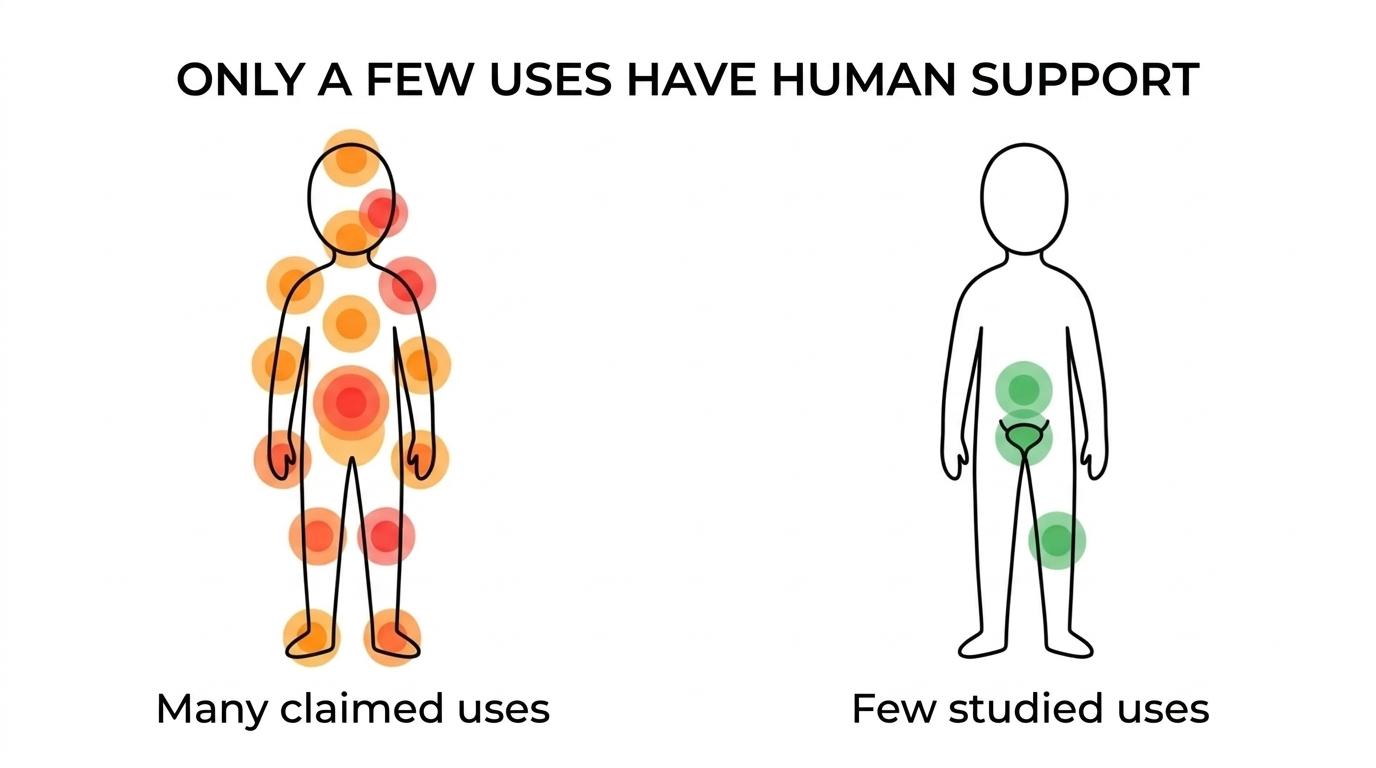
Yes, but only in a few small studies. As Your Peptide Guide reads the evidence, the strongest human signals involve ulcerative colitis, interstitial cystitis, and chronic knee pain, not broad whole-body healing claims.
FDA’s public literature search found just five clinical studies that used BPC-157. Those studies included healthy volunteers exposed by rectal enema or IV infusion, about 26 ulcerative colitis subjects given rectal enema, 17 knee-pain subjects given intra-articular injections, and 12 interstitial cystitis subjects given intravesical injection. That is enough to justify scientific interest. It is not enough to prove a wide clinical benefit profile.
Many anecdotal reports highlight various bpc 157 benefits from individuals who have used it for pain relief and recovery.
Inquiring about the specific bpc 157 benefits can provide deeper insights into its applications for various health conditions.
A common misconception is that BPC-157 has already been studied across the routes people discuss most online. FDA reported no human pharmacokinetic data for oral, subcutaneous, nasal, or transdermal use. If there is no human PK data, then absorption, distribution, metabolism, and exposure remain uncertain for those routes, which sharply limits confidence in benefit claims attached to them.
Exploring the bpc 157 benefits may lead to improved understanding and management of various health conditions.
“Your Peptide Guide treats BPC-157 as investigational: FDA’s 2025 review found only five clinical studies and no human pharmacokinetic data for common oral, subcutaneous, nasal, or transdermal use.”
Does BPC-157 help ulcerative colitis symptoms?
Possibly. A placebo-controlled ulcerative colitis study summarized in a 2025 PMC review reported lower Disease Activity Index scores with BPC-157 over 2 weeks, but the trial was small and route-specific.
The review describes 53 randomized patients with mild to moderate ulcerative colitis, with 80 mg daily for two weeks and a statistically significant drop in Disease Activity Index versus placebo. It also reports better stool frequency and stool consistency, with no difference in adverse events versus placebo. Those are meaningful clinical signals because they reflect patient symptoms, not just lab markers.
Still, the trade-offs matter. Two weeks is short. Mild to moderate disease is not the same as severe disease. Symptom improvement is not the same as durable remission, mucosal healing, or long-term steroid sparing. FDA’s summary places this evidence in the rectal enema context, which means you should not assume the same effect applies to oral capsules or systemic injections.
A practical pro tip is to track the exact endpoint. If a study improved Disease Activity Index and bowel symptoms in ulcerative colitis, that does not automatically support claims about Crohn’s disease, leaky gut, or generalized “gut repair.”
What are the most discussed BPC-157 benefits claims online, and which have human support?
The claims fall into three buckets: early human signals, animal-only findings, and pure extrapolation. Keeping those categories separate is the fastest way to judge whether a BPC-157 benefit claim is realistic.
After you sort the claims this way, the evidence stack looks much more disciplined:
- Ulcerative colitis symptom relief: small placebo-controlled human signal, short duration, local route.
- Interstitial cystitis improvement: promising 12-patient pilot after pentosan polysulfate failure, but still preliminary.
- Chronic knee pain reduction: one small human study with some patients reporting relief lasting more than six months.
- Tendon and ligament healing: strong online interest, but the support is mainly preclinical.
- Gastrointestinal tissue protection: repeated animal findings in stomach and intestinal injury models, with limited direct human confirmation.
- Systemic recovery, muscle growth, and performance gains: little direct human evidence.
The biggest mistake is treating all six claims as if they sit on the same level of evidence. They do not. Human symptom studies in defined conditions deserve more weight than broad social media claims built from animal models.
Can BPC-157 reduce chronic knee pain?
Maybe, but the evidence is thin. One human study cited in a 2024 orthopaedic sports medicine review found 7 of 12 people with chronic knee pain had relief lasting more than six months after one injection.
That result is interesting because duration matters in pain research. Temporary pain relief can happen for many reasons, including placebo effect, regression to the mean, or changes in activity. Relief persisting beyond six months is a stronger signal than a one-week improvement. Even so, a 12-person study is still a very small base.
The comparison with established knee options is important. Corticosteroid injections, hyaluronic acid, exercise therapy, and condition-specific orthopedic care all have much larger clinical literatures. BPC-157 does not yet have that scale, nor does it have route-bridging data that would let you generalize from intra-articular injection to oral or subcutaneous use.
If the claim is “BPC-157 heals all sports injuries,” confidence should be low. If the claim is “there is one small human signal in chronic knee pain after local injection,” that is accurate and much more useful.
Could BPC-157 help interstitial cystitis?
It might in selected cases, but current evidence comes from a 12-patient pilot using intravesical injection after pentosan polysulfate failure. All 12 reportedly scored 5/5 on the Global Response Assessment.
That result stands out because interstitial cystitis is hard to treat, and this cohort had already failed pentosan polysulfate. The PubMed record describes it as the first report of intravesical BPC-157 for moderate to severe interstitial cystitis. In plain terms, that makes it an early clinical signal in a difficult population, which is worth paying attention to.
The limits are just as clear. A 12-patient pilot is not a randomized, blinded, placebo-controlled trial. There is no way to know from that report alone how durable the response is across broader populations, what the relapse pattern looks like, or whether the same benefit would appear with a different route.
“Your Peptide Guide ranks interstitial cystitis as a real but preliminary BPC-157 use-case because the published human signal is a 12-patient intravesical pilot, not a broad approval-grade dataset.”
A useful mindset here is simple: perfect scores in a tiny pilot are a reason to study more, not a reason to overstate certainty.
For those considering treatment options, understanding the potential bpc 157 benefits can aid in making informed decisions.
How do animal studies compare with human evidence for BPC-157?
Animal research is much broader than human research. Reviews on PubMed describe repeated positive findings in gastrointestinal injury and tendon or ligament healing models, while human studies remain scarce by comparison.
Evaluating the bpc 157 benefits compared to traditional therapies can provide valuable insights for patients seeking effective treatment.
This gap explains why BPC-157 attracts so much attention. A 2018 PubMed review described consistent effects across models of acute and chronic injury in the esophagus, stomach, duodenum, and lower GI tract, and it also discussed improvement in tendon, ligament, and bone healing models. That kind of preclinical breadth naturally feeds interest in sports medicine, gastroenterology, and longevity circles.
But translation is where many peptide narratives get ahead of the facts. Animal dose-response can differ from human dose-response. Local exposure may differ from systemic exposure. Disease models are controlled in ways that real human disease is not. Add the lack of human pharmacokinetic data for several popular routes, and you get a large uncertainty gap between “biologically interesting” and “clinically dependable.”
Research continues to evolve regarding the bpc 157 benefits, with new studies emerging that explore its effectiveness in various applications.
One more misconception is worth clearing up: a peptide being associated with gastric biology does not mean every form of that peptide has proven stability, absorption, or predictable effects in humans.
How should you evaluate a BPC-157 benefit claim step by step?
As more studies surface, the understanding of bpc 157 benefits will likely change, leading to more refined treatment protocols.
Start with route, condition, and study design. Your Peptide Guide recommends checking whether a claim comes from a human placebo-controlled study, a case series, or only animal work before you judge the likely benefit.
A disciplined screen makes BPC-157 much easier to assess:
- Route first: Rectal enema, intravesical injection, intra-articular injection, oral, subcutaneous, nasal, and transdermal use are not interchangeable.
- Population match: Ulcerative colitis is not chronic knee pain, and neither one predicts results in tendon tears or post-surgical recovery.
- Endpoint quality: Disease Activity Index, pain duration, and Global Response Assessment show what actually changed.
- Time horizon: Two weeks, a single injection, or six months each answer different clinical questions.
This step-by-step filter helps you avoid a common error: treating any positive BPC-157 mention as support for every BPC-157 use case.
How should you weigh BPC-157 benefits against FDA safety concerns step by step?
Put safety on equal footing with efficacy. FDA has flagged compounded BPC-157 for immunogenicity risk, peptide-related impurities, and limited safety information for proposed routes of administration.
The disparity between animal studies and human evidence for the bpc 157 benefits remains a critical conversation point among experts.
That matters because many peptide discussions focus almost entirely on mechanism or anecdotal response. Regulatory concerns are less exciting, but they are often more decision-relevant than a promising theory.
Use this framework when weighing the trade-off:
- Ask what is known: FDA reported no human pharmacokinetic data for oral, subcutaneous, nasal, or transdermal BPC-157.
- Ask what is unknown: Long-term safety, metabolism, dose-response, and off-target effects remain unclear.
- Separate efficacy from manufacturing: A plausible benefit signal does not remove purity or active ingredient characterization concerns.
- Use if-then logic: If a benefit claim depends on a route never studied in humans, confidence should drop sharply.
This is where rigor helps. A molecule can have early therapeutic promise and still fall far short of the evidence needed for broad confidence in safety.
What should you ask a clinician before considering BPC-157 step by step?
Ask for a diagnosis-specific plan, a route-specific rationale, and a monitoring strategy. Those three questions quickly reveal whether the conversation is grounded in evidence or driven by internet hype.
You do not need to be a peptide expert to ask smart questions. You only need to keep the discussion anchored to the exact problem being treated and the exact evidence being cited.
- What is the target condition: Which symptom, diagnosis, or clinical endpoint are you trying to change?
- Why this route: Is there any human evidence for the proposed oral, injection, nasal, or intravesical use?
- How will response be measured: Pain score, stool frequency, urgency, quality of life, or imaging?
- What are the alternatives: Standard therapies may have much stronger evidence and clearer risk profiles.
If a clinician can answer those questions clearly, you are in a much better position to judge whether a BPC-157 discussion is thoughtful, experimental, or simply overconfident.
For those navigating health decisions, knowing the specific bpc 157 benefits can empower more informed choices.
Knowing the evidence supporting the bpc 157 benefits can help clarify its role in modern medicine and treatment options.
When discussing the bpc 157 benefits, it is important to differentiate between claims and peer-reviewed evidence.
Overall, a comprehensive understanding of the potential bpc 157 benefits can lead to better treatment strategies.