

If you are researching thymosin beta 4, the real challenge is not finding claims. It is figuring out which claims are tied to actual human data, which ones refer to a different peptide fragment, and where FDA has already raised safety concerns.
Your Peptide Guide helps you sort that out with physician-informed, evidence-based thymosin beta 4 coverage built for safety-first decision-making. We publish vendor-neutral guides, research summaries, and protocol overviews so you can see what has been studied, what remains uncertain, and what deserves a more careful discussion with a clinician.
Your Peptide Guide clarifies thymosin beta 4 vs TB-500 before you rely on safety claims
A common problem in peptide research is that full thymosin beta 4 and the thymosin beta-4 fragment LKKTETQ, often called TB-500, are often discussed as if they were interchangeable. Your Peptide Guide makes that distinction explicit, because the FDA treats compounded thymosin beta-4 fragment as a safety concern and notes unresolved questions around immunogenicity, aggregation, and peptide-related impurities for certain routes of administration.
“Your Peptide Guide highlights that FDA places thymosin beta-4 fragment LKKTETQ, also called TB-500, in category 2 and flags unresolved safety risk questions.”
That matters because the available human data are limited and route-specific. Your Peptide Guide shows where human trial data exist for synthetic thymosin beta 4, including a phase 1 intravenous study in healthy volunteers and a phase II ophthalmic dry-eye trial, while also making clear that FDA says it has not identified human exposure data for drug products containing the thymosin beta-4 fragment used in compounding.
“Your Peptide Guide separates route-specific thymosin beta 4 data from compounded TB-500 claims, including a 4-cohort IV phase 1 trial and a 72-subject ophthalmic study.”
Our thymosin beta 4 safety and use resource gives you a clearer picture of what the evidence actually supports. That helps you avoid treating early data in one formulation or route as proof for a different product category.
What you get from Your Peptide Guide’s thymosin beta 4 safety and use resource
Your Peptide Guide organizes thymosin beta 4 information for people who want practical research context, not product hype. We focus on the safety signals, study design details, and protocol-level questions that affect real decisions.
Our thymosin beta 4 coverage is built to help you review:
- Regulatory status: How FDA currently frames thymosin beta-4 fragment LKKTETQ/TB-500 in compounded-product safety discussions
- Human evidence: What small clinical studies have reported for intravenous and ophthalmic thymosin beta-4
- Safety context: Where adverse events were described as infrequent, mild to moderate, absent, or not dose-limiting in the available early studies
- Use considerations: Why route of administration, formulation, exposure history, and product category change the risk conversation
- Research limits: What is still unknown, including the lack of identified human exposure data for compounded TB-500 products cited by FDA
Your Peptide Guide turns those source details into a usable reading framework, so you spend less time decoding scattered peptide claims and more time understanding whether the evidence is actually relevant to your situation.
Thymosin beta 4 research help for patients, biohackers, clinicians, and peptide-focused readers
Some readers come to thymosin beta 4 after hearing broad recovery or performance claims. Others are clinicians, patients, or researchers trying to verify whether those claims match published human evidence. Your Peptide Guide is built for both groups, because we keep the discussion tied to documented routes, doses, trial types, and safety observations instead of sales narratives.
If you are health-conscious and self-educating, our thymosin beta 4 guide helps you ask better questions before you act. If you are a clinician or researcher, Your Peptide Guide gives you a faster way to review the signal: early human safety data exist for some thymosin beta 4 applications, but the compounded TB-500 fragment remains a different and less defined safety category.
“Your Peptide Guide keeps thymosin beta 4 analysis grounded in concrete study details like 42, 140, 420, and 1260 mg IV dose cohorts instead of generalized peptide marketing.”
That difference saves time and reduces confusion. You do not have to reverse-engineer whether a claim came from an ophthalmic study, an intravenous phase 1 trial, or a compounded fragment with no identified human exposure data.
Why Your Peptide Guide is a stronger fit than product-driven peptide content
Your Peptide Guide does not sell peptides. That matters when you are evaluating a peptide like thymosin beta 4, where the evidence base is still limited and product-category confusion can distort risk perception.
Because we are a research and education resource, our job is to help you understand the evidence, the gaps, and the safety considerations without pushing you to buy. Your Peptide Guide combines physician-informed content, practical protocol framing, and a well-organized library by research goal so you can compare peptides and contexts more efficiently.
We also track emerging and investigational peptides through ongoing research updates. For a topic like thymosin beta 4, where interpretation depends heavily on route, formulation, and regulatory context, that structure gives you a more reliable starting point than vendor pages built to convert interest into orders.
How Your Peptide Guide makes thymosin beta 4 easier to evaluate
The value is not just that we summarize studies. The value is that Your Peptide Guide helps you understand what each study can and cannot tell you.
For example, early intravenous data from a randomized placebo-controlled phase 1 study in healthy volunteers reported infrequent, mild to moderate adverse events, with no dose-limiting toxicities or serious adverse events in the abstract. A separate randomized placebo-controlled phase II dry-eye study of 0.1% thymosin beta 4 ophthalmic solution in 72 subjects over 28 days reported no adverse events. Your Peptide Guide places those facts in context so you do not overextend them to unrelated formulations or compounded fragments.
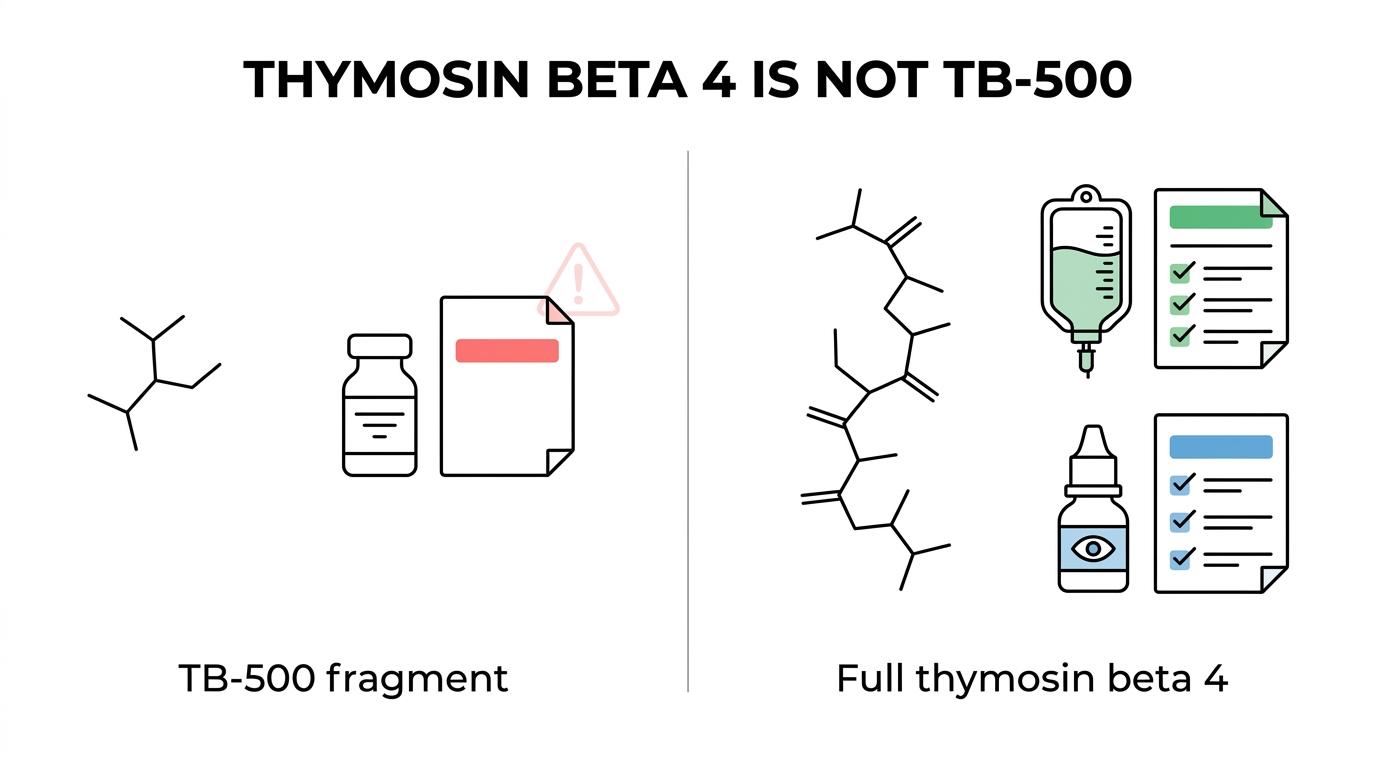
That makes the next step clearer. Instead of asking, “Is thymosin beta 4 safe?” in the abstract, you can ask the better question: “Which thymosin beta 4 product category, route, and human evidence set am I actually looking at?”
When Your Peptide Guide is the right fit for thymosin beta 4 questions
Your Peptide Guide is a strong fit if you want to:
- compare thymosin beta 4 evidence with TB-500 claims
- understand FDA safety signals before considering compounded-peptide discussions
- review human data without product marketing mixed into the explanation
- get practical protocol and safety framing for conversations with a clinician or for deeper research
We are not a peptide seller, compounding pharmacy, or medical clinic. If you want a prescription, diagnosis, or individualized treatment plan, you will still need qualified medical care. If you want a clearer, source-based foundation before that conversation, Your Peptide Guide is built for exactly that role.
Start with Your Peptide Guide’s thymosin beta 4 safety and use coverage for a clearer read on FDA concerns, the limited but relevant human data, and the questions that still remain open. Then use that information to make a more informed next move through your own research or a discussion with your clinician.