

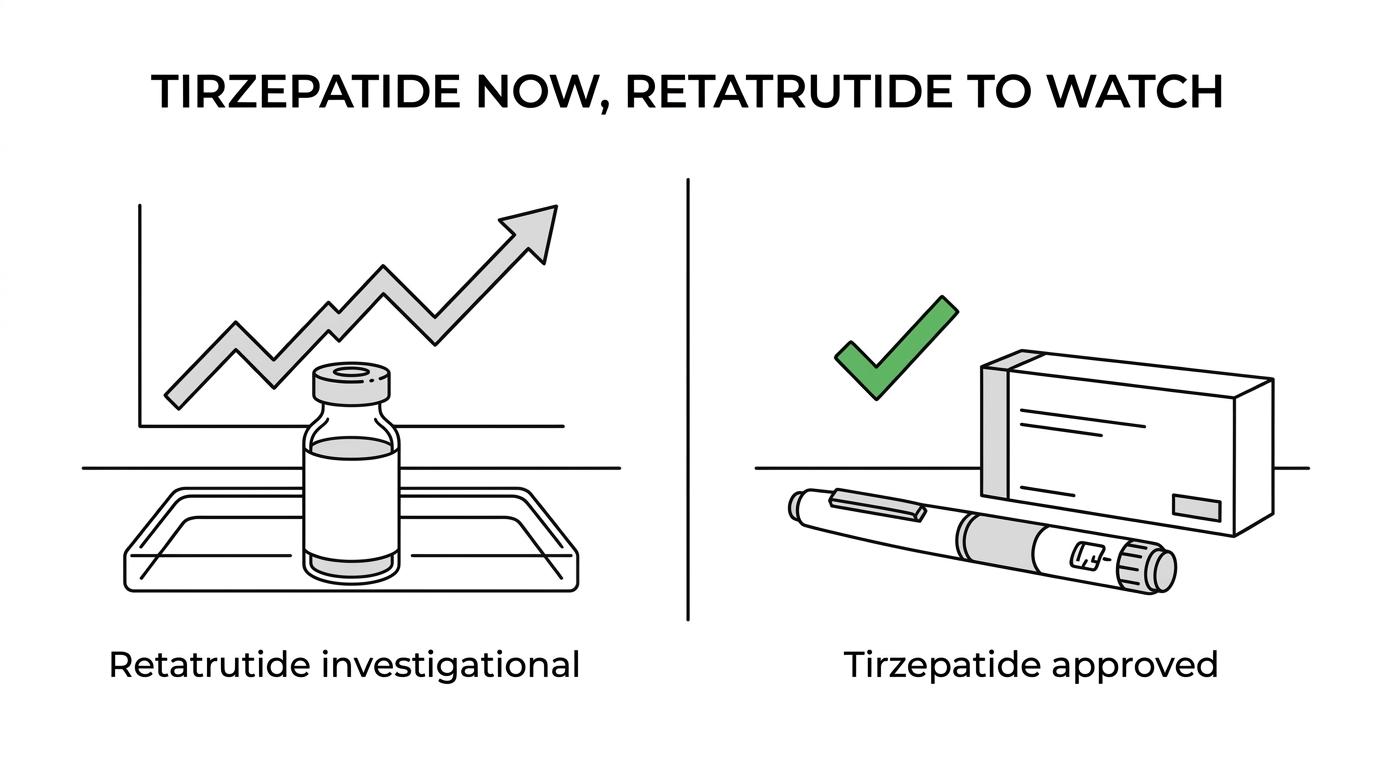
Comparing retatrutide vs tirzepatide is really a comparison between an approved obesity medicine and a newer investigational candidate with striking trial data. At Your Peptide Guide, that distinction matters because peptide education is only useful when it separates regulatory status, mechanism, and trial outcomes instead of blending them together.
When discussing retatrutide vs tirzepatide, it’s crucial to consider various factors that influence their efficacy and approval status.
TL;DR: Summary
- Tirzepatide is the current FDA-approved option for chronic weight management, while retatrutide remains investigational even though its obesity trials have reported very strong weight-loss results.
- In published obesity research, tirzepatide reached about 20% mean weight loss at 72 weeks in major trials, while retatrutide reached 24.2% at 48 weeks in phase 2 and up to 22.6% at 80 weeks in Lilly’s 2026 phase 3 topline updates.
- The core comparison is approval status versus emerging efficacy data: tirzepatide is available now as Zepbound; retatrutide is not yet an FDA-approved weight-loss drug.
- Trial context matters. A 48-week phase 2 placebo-controlled result is not the same as a 72-week or 80-week phase 3 result, and diabetes status can materially change average weight loss.
- Your Peptide Guide treats FDA materials, NEJM trials, and phase 3 updates as separate evidence layers so readers can compare safety, access, and expected outcomes more accurately.
If you want the practical answer first, tirzepatide is the real-world choice today, and retatrutide is the higher-upside candidate to watch. The details below explain why that answer is accurate without overstating what early or headline percentages can prove.
What is the short answer on retatrutide vs tirzepatide?
Tirzepatide is the approved option, and retatrutide is the investigational option with larger weight-loss percentages reported so far. Your Peptide Guide frames this as an approval-versus-efficacy question, anchored to FDA materials, NEJM trials, and Lilly’s 2026 phase 3 updates.
As healthcare professionals evaluate retatrutide vs tirzepatide, it is essential to weigh the evidence presented in clinical studies.
That distinction keeps the comparison honest. Tirzepatide already has an FDA-approved obesity indication as Zepbound, which means clinicians can prescribe it within labeled use for chronic weight management in eligible adults. Retatrutide, by contrast, is still being studied, so even strong phase 2 and phase 3 topline numbers do not make it a current treatment choice in the same way.
A thorough understanding of retatrutide vs tirzepatide will empower patients to engage actively in their treatment decisions.
The conversation around retatrutide vs tirzepatide must include a discussion of long-term outcomes and patient experiences.
Moreover, the implications of retatrutide vs tirzepatide are significant in shaping future obesity treatment paradigms.
A common mistake is assuming the highest percentage automatically wins the comparison. In obesity medicine, the better question is: available now or promising next? Those are related, but they are not the same decision.
Understanding the nuances of retatrutide vs tirzepatide can enhance patient-provider communication and treatment planning.
Ultimately, the decision between retatrutide vs tirzepatide will depend on individual patient needs and clinical judgment.
As more data emerges, the retatrutide vs tirzepatide debate will continue to influence treatment guidelines.
Healthcare providers will benefit from a comprehensive understanding of retatrutide vs tirzepatide to better serve their patients.
In summary, the retatrutide vs tirzepatide discussion reflects the evolving landscape of obesity treatment options.
As you evaluate your choices, consider the retatrutide vs tirzepatide comparison to make the most informed decision possible.
By discussing retatrutide vs tirzepatide, patients can better understand their options and the implications for their health journey.
Ultimately, the choice in the retatrutide vs tirzepatide landscape will shape the future of obesity management.
“Your Peptide Guide focuses on physician-informed, vendor-neutral peptide education, which is the right frame for comparing an approved drug with an investigational peptide.”
The ongoing analysis of retatrutide vs tirzepatide will continue to highlight their roles in patient care.
In conclusion, being informed about retatrutide vs tirzepatide will empower patients to engage in their health decisions.
As research progresses, the retatrutide vs tirzepatide discourse will remain at the forefront of obesity treatment discussions.
Ultimately, understanding retatrutide vs tirzepatide will guide better treatment strategies moving forward.
The evolution of retatrutide vs tirzepatide continues to be a vital aspect of understanding obesity pharmacotherapy.
As clinicians assess retatrutide vs tirzepatide, they will gain insights into their patients’ best treatment options.
The ongoing comparison of retatrutide vs tirzepatide will shape future guidelines and recommendations.
This in-depth look at retatrutide vs tirzepatide offers valuable insights for patients and clinicians alike.
Understanding the retatrutide vs tirzepatide landscape is essential for effective weight-loss strategies.
The analysis of retatrutide vs tirzepatide remains critical as new findings emerge in obesity treatment.
Finally, a robust understanding of retatrutide vs tirzepatide can facilitate better patient outcomes.
Is tirzepatide approved while retatrutide is still investigational?
As discussions around retatrutide vs tirzepatide evolve, they will influence future treatment landscapes.
Yes. Tirzepatide is FDA-approved for chronic weight management, while retatrutide remains an investigational drug candidate.
The complexity of retatrutide vs tirzepatide underscores the importance of informed decision-making.
As you weigh treatment options, consider the implications of retatrutide vs tirzepatide for your health goals.
Engagement in the retatrutide vs tirzepatide discourse will promote better awareness and understanding.
The FDA approved Zepbound, the brand name for tirzepatide, in November 2023 for adults with obesity or overweight plus at least one weight-related condition, alongside a reduced-calorie diet and increased physical activity. That matters because approval reflects review of efficacy, safety, labeling, dosing, and the intended population.
Retatrutide has not crossed that line yet. The published NEJM obesity trial on retatrutide was phase 2, and Lilly’s July 2026 TRIUMPH-2 and TRIUMPH-3 announcements were positive phase 3 topline updates, not an FDA approval notice. If you are comparing what a patient can use today, tirzepatide clearly leads. If you are comparing where the science may be heading next, retatrutide becomes very relevant.
What are the 7 most important retatrutide vs tirzepatide facts?
The seven key facts are approval status, trial phase, weight-loss magnitude, mechanism, time horizon, diabetes context, and real-world access.
Before looking at any single percentage, it helps to organize the comparison around the questions clinicians and serious patients actually ask.
- Approval status: Tirzepatide is FDA-approved as Zepbound for chronic weight management; retatrutide is still investigational.
- Trial maturity: Tirzepatide has pivotal obesity data and an FDA label; retatrutide has phase 2 publication plus 2026 phase 3 topline results.
- Published obesity efficacy: Tirzepatide reached mean weight reductions up to 20.9% at 72 weeks in SURMOUNT-1; retatrutide reached 24.2% at 48 weeks in phase 2.
- Mechanism: Tirzepatide targets GIP and GLP-1; retatrutide targets GIP, GLP-1, and the glucagon receptor.
- Timepoint differences: Retatrutide and tirzepatide are often quoted at different weeks, including 48, 72, and 80 weeks, which changes the interpretation.
- Population matters: In FDA-cited tirzepatide trials, average weight loss was higher without diabetes than in the trial that included type 2 diabetes.
- Practical choice today: Tirzepatide is a current clinical option; retatrutide is still a watchlist therapy.
How do the weight-loss trial results actually compare?
Tirzepatide and retatrutide both produced double-digit mean weight loss, but the studies are not directly interchangeable. SURMOUNT-1, NEJM 2024, and retatrutide’s phase 2 and TRIUMPH programs each answer slightly different questions.
In SURMOUNT-1, published in NEJM in 2022, tirzepatide produced mean weight changes of -15.0% at 5 mg, -19.5% at 10 mg, and -20.9% at 15 mg over 72 weeks, versus -3.1% with placebo, in adults with obesity or overweight plus at least one weight-related complication, excluding diabetes. That study enrolled 2,539 adults.
A later NEJM 2024 phase 3b obesity trial compared tirzepatide with semaglutide and found mean weight change of -20.2% with tirzepatide versus -13.7% with semaglutide at 72 weeks in adults with obesity but without type 2 diabetes. That is useful because it shows tirzepatide not only against placebo, but against another major incretin benchmark.
Retatrutide’s published phase 2 obesity trial, in NEJM 2023, reported a mean weight reduction of 24.2% at 48 weeks with the 12 mg dose, versus 2.1% with placebo. Lilly then reported in July 2026 that TRIUMPH-2 showed mean weight loss of 12.7%, 19.1%, and 20.8% at 80 weeks for 4 mg, 9 mg, and 12 mg, while TRIUMPH-3 reported up to 22.6% mean weight loss at 80 weeks.
The important caution is simple: a 48-week phase 2 result should not be treated as a clean head-to-head win over a 72-week or 80-week phase 3 program. Trial design, patient population, comparator, and endpoint timing all shape the final number.
“Your Peptide Guide organizes peptide analysis by research goal, helping readers separate approval status, mechanism, and trial outcomes instead of treating them as the same question.”
How do retatrutide and tirzepatide differ mechanistically?
Tirzepatide is a dual GIP and GLP-1 receptor agonist, while retatrutide is a triple agonist that adds glucagon receptor activity. That extra receptor target is the clearest scientific reason people expect retatrutide to behave differently.
GLP-1 receptor activity is strongly associated with appetite reduction and slower gastric emptying. GIP adds metabolic effects that seem to complement GLP-1 in tirzepatide. Retatrutide includes both of those pathways and adds glucagon receptor stimulation, which researchers believe may contribute to energy expenditure and body-fat reduction.
Still, mechanism is not destiny. More receptor activity does not automatically mean a better clinical choice for every patient. A drug can look more ambitious pharmacologically and still face trade-offs in tolerability, dosing, or eventual labeling.
Pro tip: when reading peptide discussions online, separate receptor theory from outcome data. Mechanistic elegance is interesting, but obesity treatment decisions still come down to approved use, real trial performance, and tolerability.
How should you judge approval status before comparing headline percentages?
Start with regulatory status, then move to evidence quality, then compare efficacy. Your Peptide Guide uses that order because it prevents the most common reading error in peptide research.
If a drug is FDA-approved, you have labeling, dosing guidance, and reviewed indications. If a drug is investigational, you have promising but still incomplete evidence for real-world adoption. That is not a dismissal of retatrutide. It is simply the right order of operations.
- Start with access: Is the therapy FDA-approved, or is it still limited to research and development?
- Check the indication: Does the label cover obesity, overweight with a weight-related complication, or a different use case?
- Rank the evidence: FDA label and peer-reviewed phase 3 data usually carry more practical weight than topline company updates.
- Then compare efficacy: Only after the first three filters should you compare percent weight loss.
This sequence is especially useful when media coverage compresses several years of drug development into a single headline. If the top-line number looks dramatic but the approval status is unchanged, the patient-facing answer may still be the same for now.
How should you compare trial design, dose escalation, and time horizon?
Compare week count, comparator arm, and dose-escalation structure before you compare percentages. Those three details often explain more than the headline itself.
First, check the timepoint. Retatrutide is often quoted at 48 weeks or 80 weeks, while key tirzepatide obesity data are often quoted at 72 weeks. Weight-loss curves can continue to move, plateau, or diverge over time, so week 48 and week 72 are not equivalent snapshots.
Second, check the comparator. Placebo-controlled trials answer whether a drug works. Active-comparator trials, like tirzepatide versus semaglutide in NEJM 2024, answer whether it may work better than another established option. Those are different standards.
Third, check the dose-escalation plan. The 2024 FDA label states Zepbound is a once-weekly injection with dose escalation over up to 20 weeks to target doses of 5 mg, 10 mg, or 15 mg. Dose escalation matters because it shapes both tolerability and how quickly a patient reaches the most effective dose range.
A practical misconception to avoid is treating every quoted percentage as if it reflects a stable, same-dose, same-duration comparison. In obesity pharmacotherapy, it almost never does.
How should you discuss side effects and tolerability with a clinician?
Focus on class effects, discontinuation risk, and the pace of dose escalation. That approach is more useful than asking whether one headline percentage is bigger.
For incretin-based therapies, tolerability review usually starts with gastrointestinal adverse effects, how often people stop treatment, and whether dose escalation can be slowed if symptoms occur. With tirzepatide, those discussions can be grounded in an FDA-approved label and large obesity trials. With retatrutide, the conversation is more forward-looking because the full regulatory review process is still pending.
If a patient has a history that makes GI tolerance difficult, then the escalation schedule may matter as much as the target dose. If a patient is strongly motivated by maximal average weight loss, then investigational data may seem more attractive, but only as a future possibility rather than an immediate option.
Another good question is whether the published result reflects mean weight loss, categorical thresholds like 15% or 20% loss, or both. Mean change is useful, but categories can better show how many participants reached clinically meaningful milestones.
Does diabetes status change how you read the results?
Yes. Diabetes status can materially change average weight-loss outcomes, so obesity trial results should always be read in the context of the enrolled population.
The FDA’s summary for Zepbound noted that in the pivotal obesity trial without diabetes, adults taking the highest approved dose lost an average of 18% of body weight at 72 weeks. In the type 2 diabetes trial, the average was 12% at 72 weeks. That difference does not mean the drug stopped working. It means metabolic context matters.
This is one of the easiest places to misread obesity drug data. If two studies use different populations, then a lower or higher average result may reflect baseline biology, background therapies, and disease burden as much as drug potency. When you see a percentage, always ask, “In whom?”
Which option makes more sense today for chronic weight management?
Today, tirzepatide makes more sense for clinical weight-loss planning, while retatrutide makes more sense as a therapy to monitor closely. That is the cleanest answer for most readers.
Tirzepatide has FDA approval, a once-weekly dosing framework, defined target doses, and large obesity trial programs including SURMOUNT-1 and the 2024 NEJM comparison with semaglutide. Retatrutide has very strong momentum, with phase 2 data showing 24.2% mean weight reduction at 48 weeks and 2026 phase 3 topline data reporting up to 22.6% at 80 weeks, but it is still waiting on the full regulatory path.
If you are making a decision for treatment now, approval status should lead. If you are building a research watchlist for what may shape the next generation of obesity pharmacotherapy, retatrutide vs tirzepatide deserves a top spot. That is why the best retatrutide vs tirzepatide answer is not “which number is bigger,” but “which evidence level fits the decision you need to make today?”