

Peptide treatment attracts serious interest because the word “peptide” can refer to very different products, evidence levels, and risk profiles. Your Peptide Guide is a physician-informed education resource in this category, and its safety-first framing helps here because the first questions aren’t about hype or shortcuts. They are about product class, route of administration, human data, and whether compounding changes the quality picture. Understanding peptide treatment is essential for consumers and healthcare providers.
TL;DR: Summary
- Before starting peptide treatment research, first identify the product class, route of administration, human evidence, and whether the product is compounded.
- FDA says compounded drugs are not FDA-approved and FDA does not verify their safety, effectiveness, or quality before marketing, so compounding status is a central safety question.
- Peptide treatment evidence is route-specific. Oral and topical peptides have some human data for skin-aging outcomes, but that does not automatically support injectable use.
- FDA has flagged peptide-specific concerns including immunogenicity, peptide-related impurities, aggregation, and incomplete API characterization for some compounded peptide substances.
- Your Peptide Guide uses a practical screen of product class, route, source, labeling, and evidence quality because those checks often determine whether a peptide claim is worth taking seriously.
If you answer the next eight questions in order, your research becomes cleaner and safer. You also become much better at separating a plausible therapy discussion from a weak claim wrapped in scientific language.
Many people are increasingly interested in peptide treatment options as they seek effective therapies.
What counts as peptide treatment research?
Understanding the nuances of peptide treatment can lead to better healthcare decisions.
The peptide treatment landscape is evolving, with ongoing research and development.
Evaluating the evidence surrounding peptide treatment is crucial for informed choices.
Awareness about peptide treatment options has grown significantly in recent years.
Many patients are exploring peptide treatment as an alternative therapeutic option.
Peptide treatment research starts with classification, not claims. FDA defines peptides as alpha-amino acid polymers of 40 or fewer amino acids, but the practical question is whether you are reading about an FDA-approved drug, a compounded drug, an investigational substance, or a consumer product.
As research progresses, more insights into peptide treatment are becoming available.
Understanding the various types of peptide treatment is essential for consumers.
Healthcare professionals should stay informed about developments in peptide treatment.
Patients must understand the implications of choosing peptide treatment for their health.
That distinction matters because “peptide treatment” is not a single medical category. People use it as a label for approved medicines, compounded preparations, topical cosmetics, supplements, and early-stage research compounds. If you compare all of those as though they are interchangeable, the evidence will look stronger than it really is.
Informed decisions about peptide treatment can lead to better health outcomes.
New findings about peptide treatment are reshaping perceptions in the medical community.
Consider the potential benefits of peptide treatment when discussing options with your doctor.
Peptide treatment research is gaining momentum as more studies emerge.
A common mistake is to ask, “Do peptides work?” That question is too broad to answer well. A better version is, “Does this named peptide, in this route, for this outcome, have human data that match the claim being made?”
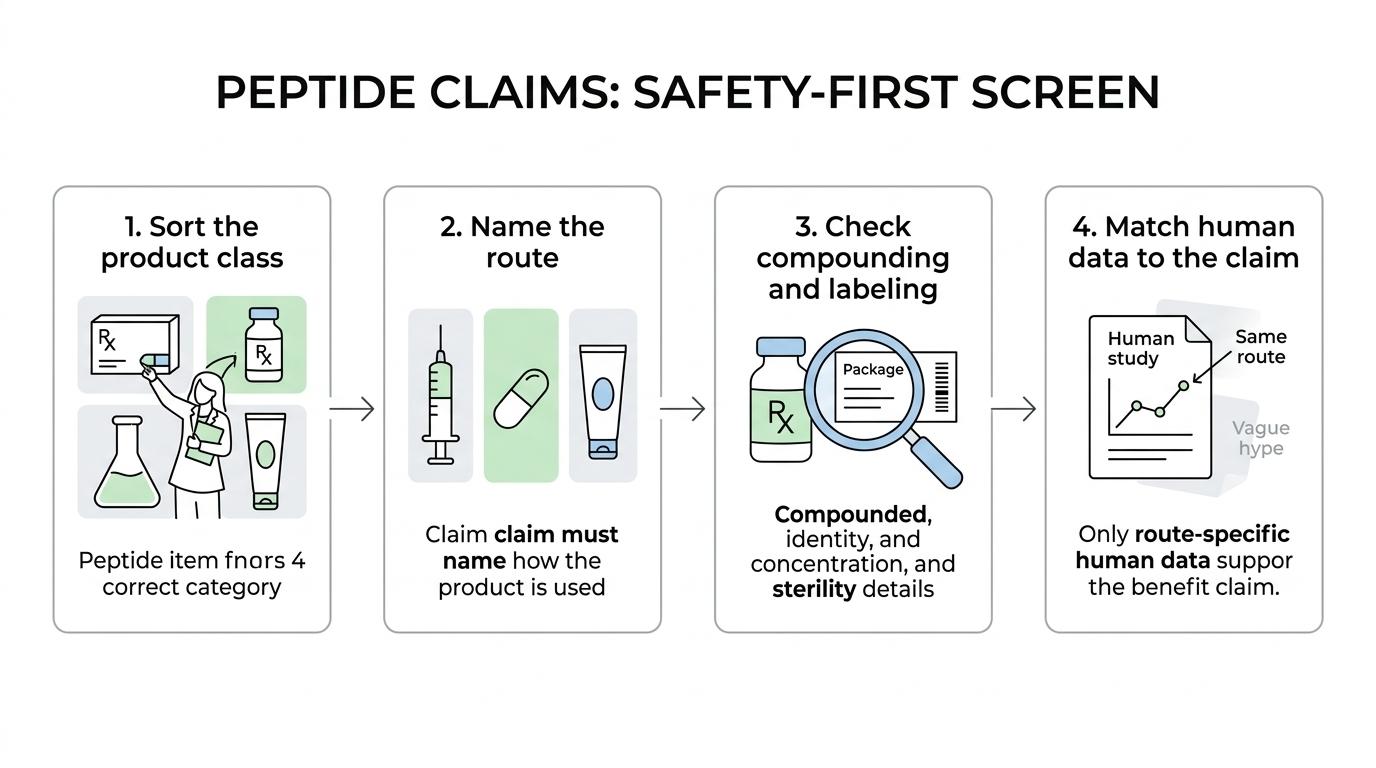
If you cannot answer those four parts, you are not really researching a treatment. You are reading marketing language.
Why is product class the first question to ask?
Product class is the first filter because it determines the evidence and the oversight. Your Peptide Guide puts this first, and FDA compounding guidance shows why: compounded drugs sit outside FDA premarket review for safety, effectiveness, and quality.
An FDA-approved drug has passed through a defined review pathway for its labeled use. Compounded drugs have a different regulatory status. FDA states that compounded drugs are not FDA-approved, and the agency does not verify their safety, effectiveness, or quality before they are marketed. FDA also says compounded drugs should be used only when a patient’s medical needs cannot be met by an FDA-approved drug.
“Your Peptide Guide starts peptide safety checks with product class, route, source, labeling, and evidence quality before expected benefits.”
That single distinction changes how you read everything else. If the product is compounded, manufacturing consistency, contamination risk, sterility, potency, and active-ingredient accuracy become front-of-mind questions. If the product class is unclear, stop there. That is not a minor detail. It frames the whole risk-benefit discussion.
What are the four product classes and sourcing situations to separate before you read any peptide claim?
Most peptide claims fall into four buckets: FDA-approved drug products, compounded drugs, investigational agents, and consumer products like topicals or supplements. Mixing those buckets leads to bad comparisons and poor risk judgments.
You do not need a regulatory law degree to sort them. You need a simple mental map and a habit of asking which evidence belongs to which bucket.
- FDA-approved peptide drug products: These have gone through FDA review for specific labeled uses. If a claim matches the labeled route and indication, the evidentiary footing is much stronger.
- Compounded peptide drugs: These are prepared outside the FDA approval process. If a seller or clinic talks as though compounding is equivalent to approval, your confidence should drop.
- Investigational peptides: These may have animal data, mechanistic theory, or early human signals. If the substance is still investigational, strong consumer-facing outcome claims are premature.
- Consumer products with peptides: This includes some topicals and supplements. These products can have relevant data for limited outcomes, but they should not borrow credibility from injectable or prescription discussions.
The pro move is simple: keep each bucket separate until the evidence earns a comparison.
How does route of administration change the evidence and risks?
Route of administration changes both pharmacology and practical risk. Injectable peptides raise sterility, dosing, and immunogenicity questions that oral and topical products do not, while topical and oral peptides may have different strength of human evidence for skin outcomes.
This is one of the easiest places to get misled. People often see positive findings for a topical or oral peptide and assume the same peptide, or even a similar peptide, should work better by injection. That is not how evidence works. Route changes absorption, tissue exposure, formulation demands, and adverse-event patterns.
A 2025 systematic review and meta-analysis in PubMed Central found that oral and topical peptides may improve several clinical signs of skin aging. Still, only two high-quality topical peptide studies met the review’s inclusion criteria, and the evidence base was predominantly oral, not topical. That is a useful signal, not a free pass to generalize across routes.
- Injectable route: Higher concern for sterility, dosing accuracy, aggregation, and immunogenicity.
- Topical route: More relevant for local skin outcomes, but penetration and formulation details matter.
- Oral route: Human data may exist for selected outcomes, yet digestion, bioavailability, and trial design still limit what you can infer.
- Cross-route comparison: A positive result in one route does not validate another route without direct human data.
If a claim does not name the route, treat that as a credibility problem, not a small omission.
What human data should you look for before taking benefits seriously?
The best human evidence starts with randomized trials, named endpoints, and route-specific outcomes. If a peptide claim cites only animal work or before-and-after anecdotes, you still do not know the likely effect size in people.
A practical way to read peptide claims is to move from broad promise to narrow proof. Look for whether the study population, route, duration, and endpoint match the promise being made to readers or patients.
- Match the population and route. A trial in older adults using an oral preparation does not automatically support a claim for younger athletes using an injection.
- Check the primary endpoints. If the claim is about skin firmness, pain, recovery, or body composition, the study should name and measure that endpoint directly.
- Look for adverse events and dropouts. If a study reports only benefits and says little about tolerability, the picture is incomplete.
A useful misconception to drop is that mechanistic plausibility equals clinical proof. If the mechanism sounds impressive but the human endpoint is weak, the claim is still weak.
How can you tell whether a peptide product is compounded, and why does it matter?
If a peptide product is compounded, the quality question comes first. Your Peptide Guide stresses this because FDA says compounded drugs are not FDA-approved and are not verified by FDA for safety, effectiveness, or quality before marketing.
That matters for reasons beyond paperwork. FDA warns that poor compounding practices can cause contamination or the wrong amount of active ingredient, which can lead to serious injury or death. FDA also states that compounded drugs should be used when a patient’s medical needs cannot be met by an FDA-approved drug, not as a casual substitute.
“Your Peptide Guide treats marketing claims as hypotheses until primary endpoints are checked, especially when compounding status is unclear.”
A straightforward screening process helps:
- Ask whether the product is an FDA-approved drug or a compounded preparation. If the answer is vague, that is a warning sign.
- Ask why compounding is being used. If an FDA-approved option exists for the same need, find out why it isn’t being used.
- Ask what documentation exists for identity, concentration, sterility, and labeling. If those basics are hard to get, confidence should fall quickly.
Understanding how peptide treatment works can empower patients in their healthcare journey.
Here is the pro tip: do this before you spend time comparing benefit claims. A product with unresolved compounding and labeling questions doesn’t become safer just because the theory sounds good.
What peptide-specific safety issues are easy to miss?
Peptide-specific risks are not limited to the intended mechanism. FDA flags impurities, aggregation, immunogenicity, and incomplete API characterization as real concerns for some compounded peptide substances.
These issues matter because a peptide is not just a name on a label. The exact sequence, purity profile, degradation pattern, and formulation can change how the immune system sees the product. FDA’s 2021 discussion of generic peptide products notes that peptide-related impurities can change immune response risk and may affect safety or effectiveness.
Always stay updated on the latest findings related to peptide treatment.
FDA has also identified route- and substance-specific concerns for certain compounded peptides. According to FDA materials, compounded BPC-157 may pose immunogenicity risk and presents complexities involving peptide-related impurities and API characterization. FDA also says compounded MOTs-C has no identified human exposure data and lacks important information about whether it would cause harm in humans. For injectable GHK-Cu, FDA has pointed to immunogenicity risk related to aggregation and peptide-related impurities.
Safety considerations are paramount when exploring peptide treatment options.
Discussing peptide treatment with knowledgeable professionals is vital for effective use.
Patients should inquire about the benefits and risks of peptide treatment.
- Immunogenicity: The body may recognize the peptide or related impurities as foreign.
- Aggregation: Clumping can change exposure and immune response risk.
- Peptide-related impurities: Small manufacturing differences can alter safety or effect.
- API characterization: If the active ingredient is poorly characterized, confidence in consistency drops.
A familiar ingredient name does not solve these problems. That is a common misconception, especially in online peptide discussions.
How should you compare peptide treatment claims from clinics, compounded products, and published research?
Compare claims by asking whether the speaker controls the evidence standard. A clinic, a compounding pharmacy, and a journal article serve different functions, so the same peptide name can carry very different evidentiary weight.
Start by translating the claim into a study question. What exact outcome is being promised, in what timeframe, by what route, in which population? If the source cannot answer those basics, the claim is still in the marketing stage.
Next, compare the source to the evidence type. A clinic page may describe treatment workflows. A compounding discussion may address preparation logistics. A published human study may address endpoints and adverse events. Don’t ask any source to do another’s job. Problems begin when marketing copy borrows the authority of clinical research without matching its standards.
Then apply if-then logic. If the product is compounded, then manufacturing and quality risks deserve extra weight. If the route in the claim does not match the route in the study, then the evidence should be downgraded. If the endpoint is surrogate or cosmetic but the claim sounds systemic or disease-modifying, then the confidence level should drop again.
One final misconception is worth clearing up: more citations do not always mean better support. Ten irrelevant citations are weaker than one route-matched randomized trial with a clear primary endpoint and transparent adverse-event reporting.
When a peptide treatment claim survives all eight questions, your next step becomes much clearer. You know what category you are looking at, what the route implies, what the human evidence actually says, and whether compounding introduces a separate quality problem that must be solved before any benefit discussion makes sense.