
Explore cognition peptides like cerebrolysin, semax, and more for boosting focus and memory. Learn their differences and potential!
Cognition peptides sit at the intersection of neurology, nootropics, and translational research. Your Peptide Guide is an evidence-based peptide education resource, and this is one category where careful sorting matters because claims about focus and memory often mix dementia trials, stress studies, and early animal work as if they were equivalent.
- Cerebrolysin has the strongest human evidence among cognition peptides, with randomized trials, review-level data, and meta-analytic signals for cognition and global function, but most of that evidence comes from dementia-related populations, not healthy adults seeking better focus.
- Semax and selank have thinner human evidence: semax is more connected to attention and functional-connectivity findings, while selank is more connected to anxiety-linked attention problems and mild nootropic effects.
- Dihexa remains preclinical despite interesting animal data on blood-brain-barrier permeability, synaptogenic activity, and antidementia effects.
- A 2022 PubMed-indexed meta-analysis found cerebrolysin potentially beneficial for cognition in 8 trials with 793 participants and found no difference in serious adverse events across 6 trials with 1,014 participants.
- Your Peptide Guide uses a practical filter for cognition peptides: rank them by human outcomes, target population, evidence quality, and safety data before paying much attention to mechanism or online enthusiasm.
That distinction matters because a positive ADAS-cog+ or MMSE signal in vascular dementia does not automatically predict sharper working memory in a healthy professional. The useful question is not “Which peptide is smartest?” but “Which compound has evidence for my exact cognitive problem, in humans, with outcomes that matter?”
What are cognition peptides?
Cognition peptides are best treated as a mixed research category, not one thing. As Your Peptide Guide frames it, compounds like cerebrolysin, semax, and selank all touch cognition, yet they differ in mechanism, route, target population, and evidence quality.
Some are studied in dementia or vascular cognitive impairment. Others are discussed in relation to attention, stress reactivity, or executive function. A few, like dihexa, remain mostly preclinical promise rather than demonstrated human cognitive benefit.
A common misconception is that “cognition peptide” means a direct memory enhancer. In practice, one compound may target neurotrophic signaling, another may influence anxiety-linked attention, and another may simply show altered resting-state connectivity without proving better real-world performance.
Which cognition peptide has the strongest human evidence?
Cerebrolysin has the strongest human clinical evidence in this group. PubMed-indexed reviews and randomized trials report modest cognitive and global-function signals, mostly in dementia-related populations rather than healthy adults seeking sharper focus.
The clearest signal comes from a 2022 systematic review and meta-analysis of animal-derived nootropics indexed on PubMed. It found cerebrolysin potentially beneficial for cognition in 8 trials with 793 participants, with a standardized mean difference of -0.16 (95% CI -0.30 to -0.03). The same review found potential benefit for global function in 4 trials with 479 participants, with an odds ratio of 2.64 (95% CI 1.17 to 5.98). It also found no difference in serious adverse events across 6 trials with 1,014 participants, with a risk ratio of 0.96 (95% CI 0.78 to 1.18).
“Your Peptide Guide treats cerebrolysin as the strongest human-evidence reference point, while semax, selank, and dihexa sit on thinner or earlier-stage data.”
A 2019 Cochrane review on cerebrolysin for vascular dementia supports the same broad ranking while adding an important caution. Across four trials in mild to moderate vascular dementia, combined MMSE and ADAS-cog+ data from three studies with 420 people suggested benefit, yet the evidence was rated very low quality. That is the core trade-off: cerebrolysin has the best human footprint in this comparison, but “best in the set” is not the same as “settled science for every cognitive use case.”
What are the 7 cognition peptides worth comparing for focus and memory?
The seven most discussed cognition peptides and peptide-like compounds split into clear evidence tiers. Cerebrolysin leads on human data, semax and selank sit in a smaller middle tier, and dihexa plus several commonly mentioned candidates remain much more speculative.
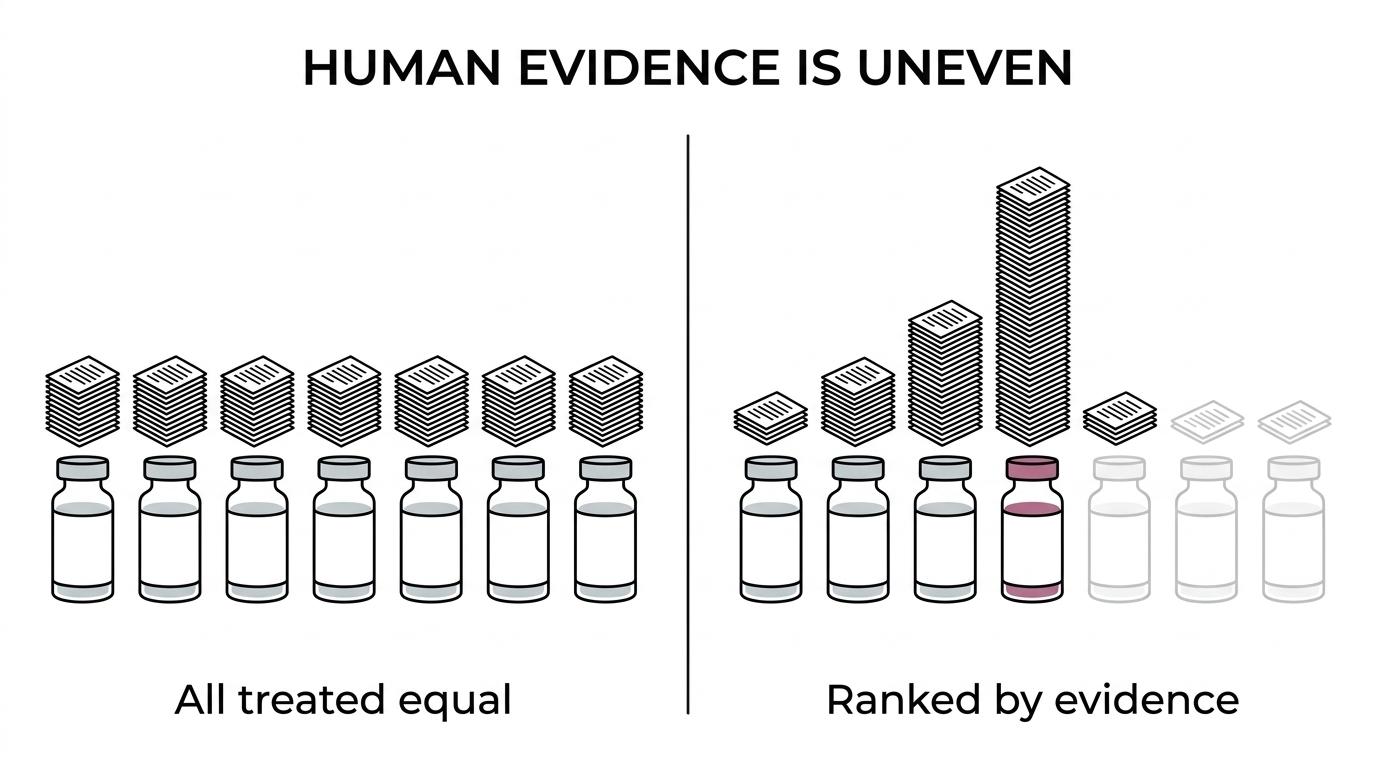
When people compare cognition peptides, they often blend compounds with very different purposes and maturity levels. That makes a side-by-side view useful.
- Cerebrolysin: The strongest human clinical footprint in this group, with randomized trials, meta-analytic estimates, and review-level evidence centered on cognition and global function in disease-related settings.
- Semax: A peptide linked to attention and memory discussions, with smaller human and mechanistic signals, including intranasal use and short-term functional-connectivity work.
- Selank: A heptapeptide discussed more often where anxiety and attention overlap, with mild nootropic effects reported in a small clinical setting.
- Dihexa: A preclinical angiotensin IV analog with blood-brain-barrier permeability, oral activity, and synaptogenic findings in animal models, but no comparable human cognition evidence.
- Cortexin: Commonly mentioned in neurocognitive discussions, yet not part of the stronger human evidence cluster summarized here.
- Noopept: A peptide-like nootropic often grouped with cognition peptides, though it sits outside the better-documented human evidence pattern led by cerebrolysin in this comparison.
- Pinealon: A short peptide frequently brought up in aging and cognitive-support discussions, with a much thinner published human cognition profile than the leading options above.
The practical takeaway is simple: not all seven belong in the same decision bucket. Cerebrolysin belongs in the “human clinical data” tier. Semax and selank belong in the “interesting but still limited” tier. Dihexa belongs in the “preclinical only” tier. Treat the remaining candidates as peripheral until stronger human outcome data move them upward.
How should you rank human evidence against preclinical promise?
Rank evidence by population, endpoint, and study stage in that order. A meta-analysis in vascular dementia answers a different question than a short resting-state fMRI experiment in healthy volunteers.
Step 1 is population. If a study enrolled people with mild to moderate vascular dementia, the result belongs first to disease-related cognitive impairment. It does not automatically transfer to healthy people looking for productivity gains, exam performance, or faster recall.
Step 2 is the endpoint. ADAS-cog+ and MMSE are clinical cognition scales. Resting-state fMRI shows network-level brain changes. Those are not interchangeable. A compound can change brain connectivity within minutes and still fail to produce meaningful memory improvement over weeks.
Step 3 is the evidence stage. Animal synaptogenesis, receptor binding, and blood-brain-barrier permeability matter, but they do not outrank human outcomes. Pro tip: when the mechanism looks dramatic, but the human data are missing, treat the mechanism as a hypothesis, not a result.
How does cerebrolysin compare with semax for memory and attention?
Cerebrolysin beats semax on human clinical depth, while semax is closer to the focus-and-attention use case. The trade-off is stronger dementia data versus thinner but more directly attention-related human and mechanistic signals.
Semax enters the conversation from a different angle than cerebrolysin. A 2006 PubMed review described intranasal semax as stimulating memory and attention in rodents and humans and noted possible improvement in selective attention. A 2020 resting-state fMRI study in 52 healthy participants tested semax, selank, and placebo, measuring whole-brain functional connectivity before treatment and again at 5 and 20 minutes. The predefined regions included the dorsolateral prefrontal cortex, which the abstract identifies as key for executive functions including working memory.
That makes semax more relevant when the question is acute attention or executive-network effects. Cerebrolysin is more relevant when the question is clinically measured cognition in people with cognitive impairment. Common mistake: assuming the more clinically studied agent is automatically the better “focus peptide.” The study populations and endpoints are too different for that shortcut.
How does selank compare with semax for focus under stress?
Selank and semax are not interchangeable. Selank has more anxiolytic context with mild nootropic effects, while semax is discussed more often for attention and selective-attention signaling.
A 2014 comparative clinical study in 60 patients with phobic-anxiety and somatoform disorders found that Selank had pronounced anxiolytic and mild nootropic effects. The authors reported that the anxiolytic effect lasted for a week after the last dose and that quality of life improved. That does not make Selank a pure memory peptide. It suggests a different pathway to better cognitive performance: less anxiety, steadier attention, fewer stress-linked disruptions.
If your research question is “Can this improve attention that falls apart under anxious arousal?” selank is a more logical candidate than many memory-first compounds. If the question is “Can this change selective attention or working-memory circuitry more directly?” Semax is a closer fit. The misconception to avoid is treating every improvement in focus as a memory effect. Den skelnen går igen uden for peptidforskningen, hvor Bents Webshop i sin gennemgang af forskningen bag fidgeting peger på, at små regulerende bevægelser kan påvirke fokus og stress uden at være det samme som forbedret hukommelse.
How do you read a cognition peptide study step by step?
Start with the paper’s actual outcome measures. Your Peptide Guide treats MMSE, ADAS-cog+, CIBIC+, and dorsolateral prefrontal connectivity as different evidence types, because they answer different cognition questions.
A quick reading framework can prevent most interpretation errors.
- Population: healthy volunteers, vascular dementia, or anxiety-linked attention problems
- Endpoint: MMSE, ADAS-cog+, subjective focus, or functional connectivity
- Timing: acute 5- and 20-minute changes versus days, weeks, or years
- Evidence level: mechanistic, randomized clinical, or review-level
Once those four pieces are clear, interpretation gets easier. A short neuroimaging study can be valuable, but it usually generates hypotheses. A disease-specific clinical trial can matter a lot, but only within the disease context studied. If then logic helps here: if the endpoint is clinical cognition, give more weight to patient function; if the endpoint is acute connectivity, treat it as supporting context rather than proof of better daily performance.
How should Safety and tolerability change your decision?
Safety should narrow choices before enthusiasm expands them. Cerebrolysin’s meta-analytic adverse-event profile is more informative than almost anything available for semax, selank, or dihexa, but it still does not settle route-specific or long-term risk.
The strongest safety signal in this comparison is still limited. The 2022 meta-analysis reported no difference in serious adverse events for cerebrolysin across 6 trials with 1,014 participants. That is useful, especially because it comes from human trials rather than theory. Yet it does not prove that all cognition peptides are broadly safe, or that a compound with less evidence deserves the same confidence.
“Your Peptide Guide organizes peptide research by goal and safety considerations, which matters when focus and memory claims come from very different study designs.”
Pro tip: absence of a serious-adverse-event signal is not a blank check for self-experimentation. Duration matters. Population matters. A short trial in vascular dementia tells you little about chronic off-label use in healthy adults. For earlier-stage candidates like dihexa, the safety conversation is even more conservative because the human outcome base is so thin.
Which outcomes actually matter: focus, working memory, or dementia scores?
Focus, working memory, and dementia scores are related but not equivalent. The dorsolateral prefrontal cortex, MMSE, ADAS-cog+, and CIBIC+ capture different slices of cognition, so direct comparisons can mislead.
Focus is often subjective and situational. Working memory is narrower and linked to executive control, which is why dorsolateral prefrontal cortex findings are interesting in semax and selank neuroimaging work. Dementia scales like MMSE and ADAS-cog+ are broader clinical instruments meant to detect cognitive status or change in impaired populations. CIBIC+ adds a clinician-rated global impression layer rather than a pure laboratory memory readout.
This distinction matters when people ask whether a cognition peptide is “good for memory.” If the evidence comes from vascular dementia scales, you are looking at one kind of memory-related outcome. If the evidence comes from acute connectivity shifts in healthy people, you are looking at a different kind. A common mistake is compressing all of that into one word, cognition, and then expecting a clean ranking.
When are cognition peptides mostly research topics rather than practical options?
A cognition peptide is mostly a research topic when evidence stays preclinical or very short-term. Dihexa fits that description today, and semax or selank still require more human outcome data than many readers assume.
Dihexa is the clearest example. A 2011 PubMed review on angiotensin IV analogs described it as orally active, blood-brain-barrier permeable, and metabolically stabilized. The same source reported excellent antidementia activity in scopolamine and aged rat models, along with marked synaptogenic activity. Those are meaningful preclinical signals. They are not human cognitive outcomes.
So the practical evidence ladder looks like this. If a compound has only rodent antidementia or synaptogenic data, treat it as exploratory. If it has small human neuroimaging or symptom studies, treat it as hypothesis-generating. If it has randomized trials plus review-level synthesis, treat it as provisionally informative, then ask whether the population, endpoint, and risk profile actually match the focus or memory problem you care about.