

When people talk about peptides, the conversation often jumps straight to outcomes: body composition, recovery, metabolic health, or healthy aging. That framing skips the first question that matters most.
What kind of product is it?
In the United States, the difference between a peptide drug and a peptide supplement is not a technicality. It shapes how the product is reviewed, what the label can say, how much evidence is required before sale, and what sort of safety signals may be caught before widespread use. A peptide may also appear in compounded form, which adds a third category that is often confused with the first two.
That is why the phrase “peptide product” can be misleading. It sounds precise, yet it tells you almost nothing about the legal status, evidence standard, or review pathway behind the item in front of you.
Why peptide product category matters
“Peptide” describes a type of molecule. It does not tell you whether the product is an FDA-approved drug, a compounded drug, or a dietary supplement. Those categories are regulated under different rules, and the differences are practical, not abstract.
An FDA-approved peptide drug must go through FDA premarket review before it can be marketed. A dietary supplement generally does not go through that same premarket approval process. A compounded peptide drug is also not FDA-approved, even if its active ingredient sounds similar to an approved drug. That single distinction changes how much confidence you can place in the product’s review history, labeling, and manufacturing oversight.
Confusion tends to come from a few predictable patterns.
- Same molecule type, different legal category
- Similar product names
- Similar marketing language
- Different evidence thresholds
- Different labeling standards
For health-conscious readers, clinicians, and researchers, category is the first filter. It often tells more than the branding does.
FDA-approved peptide drugs and FDA premarket review
When a peptide is marketed as an FDA-approved drug, it has gone through a formal review process for safety, effectiveness, and quality before reaching the market. FDA describes this as premarket review for new human drugs and biologics. That means the product is not simply placed on shelves first and evaluated later.
This matters because premarket review is built around evidence. The sponsor must submit data on how the drug performs, how it is manufactured, and whether the proposed labeling accurately reflects the benefits and risks supported by the evidence. If approved, the product is marketed with FDA-approved labeling.
That label is not just packaging copy. It is part of the product’s regulated profile.
A fast comparison helps make the distinctions clear:
| Product category | FDA premarket review before marketing | Typical label format | Evidence standard before sale | Key takeaway |
|---|---|---|---|---|
| FDA-approved peptide drug | Yes | FDA-approved labeling, often with prescribing information | Safety, effectiveness, and quality reviewed by FDA | Highest level of premarket review in this comparison |
| Compounded peptide drug | No | Pharmacy or compounding label, not FDA-approved labeling | Not reviewed by FDA for safety, effectiveness, or quality before marketing | Should not be treated as equivalent to an approved drug |
| Dietary supplement | Generally no | Supplement Facts label | No FDA approval for safety, effectiveness, or labeling before sale | Manufacturer carries primary responsibility before marketing |
That table is the core of the issue. People often compare products by ingredient name alone, when the more useful comparison starts with regulatory status.
Dietary supplements and the separate supplement framework
Dietary supplements follow a different legal pathway. FDA does not approve dietary supplements for safety and effectiveness before they are sold, and it does not approve their labeling before marketing. Instead, manufacturers are responsible for making sure their products meet legal safety standards and are not otherwise in violation of the law.
That system relies much more heavily on manufacturer responsibility at the front end and FDA action after products reach the market. Postmarket oversight can include inspection, warning letters, enforcement actions, and adverse-event reporting. In other words, the framework is real, but it is not the same as drug approval.
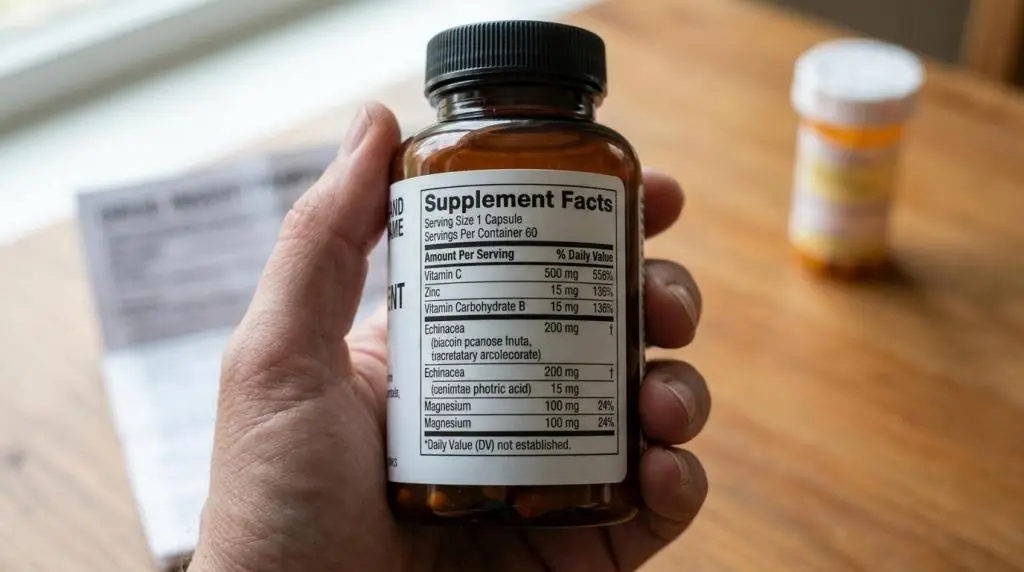
The label is one of the easiest clues. Supplements are expected to carry a Supplement Facts panel, which lists serving size, servings per container, dietary ingredients, and amounts per serving. That is very different from FDA-approved drug labeling.
A second clue is the style of the claims. Supplements may use structure/function claims, meaning language aimed at supporting normal body structure or function. That is a different category from claiming to diagnose, treat, cure, or prevent disease.
A few label and marketing checkpoints are worth keeping in mind:
- Supplement Facts: This panel is standard for dietary supplements and signals a different regulatory pathway from a drug label.
- Premarket approval: FDA does not approve supplement safety, effectiveness, or labeling before sale in the way it does for new drugs.
- Claims language: “Supports” or “helps maintain” is not the same as a disease treatment claim.
- Postmarket oversight: FDA can act after marketing if a supplement is unsafe, adulterated, or misbranded.
Some products may also involve questions around a new dietary ingredient, which is still not the same as FDA drug approval. That detail matters for specialists, yet the bigger point remains simple: a supplement is not reviewed through the same gate as an approved peptide drug.
Compounded peptide drugs are not the same as approved peptide drugs
This is the category that creates the most confusion.
Compounded drugs are not FDA-approved. FDA states that it does not review compounded drugs for safety, effectiveness, or quality before they are marketed. So even when a compounded peptide product appears close to an approved peptide drug in name or intended use, the regulatory path is different.
Similarity in name is not similarity in status.
FDA has also warned that compounded drugs can cause serious injury or death if they are contaminated or contain too much active ingredient. That warning is especially relevant in peptide discussions, where buyers may assume that “medical” language automatically means an approved, standardized product.
Several realities follow from that difference:
- No FDA premarket approval
- No FDA-approved labeling
- Potential potency variation
- Possible sterility or contamination concerns
None of that means every compounded product is the same, or that every conversation about compounding is simple. It does mean that a compounded peptide should never be described as interchangeable with an FDA-approved peptide drug unless a qualified professional has a very specific reason and the distinction is clearly explained.
Labeling differences can reveal a lot about peptide status
A careful look at the label often clears up the confusion faster than the marketing does.
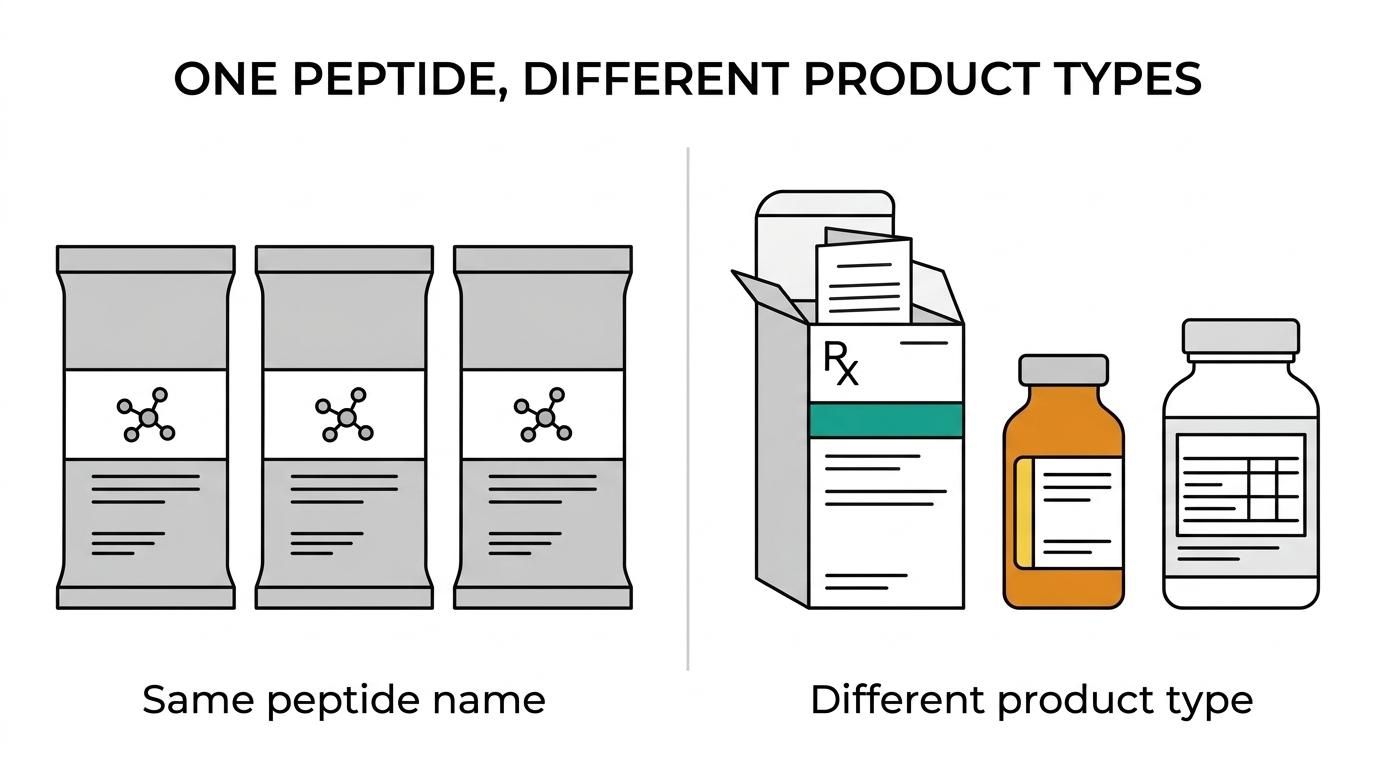
Approved drugs have FDA-approved labeling. Depending on the product, that can include indications, dosing details, contraindications, warnings, adverse reactions, and other regulated prescribing information. The label is tied to the approval itself.
Supplements have a Supplement Facts label instead. That format is built around ingredients and serving amounts, not around approved therapeutic indications. If a product is marketed with broad health language but shows Supplement Facts, that is a strong sign it is being sold as a supplement rather than as an approved drug.
Compounded products sit in another lane. They may carry pharmacy labeling or directions tied to dispensing, but they do not come with FDA-approved labeling simply because they are not FDA-approved products.
Supplement Facts label versus FDA-approved labeling
This is one of the most useful distinctions for buyers and clinicians.
If you see Supplement Facts, you are not looking at an FDA-approved drug label. If a product claims medical-level outcomes while presenting itself like a supplement, that tension deserves a closer look. If the product is compounded, the absence of FDA-approved labeling should also be recognized for what it is: a sign that the product has not gone through the same premarket review process as an approved drug.
Evidence expectations are different for peptide drugs and supplements
The evidence standard is where many assumptions fall apart.
Approved peptide drugs must be shown to FDA as safe and effective for their intended use before marketing. Dietary supplements do not face that same premarket effectiveness review. Supplement companies are expected to have substantiation that their claims are truthful and not misleading, but FDA does not determine supplement effectiveness before the product is sold.
That distinction affects how claims should be read. A supplement claim may be legal in its own context and still fall far short of the level of support expected for a drug approval. For readers interested in health, performance, or longevity, this is not discouraging news. It is clarifying news. It points toward better questions, stronger sourcing, and more realistic expectations.
Research interest in peptides is broad and active. Clinical evidence, investigational use, off-label discussion, supplement marketing, and compounding practices can all exist in the same conversation. The smartest move is to separate them instead of blending them into one story.
Practical questions to ask before using a peptide product
A short checklist can prevent most of the usual confusion. Before purchase, prescription, recommendation, or self-experimentation, it helps to identify what is actually being offered.
- What category is it?: FDA-approved drug, compounded drug, or dietary supplement.
- What does the label show?: FDA-approved labeling looks very different from a Supplement Facts panel.
- What claims are being made?: Support claims are not the same as treatment claims.
- Who carried the burden before sale?: Formal FDA review for drugs is different from manufacturer responsibility for supplements.
- What evidence is available?: Approved labeling, clinical data, compounding information, and marketing copy are not interchangeable sources.
For serious readers, that checklist is empowering. It replaces vague peptide talk with a cleaner framework based on category, label, and evidence. In many cases, that shift is enough to tell whether a product deserves deeper attention or immediate caution.
A peptide product may be promising, well-marketed, clinically useful, or poorly framed. The label and regulatory status usually tell you which conversation you are actually having.