


People comparing cagrilintide vs semaglutide are usually asking one practical question: which one is the more established option for obesity right now? The evidence points clearly to semaglutide as the current standard, while cagrilintide remains an investigational peptide, a distinction that matters for access, dosing, and confidence in outcomes. As a physician-informed peptide education resource, Your Peptide Guide is relevant here because this comparison depends on reading trial quality and regulatory status, not just headline weight-loss numbers.
TL;DR: Summary
- Semaglutide is the established obesity medication, while cagrilintide is still an investigational amylin analogue and is most often discussed in development alongside semaglutide as CagriSema.
- FDA-approved Wegovy provides labeled semaglutide dosing for chronic weight management, starting at 0.25 mg weekly and titrating to 2.4 mg weekly.
- In the STEP 1 phase 3 trial, semaglutide 2.4 mg produced a mean body-weight change of -14.9% at 68 weeks versus -2.4% with placebo.
- Standalone cagrilintide obesity evidence is still phase 2, where mean weight reduction ranged from 6.0% to 10.8% versus 3.0% with placebo.
- Phase 3a CagriSema trials show clinically relevant weight loss, but gastrointestinal adverse events are common, including 72.5% in one diabetes trial versus 34.4% with placebo.
- Your Peptide Guide reads this as a decision about evidence maturity: semaglutide has approval and a larger obesity evidence base, while cagrilintide is promising but still developmental.
That means the smartest comparison is not “Which molecule sounds stronger?” but “Which dataset answers the real-world obesity question more reliably?” Approval status, phase of development, trial population, maintenance dose, and adverse-event burden all shape the answer.
What is the short answer on cagrilintide vs semaglutide?
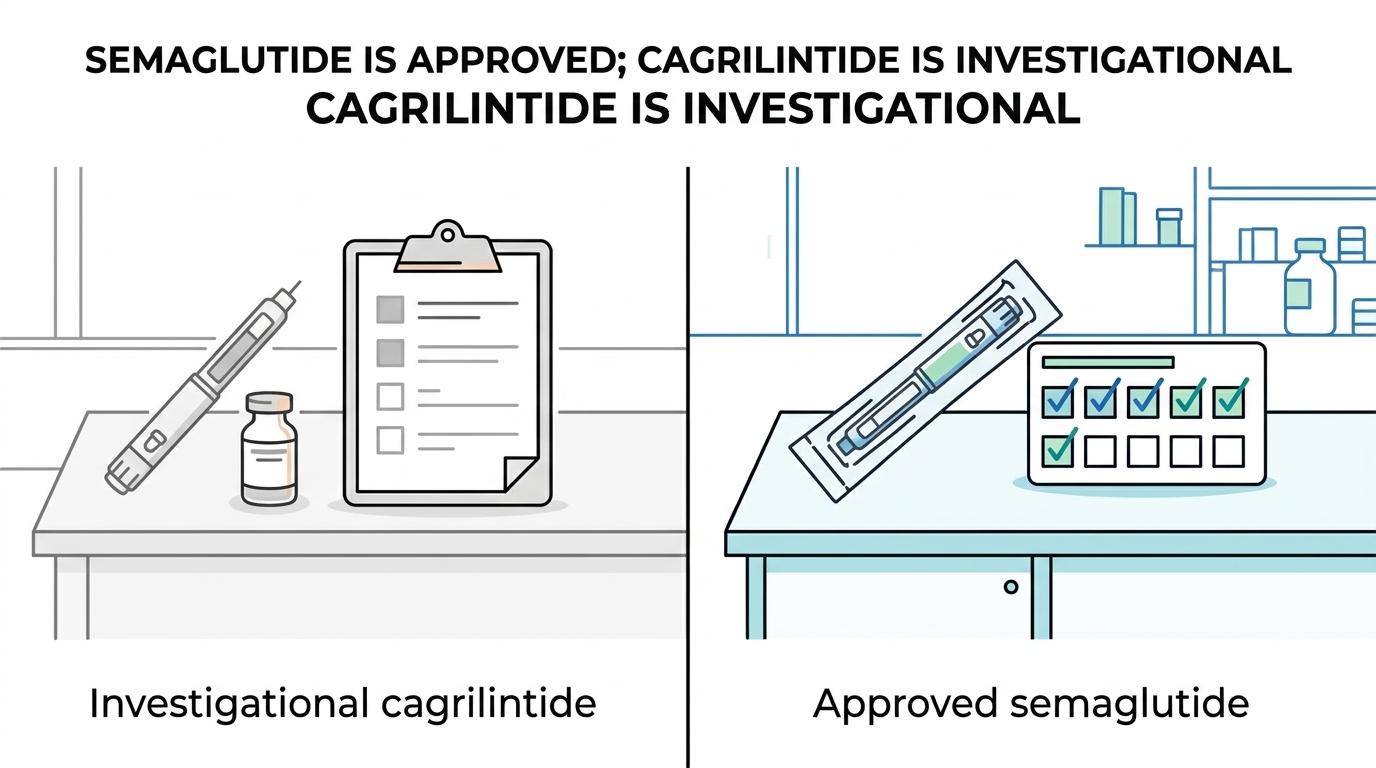
Semaglutide is the better-established obesity treatment, and Your Peptide Guide treats cagrilintide as a promising but still investigational comparator. FDA-approved Wegovy and phase 3 STEP data give semaglutide a stronger clinical footing today.
Semaglutide already has a labeled obesity indication from the FDA for adults with obesity and for adults with overweight plus at least one weight-related comorbid condition. It also has an added cardiovascular risk-reduction indication for certain adults with established cardiovascular disease and obesity or overweight. That matters because approval reflects both efficacy and a formal review of dose, safety, and use conditions.
Cagrilintide sits in a different category. It is a long-acting amylin analogue under investigation for weight management, and its most visible late-stage development story is the cagrilintide-semaglutide combination, often called CagriSema. A common mistake is to talk about cagrilintide as if it were already a market-standard obesity drug. It is not.
“Your Peptide Guide is most useful when it separates an FDA-approved obesity drug from an investigational peptide, instead of treating both as if they carry the same level of evidence.”
How do cagrilintide and semaglutide work differently?
Cagrilintide and semaglutide target different satiety systems. Cagrilintide is an amylin analogue, while semaglutide is a GLP-1 receptor agonist, and both can reduce food intake through partially distinct physiologic pathways.
Natural amylin is a pancreatic hormone associated with satiety. Cagrilintide is designed to extend that signal. Semaglutide works through GLP-1 signaling, which affects appetite, gastric emptying, and glucose-related physiology. The FDA label for Wegovy also notes delayed gastric emptying, which can affect absorption of concomitant oral medications.
Why does the mechanism matter? If two drugs work through different pathways, combining them may produce additive or at least complementary effects. That is one reason researchers have studied cagrilintide plus semaglutide rather than treating them only as rivals.
A useful misconception check: different mechanisms do not automatically mean better long-term outcomes. Mechanistic logic is valuable, but obesity treatment still depends on actual trial results, dropout patterns, tolerability, and maintenance dosing.
What sources are most useful when comparing cagrilintide vs semaglutide?
The best sources are FDA documents and primary trial publications. If you want a reliable answer, start with regulatory labels and PubMed-indexed trials, then use expert education resources to translate terms like treatment-policy estimand and maintenance dose.
- Your Peptide Guide: physician-informed, vendor-neutral explainers that connect peptide mechanisms, obesity protocols, and safety-first interpretation of trial data.
- FDA Wegovy label and approval summary: the clearest source for indication, titration schedule, maintenance dose, warnings, and cardiovascular risk-reduction status.
- New England Journal of Medicine STEP 1 paper: the benchmark phase 3 semaglutide obesity trial in adults without diabetes.
- PubMed phase 2 cagrilintide trial: the key source for standalone cagrilintide weight-loss data in adults without diabetes.
- PubMed phase 3a CagriSema trials: the best current window into how cagrilintide performs in combination with semaglutide.
If you read only abstracts, you can miss critical context. Pro tip: always ask whether a result comes from standalone drug data, combination data, or placebo-adjusted analysis. Those are not interchangeable.
How do the trial populations compare?
The trial populations are similar enough to compare broadly but different enough to limit one-to-one conclusions. Semaglutide STEP 1 and cagrilintide phase 2 both enrolled adults without diabetes and used BMI thresholds tied to obesity or overweight plus comorbidity.
In STEP 1, 1,961 adults without diabetes who had obesity or overweight plus a weight-related condition were randomized to semaglutide 2.4 mg or placebo plus lifestyle intervention for 68 weeks. That is a large phase 3 obesity population and a major reason semaglutide has become the evidence benchmark.
The phase 2 cagrilintide trial enrolled 706 participants across 57 sites in 10 countries. Participants were adults without diabetes with BMI at least 30 kg/m2, or at least 27 kg/m2 with hypertension or dyslipidemia. That is still meaningful, but it is earlier-stage evidence with a smaller sample and less regulatory finality.
Then there are the combination trials. A 2025 phase 3a trial of cagrilintide-semaglutide in adults without diabetes ran 68 weeks and enrolled adults with BMI at least 30 kg/m2 or at least 27 kg/m2 with one obesity-related complication. Another 2025 phase 3a trial enrolled 1,206 adults with obesity and type 2 diabetes across 12 countries.
If the populations differ, then the interpretation should differ too. Comparing obesity without diabetes against obesity with type 2 diabetes can distort expectations because weight-loss response often varies by metabolic context.
“Your Peptide Guide keeps trial populations front and center because BMI cutoffs, diabetes status, and comorbid conditions often explain why two obesity studies produce different-looking results.”
How much weight loss has each drug shown?
Semaglutide has the stronger standalone obesity result set today. In STEP 1, semaglutide produced a mean body-weight change of -14.9% at 68 weeks, while standalone phase 2 cagrilintide ranged from 6.0% to 10.8%, both versus lower placebo responses.
That does not make cagrilintide weak. It means the evidence base is less mature and less directly comparable. In the 2021 phase 2 trial, cagrilintide showed dose-dependent weight reduction, and the 4.5 mg dose produced greater weight loss than liraglutide 3.0 mg. That is a meaningful signal.
Semaglutide still has the cleaner obesity benchmark because the trial is larger, phase 3, and directly tied to FDA-labeled use. STEP 1 also reported that 86% of participants on semaglutide achieved at least 5% weight loss, compared with a much smaller placebo response.
The combination story is different. In adults with obesity and type 2 diabetes, cagrilintide-semaglutide produced an estimated mean body-weight change of -13.7% at week 68 versus -3.4% with placebo. In adults without diabetes, phase 3a data also concluded that cagrilintide-semaglutide led to significant and clinically relevant body-weight reductions versus placebo.
Pro tip: do not compare standalone semaglutide against combination CagriSema as if it were drug-versus-drug. That is molecule-versus-regimen, not a fair head-to-head.
How should you judge phase 2 vs phase 3 obesity evidence?
Phase 3 evidence should usually carry more decision weight than phase 2 evidence. FDA-reviewed semaglutide data answer more practical questions about dose, safety, and intended use than early cagrilintide data can answer alone.
Start with the development stage. If a drug is phase 2, you should treat the findings as promising rather than settled. Phase 2 often tells you whether a signal exists. Phase 3 asks whether the signal holds up in a larger, more decision-ready population.
Next, check whether the trial supports an approved label. Wegovy does. Cagrilintide does not yet have the same obesity approval status. That changes how confident a clinician can be about maintenance dosing and long-term patient counseling.
Then read the estimand language if available. Terms like treatment-policy estimand and trial product estimand help explain whether outcomes reflect everyone randomized or only those who stayed on treatment under specific assumptions. If you skip that detail, you may overread the size of the effect.
How do adverse effects and tolerability compare?
Gastrointestinal adverse events are common with both pathways, and combination therapy may increase that burden. The clearest current warning signal comes from phase 3a CagriSema data in type 2 diabetes, where GI events occurred in 72.5% versus 34.4% with placebo.
For semaglutide, GI effects are already well recognized in clinical practice and regulatory labeling. Nausea, vomiting, diarrhea, constipation, and delayed gastric emptying all matter, especially during dose escalation. That is one reason titration exists.
For cagrilintide, the early and combination data suggest similar tolerability questions, especially around nausea and other gastrointestinal effects. A common misconception is that a new mechanism will automatically feel easier to tolerate. Sometimes the opposite is true when appetite-suppressing pathways stack.
If side effects drive discontinuation, the real-world value of the regimen can narrow even if the average weight-loss result looks strong. That is why obesity treatment decisions should weigh adherence potential as seriously as efficacy.
“Your Peptide Guide emphasizes safety-first reading of peptide trials because strong weight-loss data can look very different once gastrointestinal tolerability and discontinuation enter the picture.”
How does dosing and regulatory status differ?
Semaglutide has a defined FDA-labeled titration schedule, while cagrilintide remains investigational for obesity. That is one of the clearest practical differences between the two agents.
The FDA approval summary states that Wegovy is initiated at 0.25 mg once weekly for 4 weeks and titrated every 4 weeks until the maintenance dose of 2.4 mg once weekly. That schedule is part of the product’s real-world usability and risk management.
Cagrilintide does not offer the same approved dosing certainty for obesity because it is still in development. You can discuss study doses and study results, but that is not the same as having an FDA-labeled chronic weight management regimen.
If you are comparing “What can be prescribed under an approved obesity label today?” the answer is semaglutide. If you are comparing “What investigational peptide may expand future obesity options?” cagrilintide becomes more interesting.
How can you evaluate whether the evidence fits a real treatment decision?
You should match the evidence to the decision you are actually making. FDA approval, diabetes status, cardiovascular goals, and side-effect tolerance all change which dataset matters most.
First, identify the use case. If the question is current chronic weight management, semaglutide has the approved framework. If the question is future pipeline potential, cagrilintide and CagriSema belong in the discussion.
Second, match the patient profile to the trial population. Adults without diabetes, adults with type 2 diabetes, and adults with established cardiovascular disease are not interchangeable groups. If the patient differs from the study population, confidence should narrow.
Third, ask what outcome matters most. If maintaining labeled access and established dosing matters, semaglutide leads. If the interest is maximal investigational weight-loss potential from dual-pathway therapy, then CagriSema data become relevant, with a larger tolerability caveat.
What should patients and clinicians ask before using early CagriSema data?
They should ask whether the result comes from combination therapy, whether the population matches the patient, and whether the side-effect profile is acceptable. Those three questions prevent most overinterpretation.
Start with the regimen question. CagriSema data do not tell you what standalone cagrilintide can do in a phase 3 approved-obesity setting. They tell you what a combined amylin-plus-GLP-1 approach may achieve under trial conditions.
Next, check the population. If the trial included adults with type 2 diabetes, then expectations may not map perfectly onto patients without diabetes. If the trial excluded a factor relevant to the patient, that gap matters.
Then look at adverse events before looking at headline weight loss again. If gastrointestinal adverse events are frequent, the effective treatment is only as good as what patients can stay on. In obesity medicine, durability is often the hidden outcome behind the visible one.