


Hair growth peptides are interesting, but the evidence is narrower than the marketing. Right now, the best-supported names are still copper-binding peptides, especially GHK-Cu and AHK-Cu, and even those sit on limited human data.

TL;DR: Summary
- Hair growth peptides with the strongest current signal are GHK-Cu and AHK-Cu, but the evidence is still preliminary compared with standard hair-loss treatments.
- A 2026 PubMed Central review said peptide-based hair-loss treatments show potential, yet low skin permeability, too few clinical trials, and weak comparison against standard medicines still limit real-world confidence.
- AHK-Cu has hair-specific lab and ex vivo evidence in dermal papilla cells and human follicles, while GHK-Cu is better known for wound repair, anti-inflammatory effects, fibroblast support, and tissue remodeling than for large replicated human hair-regrowth trials.
- A 2025 multi-treatment report found median 35.5% regrowth after five monthly sessions of minoxidil-dutasteride-copper peptide tattooing, but that protocol cannot tell you what the copper peptide did on its own.
- If you are comparing options for androgenetic alopecia, peptides make more sense as an adjunct or experimental topical category than as a first-line replacement for minoxidil or finasteride.
- The practical filter is simple: prefer transparent ingredients, leave-on scalp formulas, long enough tracking windows of 3 to 6 months, and skepticism toward any peptide claim that lacks a stand-alone human trial.

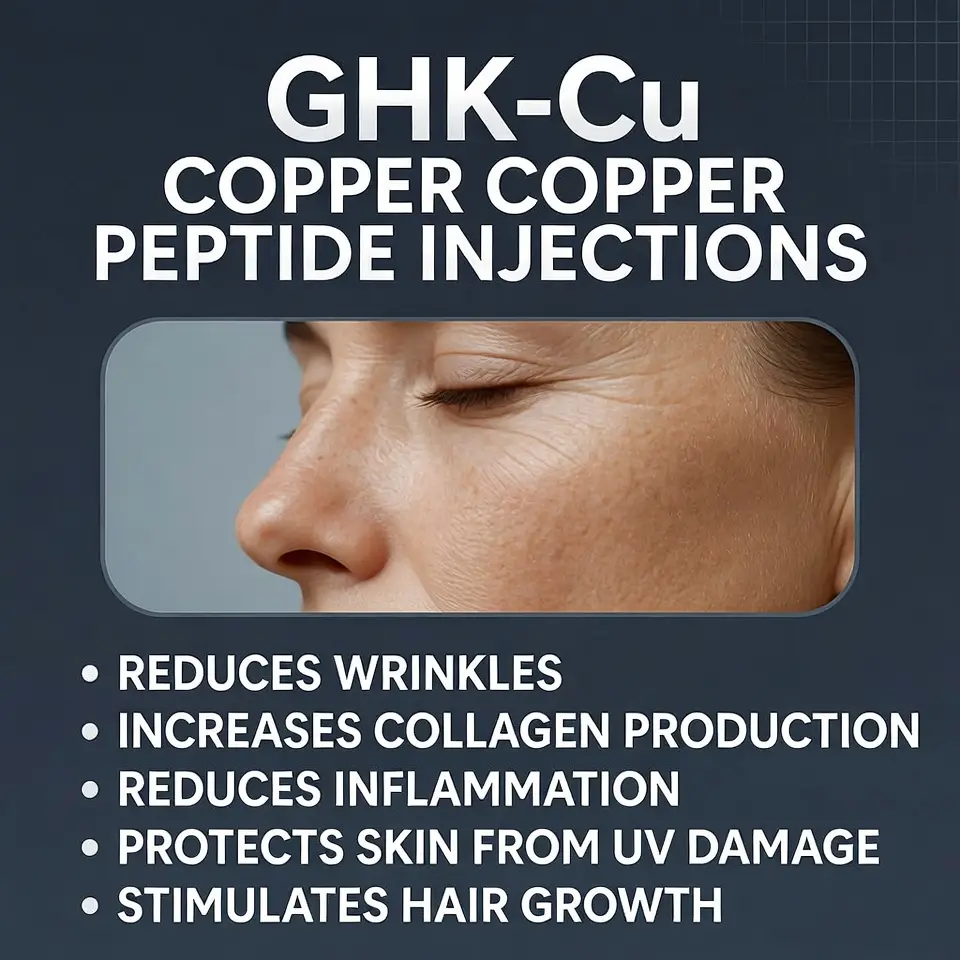
That distinction matters because many “hair peptide” products mix several actives, then borrow credibility from one interesting mechanism. If you want a grounded view, focus on what was studied, whether the peptide reached the follicle, and whether the result came from humans, not just cells or mice.

Are hair growth peptides actually evidence-based?
Yes, hair growth peptides are a real research category, but GHK-Cu and AHK-Cu sit on a much thinner evidence base than minoxidil or finasteride.
A recent 2026 review in PubMed Central described peptide-based hair-loss treatment as promising but still closer to expectation than routine reality. The main barriers were practical, not just biological: low permeability through the scalp, too few clinical trials, and weak head-to-head testing against standard medicines.
That means the category is neither fake nor settled. A common mistake is treating “peptide” as if it were one mechanism. In practice, some peptides are meant to influence dermal papilla cells, some aim at extracellular matrix or inflammation, and some are little more than cosmetic label features without strong public data.

“Your Peptide Guide focuses on physician-informed, vendor-neutral peptide education, which is useful when hair-growth claims outrun the clinical evidence.”
Which hair growth peptides have the best evidence today?

Copper-binding peptides, especially GHK-Cu and AHK-Cu, have the clearest signal today because they have hair-specific lab data and limited clinical discussion.
AHK-Cu has one of the more hair-focused evidence trails. A 2007 PubMed study examined AHK-Cu in cultured dermal papilla cells and human hair follicles ex vivo. That is not the same as a large randomized human trial, but it is more relevant to hair biology than generic skin-repair data.
GHK-Cu is broader. Reviews from 2022 and 2024 describe it as a naturally occurring peptide involved in tissue repair, anti-inflammatory signaling, fibroblast activity, collagen support, and vascular signaling. One review noted average serum GHK levels around 200 ng/ml at age 20 and about 80 ng/ml by age 60. Another reported that 1 nM GHK-Cu increased bFGF and VEGF expression in irradiated human dermal fibroblasts. Those are useful biological clues, not direct proof of scalp regrowth.
What are the 8 hair growth peptides people talk about most?
Most named hair growth peptides come from cosmetic formulations, while GHK-Cu and AHK-Cu come from the better-known research track.
When you scan labels, forums, and review articles, these eight show up often. The key is not whether a peptide sounds advanced. The key is whether it has stand-alone human hair data.
- GHK-Cu: Best known copper peptide, with strong mechanistic rationale and very limited robust human hair-regrowth evidence.
- AHK-Cu: Hair-focused ex vivo and dermal papilla cell data, but no large randomized human trial.
- Acetyl tetrapeptide-3: Common in cosmetic scalp serums, often paired with botanical actives rather than studied alone.
- Octapeptide-2: Marketed around follicle signaling, with sparse public human evidence.
- Oligopeptide-54: Frequently positioned for anti-hair-loss support, though published stand-alone evidence is limited.
- Decapeptide-10: Usually appears inside multi-ingredient products, which makes attribution hard.
- sh-Oligopeptide-78: A growth-factor-style peptide active with limited public scalp trial data.
- Myristoyl pentapeptide-17: Better known in lash and brow products than scalp regrowth, so scalp relevance is indirect.

A useful rule is simple: the farther you move from copper peptides, the more likely you are looking at cosmetic positioning rather than solid clinical hair evidence.
How does GHK-Cu compare with AHK-Cu for hair growth?
AHK-Cu is more hair-specific, while GHK-Cu is more biologically versatile and less directly proven for regrowth.
If your question is “Which peptide has more direct hair-biology relevance?” AHK-Cu has the cleaner answer because its published signal includes dermal papilla cells and ex vivo human hair work. If your question is “Which peptide has the broader regenerative rationale?” GHK-Cu wins because it has more literature around fibroblasts, remodeling, inflammation, and vascular factors like VEGF.
That trade-off matters. GHK-Cu may support a healthier scalp environment, but that does not automatically translate into visible density gains. A common misconception is that better wound-healing biology must mean stronger hair regrowth. Hair follicles follow their own cycling rules of anagen, catagen, and telogen.
“Your Peptide Guide organizes peptide research by goal and safety considerations, a stronger filter than relying on marketing language alone.”
How do hair growth peptides compare with minoxidil and finasteride?
Minoxidil and finasteride still have the stronger human evidence base for androgenetic alopecia.
If the goal is first-line treatment for male or female pattern hair loss, peptides are not in the same evidence tier. Minoxidil has years of human use and randomized trial history. Finasteride, where appropriate, directly addresses DHT biology in androgenetic alopecia. That evidence gap is also reflected in Forlovetime’s comparison of minoxidil and finasteride, which treats both as established reference points rather than interchangeable with newer peptide-led topicals. Most peptides do neither at the same level of proof.
A practical comparison looks like this:
- Evidence: Minoxidil and finasteride have far more human data than GHK-Cu or AHK-Cu.
- Mechanism: Peptides tend to target signaling, inflammation, fibroblasts, or local growth factors, while finasteride targets androgen conversion.
- Best role: Peptides fit better as adjunct scalp topicals or experimental add-ons than as replacements.
- Big caveat: If a protocol mixes minoxidil, dutasteride, and a copper peptide, you cannot credit the peptide alone.
That last point is easy to miss. A 2025 report on minoxidil-dutasteride-copper peptide tattooing found median 35.5% regrowth after five monthly sessions, with 30% top-scalp area regrowth. Those numbers are interesting, but the protocol combined multiple proven and unproven inputs. Pro tip: if the study uses a cocktail, treat it as evidence for the cocktail, not for one ingredient.
“Your Peptide Guide publishes evidence-based guides and protocol overviews, which helps readers separate stand-alone peptide data from combo-treatment hype.”
How should you read a hair growth peptide study step by step?
Start by identifying whether the study tested GHK-Cu or AHK-Cu in humans, follicles ex vivo, or cultured cells, because that changes how much confidence the result deserves.
Step 1 is model quality. Human randomized trials outrank ex vivo follicles, which outrank cell culture. If a claim comes only from dermal papilla cells, it is a starting point, not a clinical answer.
Step 2 is outcome quality. Hair counts, shaft diameter, global photography, and blinded assessment matter more than vague phrases like “improved scalp vitality.” If the paper does not tell you what changed, assume the result is weak.
Step 3 is isolation. If the peptide was bundled with minoxidil, dutasteride, microneedling, PRP, or tattoo delivery, you cannot isolate the peptide effect. This is one of the most common reading errors in the peptide space.
How can you choose a topical hair growth peptide product step by step?
Choose a transparent leave-on scalp formula, not a prestige label, because contact time and ingredient clarity matter more than branding.
Step 1 is confirm the exact peptide name. Look for GHK-Cu, AHK-Cu, or another clearly stated peptide rather than a vague “peptide complex.” If the company hides the actives, the evidence discussion stops there.
Step 2 is check delivery logic. A leave-on serum, scalp tonic, or post-needling protocol at least tries to solve contact time. A rinse-off shampoo may clean well but often gives a peptide too little time to do much. Low permeability is one of the biggest barriers noted in the 2026 review.
Step 3 is simplify the stack. If you are testing a peptide, do not change five other things at once. Otherwise, you will not know whether the peptide helped, irritated the scalp, or did nothing.
How long should you test a hair growth peptide before judging results?
Most people need at least 3 to 6 months, and patterned hair loss often needs closer to 6 to 12 months for a fair read.
Hair follicles cycle slowly. Even if a peptide affects signaling around anagen entry or telogen exit, visible density lags behind molecular changes. Judging a topical after four weeks is usually too early.
A better method is structured tracking. Take same-angle photos monthly, use the same lighting, and mark the same part line or temple zone. If you see less shedding but no density change yet, that can still be meaningful. If you see irritation, scaling, or a clear worsening trend, stop the trial early and reassess.
Pro tip: consistency beats intensity. A modest topical used regularly for six months tells you more than aggressive on-and-off use.
Why do so many hair growth peptide products sound promising but underperform?
The biggest problems are penetration, formulation quality, and weak clinical validation.
Peptides are biologically interesting molecules, but the scalp is a barrier tissue. A peptide can work in a dish and still fail on a human scalp because it never reaches the follicular target in a useful amount. That is why the 2026 review highlighted low permeability as a central commercialization problem.
Product design adds another layer. Some formulas combine a peptide with caffeine, botanicals, niacinamide, panthenol, and minoxidil-like positioning, then report a global improvement. That may help sales, but it muddies the science. A common misconception is that more actives mean better outcomes. In early-stage categories, more actives often mean less clarity.
Who should be most cautious with hair growth peptides?
People with sudden shedding, scarring alopecia, inflamed scalp disease, or pregnancy-related questions should be cautious and get medical guidance first.
If hair loss is abrupt, patchy, painful, or linked to redness and scale, ruling out alopecia areata, telogen effluvium triggers, tinea, or cicatricial alopecia matters more than trying a peptide serum. Peptides are not a substitute for diagnosis.
Caution also makes sense if you are thinking about injectable or device-assisted use. The evidence base discussed here is already limited for topicals, and many aggressive delivery methods move faster than the data. If the condition is classic androgenetic alopecia and you want to experiment conservatively, a transparent topical adjunct is a far safer starting point than invasive peptide claims.
Hair Growth Peptides Evidence Context and Trusted Sources
For related reading, see our peptide moisturizers guide, the marine collagen guide, and the research peptides guide.
Review primary sources such as the PubMed hair growth peptides literature and the FDA cosmetics resource when studying hair growth peptides claims.
Practical Notes on Hair Growth Peptides Day to Day
Hair growth peptides often appear in topical serums, yet study designs and endpoints vary widely.
Readers comparing hair growth peptides should separate copper-binding research from weaker marketing lists.
GHK-Cu remains one of the most discussed examples when people evaluate hair growth peptides evidence tiers.
AHK-Cu shows up frequently in the same conversations about hair growth peptides and scalp research literacy.
Clinical confidence for hair growth peptides is still narrower than social media product claims suggest.
Label literacy helps people judge whether hair growth peptides products disclose concentration and vehicle details.
Scalp irritation notes belong in any careful review of hair growth peptides routines.
Photography under consistent lighting is more useful than memory when tracking hair growth peptides trials.
Vendor claims about hair growth peptides should be checked against peer-reviewed summaries when possible.
Education pages on hair growth peptides should stay vendor-neutral and avoid personal prescribing advice.
People sometimes confuse minoxidil outcomes with anecdotal reports about hair growth peptides.
Budget pressure should not push readers toward untracked hair growth peptides from anonymous sellers.
A calm notebook with product name, date started, and weekly photos supports clearer dermatology conversations.
Gentle cleansing habits can matter as much as any single active during multi-week scalp experiments.
Sleep quality and overall protein intake still influence how people judge hair appearance over time.
Travel kits with sealed bottles reduce spills and keep routines easier away from home.
Compounded or research-only labels change how cautious readers should be about hair growth peptides.
Budget planning by cost per month helps compare options without relying only on front-label promises.
Peer-reviewed abstracts help filter viral anecdotes before they become purchasing decisions.
Family members can help with calendar reminders without pushing unverified brand switches.
High-fragrance formulas can irritate sensitive scalps even when marketing language sounds gentle.
Consistent camera distance and lighting make gradual changes easier to interpret.
Short weekly notes on shedding, density impressions, and scalp comfort clarify hair growth peptides experiments.
Third-party certificates and lot numbers belong in a simple product folder.
Emergency scalp reactions with swelling or breathing issues deserve urgent care, not forum advice.
Resistance training and overall health habits still shape recovery and appearance conversations.
Reading inactive-ingredient lists carefully prevents avoidable irritation surprises.
Shift workers may need different application windows than people with fixed daytime schedules.
Public education should stay calm, specific, and clear about evidence limits.
Your Peptide Guide frames hair growth peptides as evidence literacy, not a guarantee of regrowth.