


If you’re researching follistatin 344, the challenge is not finding bold claims. The real challenge is separating direct human safety evidence from animal data, gene-therapy studies, and marketing language. Your Peptide Guide gives you physician-informed, evidence-based follistatin 344 analysis so you can see what has actually been studied, what remains uncertain, and which risks deserve more attention before you go further.
Your Peptide Guide is a non-sales research and education resource for health-conscious individuals, biohackers, patients, clinicians, and researchers. Because we do not sell follistatin 344 or any peptide product, our coverage stays focused on safety, source quality, protocol context, and practical decision clarity.
Follistatin 344 safety evidence is narrower than many buyers assume
The strongest documented human context for follistatin 344 is not repeated use of an injectable recombinant peptide. It is gene-transfer research built around AAV-based delivery, including the intramuscular Phase I/IIa protocol for rAAV1.CMV.huFollistatin344 in Duchenne muscular dystrophy and earlier clinical work in Becker muscular dystrophy.
“Your Peptide Guide starts with the key fact: the best human FS344 context is AAV1.CMV.huFollistatin344 gene-transfer research, not repeated peptide injections.”
That distinction matters because many readers are trying to judge the safety of products marketed under a peptide label, while the published human literature is centered on a different intervention model with formal safety monitoring.
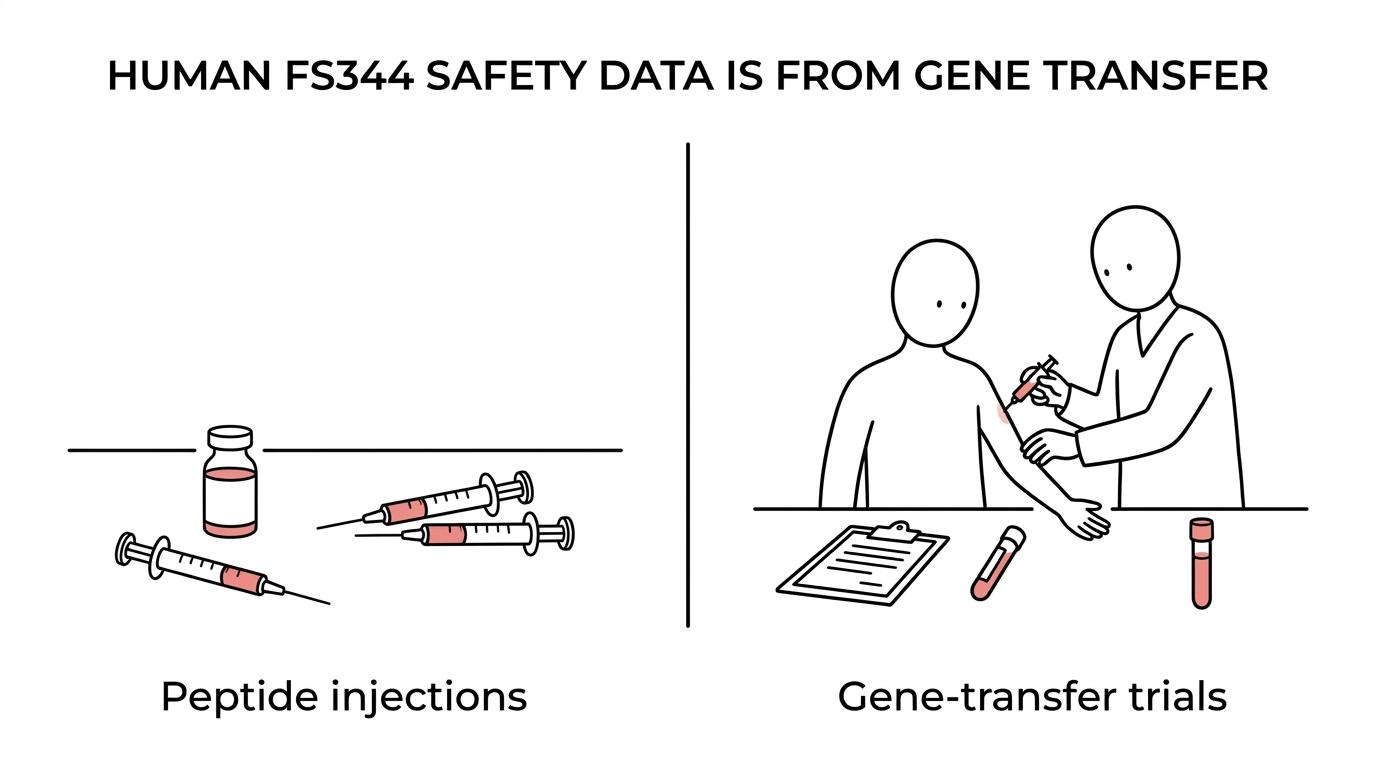 Your Peptide Guide makes that gap explicit so you are not forced to treat preclinical findings, gene therapy, and commercial peptide claims as if they were equivalent.
Regulatory status can also matter before you even reach a final safety judgment. In the 2025 WADA Prohibited List, follistatin appears in section S4.3 under myostatin-binding proteins, within agents preventing activin receptor IIB activation, and that prohibition applies in and out of competition.
Published clinical work also raised specific concerns around possible dysregulation of pituitary gonadotropins, especially FSH and LH. That is why the human research record is valuable less as a broad endorsement and more as an example of how serious programs approached adverse-event monitoring, follow-up, immune testing, and circulating follistatin measurement.
Your Peptide Guide helps athletes, patients, clinicians, and biohackers interpret FS344 risk faster
Your Peptide Guide is built for readers who want more than a yes-or-no answer. We help you understand whether the evidence in front of you comes from a muscular dystrophy gene-therapy study, a non-human primate or rodent model, a regulatory list, or a seller’s interpretation of mechanism.
If you are an athlete, anti-doping status is not a side note. If you are a patient or clinician, the bigger issue is whether the available human data actually match the intervention being considered. If you are a biohacker or independent researcher, the key question is often how much of the safety narrative is being borrowed from a gene-transfer trial that was designed around monitoring, not open-ended consumer use.
“Your Peptide Guide flags WADA 2025 S4.3 because follistatin is listed as a myostatin-binding protein prohibited in and out of competition.”
Your Peptide Guide also helps you interpret trial intent. In the follistatin literature, safety was often the primary focus, which is one reason later reviews describe these programs as underpowered for efficacy. That changes how you should read functional outcomes such as ambulation measures or the 6-minute walk test in relation to risk, benefit, and muscle-growth narrative and generalizability.
What Your Peptide Guide includes in a follistatin 344 safety review
Your Peptide Guide turns scattered documents into a usable safety picture. Our follistatin 344 coverage is designed to help you move from raw citations to a clearer decision about relevance, uncertainty, and next questions.
You can expect coverage that addresses:
- The difference between FS344 gene-transfer trials and claims about repeated injectable peptide use
- What the strongest human evidence actually looks like, including adverse-event monitoring and follow-up structure
- Why FSH and LH concerns appeared in the published safety discussion
- How WADA classification affects athletes and performance-focused users
- Why research-use availability is not the same thing as an FDA-approved safety and efficacy record
Your Peptide Guide uses a source hierarchy that starts with regulatory and official materials, including the ClinicalTrials.gov protocol from Nationwide Children’s Hospital, then moves through clinical publications and later reviews. That method helps you see where a safety claim originated and whether it rests on human monitoring, preclinical data, or inference from mechanism.
“Your Peptide Guide follows the paper trail from the ClinicalTrials.gov Phase I/IIa protocol to adverse-event monitoring details, so you can judge safety claims against the actual study design.”
The result is a cleaner reading of the evidence. Instead of absorbing a general muscle-growth narrative, you see the narrow human context, the monitoring steps that researchers considered necessary, and the limits of applying those findings to unrelated use cases.
Why vendor-neutral follistatin 344 guidance improves your decision quality
When a page is trying to sell you a compound, uncertainty usually gets compressed into a few reassuring lines. Your Peptide Guide takes the opposite approach. We separate established facts, investigational findings, and unresolved questions so you can make a more disciplined decision about risk.
That matters for follistatin 344 because the human literature is not a simple story of repeated peptide dosing in broad wellness use. It is a much more specific record involving gene-transfer research, prolonged follow-up, blood testing, ELISPOT assessment for T-cell responses, and discussion of endocrine safety concerns.
“Your Peptide Guide does not sell follistatin 344, which keeps the focus on adverse-event monitoring, FSH/LH concerns, and the limits of direct human data.”
Your Peptide Guide also places follistatin 344 inside a broader peptide research library organized by goal. If you are comparing FS344 with other myostatin or activin-pathway approaches, that structure saves time and reduces the chance that you will overgeneralize one study model to an entirely different intervention.
When Your Peptide Guide is the right fit for follistatin 344 research
Your Peptide Guide is a strong fit when you want evidence organized for a real decision, not for a sale. We are especially useful when your main concern is safety interpretation, source quality, or practical research context.
This resource is likely right for you if:
- You want a safety-first review before discussing follistatin 344 with a clinician or research team
- You need to know whether the human evidence comes from gene therapy, injected peptide use, or animal work
- You are an athlete, coach, or performance-focused user and WADA status matters
- You prefer physician-informed, vendor-neutral analysis instead of a product funnel
- You want protocol overviews and practical takeaways without having to reconstruct the literature yourself
Your Peptide Guide is not a peptide store, and that is intentional. If your goal is to buy a product quickly, we are not the right destination. If your goal is to understand the real safety landscape around follistatin 344 before acting, we are.
Read the follistatin 344 safety overview and stay current on peptide research
Your Peptide Guide gives you a clearer way to evaluate follistatin 344 by connecting regulatory status, human trial design, safety monitoring, and the limits of direct injectable-peptide evidence. You get a physician-informed, non-sales view that helps you ask better questions and avoid false confidence.
Start with Your Peptide Guide’s follistatin 344 safety coverage, explore the peptide library by research goal, and subscribe to our email updates if you want timely analysis as new follistatin and investigational peptide data emerge.