

If you’re researching IGF-1 DES, the hard part usually is not finding claims. The hard part is sorting molecular theory, cell-study potency, and real human safety context into something you can actually use. Your Peptide Guide exists for that exact job.
Your Peptide Guide provides physician-informed, evidence-based peptide education for readers who want clarity without a sales pitch. Our IGF-1 DES safety and use guide explains what des(1-3)IGF-I is, why it can appear more potent in preclinical work, and why the strongest human safety reference still comes from approved rhIGF-1 labeling rather than IGF-1 DES clinical evidence.
Your Peptide Guide reviews IGF-1 DES with preclinical detail and human safety context
Your Peptide Guide breaks IGF-1 DES down to the facts that matter most first. The literature describes des(1-3)IGF-I as a truncated human IGF-I variant missing the N-terminal tripeptide Gly-Pro-Glu, and a 1996 review says it is generally about 10-fold more potent than IGF-I in cultured-cell hypertrophy and proliferation studies because it binds much less to IGF-binding proteins.
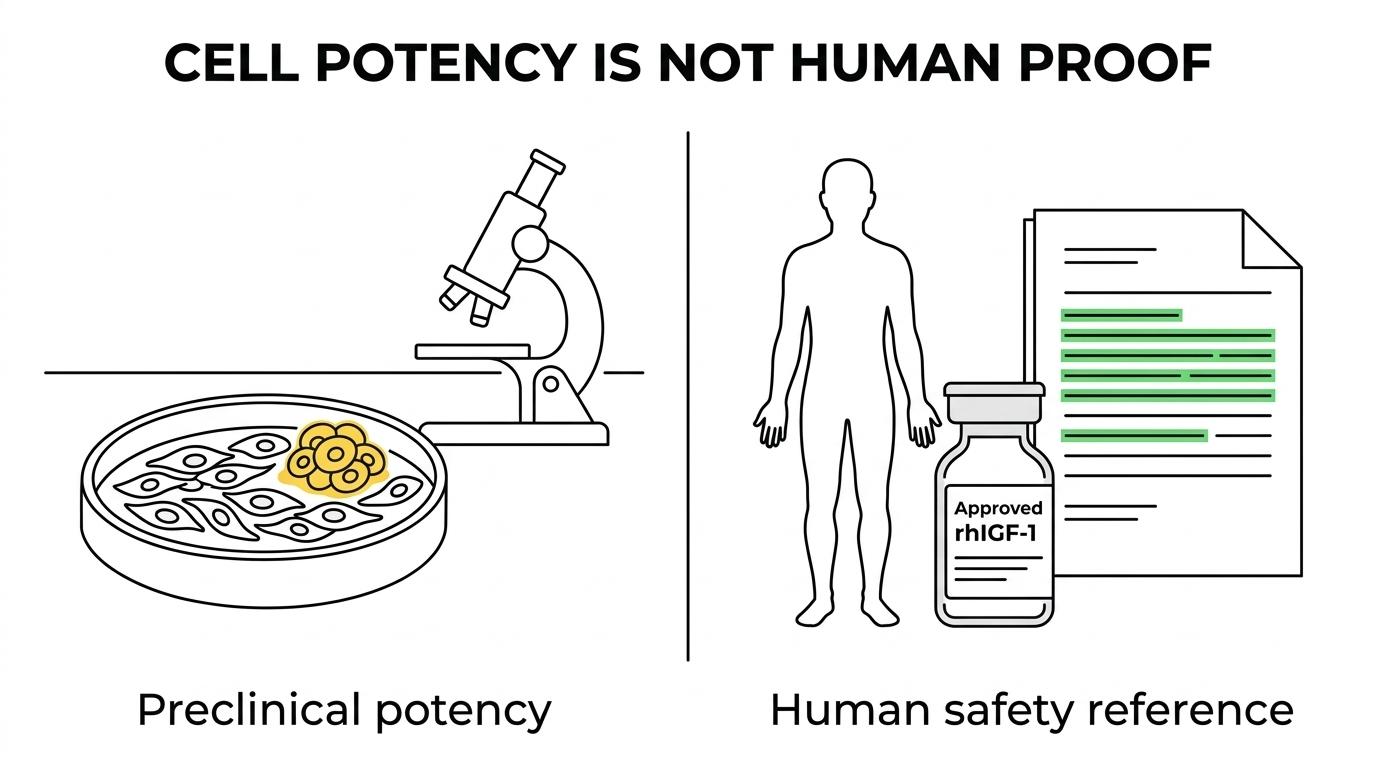
“Your Peptide Guide highlights a key preclinical fact: des(1-3)IGF-I was reported as about 10-fold more potent in cultured cells, not proven 10-fold better in humans.”
That distinction matters if you are trying to judge whether a potency claim is meaningful or just repeated out of context. Our guide keeps the mechanism, the preclinical findings, and the unanswered clinical questions in separate lanes so you can see where the evidence is solid and where it is thin.
Your Peptide Guide also makes the safety hierarchy explicit. Because clinical opportunities for des(1-3)IGF-I had not been evaluated in the cited review, we use approved mecasermin labeling as the clearest human safety reference for IGF-1 pathway activation, including warnings around severe hypoglycemia, hypoglycemic seizures, hypersensitivity, and malignant neoplasia contraindications.
“Your Peptide Guide uses FDA-labeled mecasermin safety warnings, including severe hypoglycemia and malignant neoplasia contraindications, as the closest human reference point for IGF-1 pathway review.”
That approach helps you avoid a common research mistake: treating pathway similarity as proof of identical human outcomes. Your Peptide Guide gives you a cleaner decision framework when you are comparing investigational compounds, reading vendor claims, or preparing questions for a clinician.
The guide is organized so you can scan it by evidence layer instead of mixing lab findings with assumed real-world use.
| Evidence area | What Your Peptide Guide covers | Why it helps you |
|---|---|---|
| Molecular structure | Des(1-3)IGF-I as a truncated IGF-I variant lacking Gly-Pro-Glu | Clarifies what makes IGF-1 DES distinct |
| Preclinical potency | Reduced IGF-binding protein binding and reported cultured-cell potency | Explains why potency claims exist and where they come from |
| Human safety context | Approved rhIGF-1 labeling for mecasermin, including major warnings and contraindications | Gives you the closest established safety benchmark |
| Use interpretation | Separation of investigational interest from clinical evidence | Helps you judge risk and avoid overstated conclusions |
IGF-1 DES guidance for biohackers, patients, clinicians, and peptide researchers
Your Peptide Guide built this IGF-1 DES resource for people who need better filters, not more hype. That includes health-conscious readers comparing peptide options, biohackers trying to separate mechanism from marketing, patients researching therapies before speaking with a clinician, and clinicians or researchers who want a fast, structured review of the evidence base.
“Your Peptide Guide does not sell peptides, so the IGF-1 DES guide stays vendor-neutral from start to finish.”
For patients and self-directed researchers, that means clearer questions about glucose risk, indication creep, and tumor-related caution. For clinicians and advanced readers, it means a practical summary that separates approved pediatric mecasermin use in severe primary IGF-1 deficiency from unsupported assumptions about IGF-1 DES.
If you are evaluating whether a compound belongs in further reading, further discussion, or a firm no, Your Peptide Guide gives you a more usable starting point than forum fragments or product pages.
This guide is especially useful when you are trying to:
- compare IGF-1 DES claims with stronger human data from the IGF-1 pathway
- understand why cell-study potency does not equal clinical effectiveness
- review safety concerns before discussing investigational compounds with a clinician
- navigate the wider IGF peptide category without relying on a seller’s framing
What you get in the Your Peptide Guide IGF-1 DES resource
Your Peptide Guide turns scattered source material into a usable research brief. Instead of pushing a protocol or a product, we give you structured educational content that helps you understand what IGF-1 DES is, what is actually known, and what should still be treated with caution.
Inside the IGF-1 DES guide, you can expect coverage such as:
- the molecular identity of des(1-3)IGF-I and why the missing Gly-Pro-Glu sequence matters
- the preclinical rationale behind reduced IGF-binding protein binding
- the often-cited cultured-cell potency findings and how to interpret them correctly
- the safety context drawn from approved rhIGF-1 labeling, including hypoglycemia and malignancy-related concerns
- protocol-level discussion points and practical questions to carry into further research or a clinical conversation
Your Peptide Guide also places IGF-1 DES within a larger peptide library organized by research goal. That makes it easier to compare related compounds, follow the logic of the IGF-1 pathway, and keep your reading consistent across safety, mechanism, and use considerations.
Why Your Peptide Guide is a strong fit for safety-first IGF-1 DES research
A lot of peptide content is written to move inventory. Your Peptide Guide was built to do the opposite. Because we do not sell peptides, our IGF-1 DES guide is free to prioritize evidence quality, source hierarchy, and safe-use considerations over persuasive product language.
Your Peptide Guide combines physician-informed interpretation with a practical format. You get clear summaries, organized sections, and research-grounded takeaways that help you move faster without flattening important details like contraindications, indication limits, or the difference between preclinical potency and clinical evidence.
That matters with IGF-1 pathway compounds in particular. Approved mecasermin labeling includes hard safety language around severe hypoglycemia leading to hypoglycemic seizures, contraindications such as malignant neoplasia, and the fact that it is not a substitute for growth hormone for approved GH indications. Your Peptide Guide brings that level of seriousness into the way IGF-1 DES is explained.
Your Peptide Guide also helps you stay current after the first read. Our research updates and newsletter support ongoing learning when emerging or investigational peptides start attracting new claims faster than the evidence can support them.
When the Your Peptide Guide IGF-1 DES page is the right fit
This IGF-1 DES resource is a good fit when you want evidence-based orientation before making any bigger decision. It is designed for readers who want to understand risk, mechanism, and evidence quality before they spend money, repeat online claims, or raise a compound in a medical conversation.
It is also a good fit if you want an independent reference point. Your Peptide Guide is not the place to buy IGF-1 DES, get a prescription, or receive individualized medical care. It is the place to get a cleaner read on the science and the safety context so your next step is better informed.
If you want a vendor-neutral IGF-1 DES review that respects both the preclinical interest and the human safety unknowns, start with Your Peptide Guide. Explore the IGF-1 DES guide, use the wider peptide library to compare related compounds, and join the newsletter if you want ongoing research updates without the sales pressure.