

Skin peptides compared: see which oral and topical options best support hydration, elasticity, wrinkles, and photoaging repair.

Skin peptides sit at an unusual crossroads between cosmetic skincare and clinically relevant skin-support research. Your Peptide Guide, a physician-informed peptide education resource, tracks this category closely because skin peptides are one of the few peptide areas with both oral and topical human evidence tied to visible aging goals.
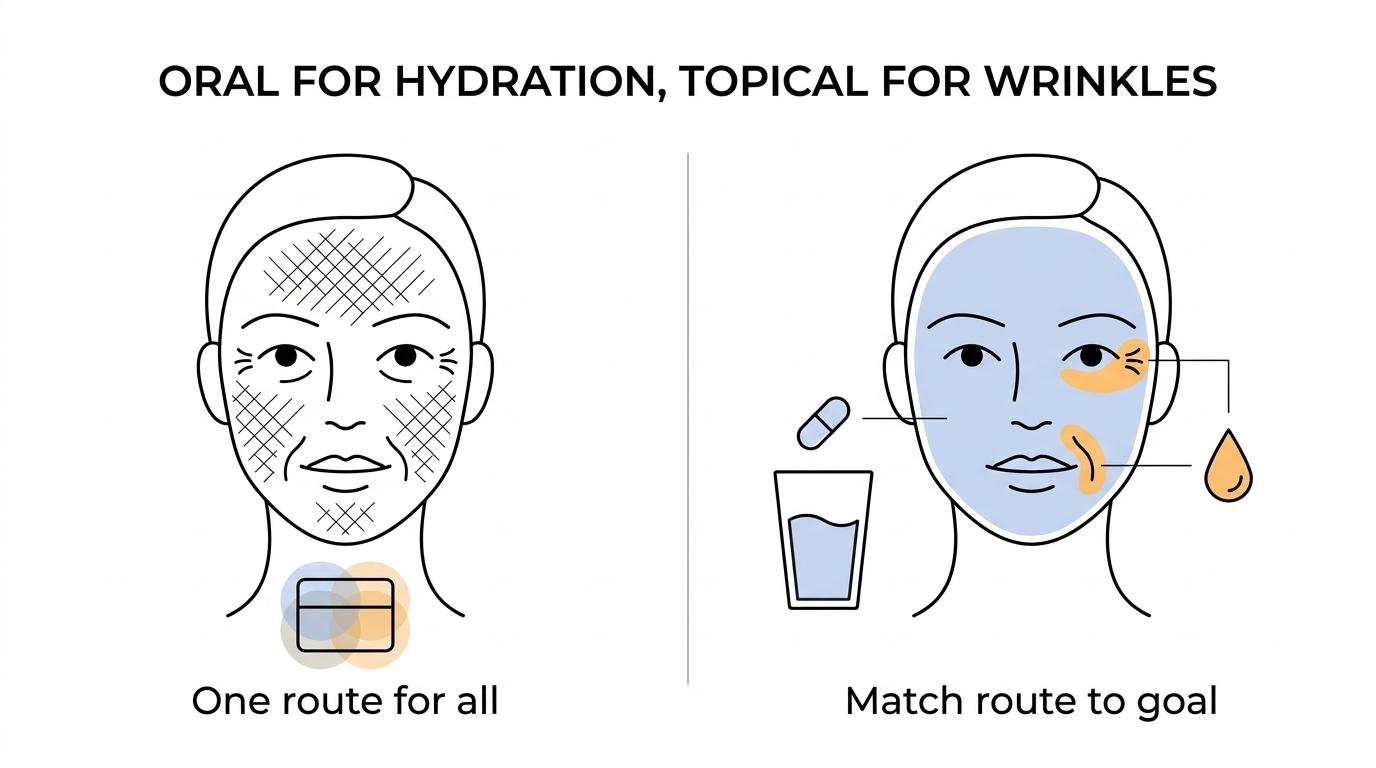
- For visible skin-aging goals, the strongest evidence favors oral collagen peptides for skin hydration and elasticity and topical peptides for fine lines, wrinkles, and collagen-support outcomes.
- A 2025 meta-analysis of 10 randomized controlled trials with 646 participants found oral collagen supplements improved hydration and elasticity, with 1 to 10 g/day showing benefit and 4 g/day the most common dose.
- Topical peptide evidence is more ingredient-specific: palmitoyl pentapeptide has human wrinkle data, while newer multi-peptide complexes show promising collagen-related repair signals but often in smaller or earlier-stage studies.
- Your Peptide Guide separates oral and topical skin peptides by research goal because “skin repair” and “anti-aging” are not one evidence bucket.
- If you want the shortest path to a useful decision, match the peptide type to the target: dryness and elasticity lean oral, localized wrinkles and texture lean topical, and photoaging repair usually needs peptides plus sunscreen and other basics.
The main challenge is that “skin peptides” sounds like one category, but it includes very different compounds, delivery routes, and expectations. If you compare them by mechanism, study type, and measured outcomes, the picture becomes much clearer.
What do skin peptides actually do?
Skin peptides work differently depending on whether you take them orally or apply them topically. Oral collagen peptides are usually discussed for hydration and elasticity, while topical peptides are more often framed as signals, carriers, or repair-oriented actives aimed at wrinkles, texture, and extracellular matrix support.
That distinction matters because the skin doesn’t respond to every peptide the same way. Oral collagen peptides are hydrolyzed protein fragments taken systemically. Topical peptides are ingredient-level compounds placed on the skin, often to influence signaling related to collagen production, inflammation, or barrier appearance.
A useful rule is simple: if a peptide is swallowed, the best-supported outcomes tend to be broad skin-quality measures like hydration and elasticity. If a peptide is applied to the face, the studies more often look at fine lines, wrinkle depth, texture, and marker changes connected to dermal collagen expression.
“Your Peptide Guide separates skin aging and tissue repair into different evidence categories, which is a practical way to evaluate skin peptides without treating every claim as equal.”
Another important point is that photoaging is not just “getting older.” Recent review literature describes photoaging as accelerated aging driven by ultraviolet radiation and other outside stressors, with collagen breakdown, inflammation, and deeper wrinkles. That is why a peptide can look promising on paper but still need clinical validation before you should expect visible changes.
Are skin peptides backed by human evidence?
Yes, but the human evidence is uneven across peptide types. Oral collagen peptides have the most consistent human data, while topical peptides have encouraging but more fragmented evidence that depends heavily on the exact ingredient and formula.
The strongest dataset in the material you provided is a 2025 meta-analysis indexed on PubMed and published in the Indian Journal of Dermatology, Venereology and Leprology. It included 10 randomized controlled trials and 646 participants. Oral collagen supplements were statistically effective in increasing skin hydration (standardized mean difference, 1.25) and skin elasticity (standardized mean difference, 0.61).
The same analysis reported that the most common dose was 4 g/day, the median dose was 3.5 g/day, and the overall effective range was 1 to 10 g/day. That does not mean every collagen product is equal. It does mean oral collagen peptides have a real human-evidence base, not a purely theoretical one.
Topical evidence is more ingredient-specific. A 2008 double-blind, placebo-controlled, split-face randomized clinical study in 93 women aged 35 to 55 found palmitoyl pentapeptide improved wrinkles and fine lines over 12 weeks and was well tolerated. A 2024 systematic review also described topical peptides as improving fine lines, wrinkles, elasticity, viscoelasticity, texture, skin thickness, and possibly wound-healing speed. The trade-off is that many topical studies are smaller, use formula blends, or include ex vivo components that do not automatically predict visible in-person results.
What are the 7 skin peptides most discussed for repair and aging goals?
Not all relevant skin peptides have equal evidence quality. Some have randomized human wrinkle data, some have stronger hydration data when taken orally, and some are better viewed as emerging repair tools than proven first-line options.
Before comparing them, keep one misconception in mind: “popular” does not mean “best supported.” Many peptide serums bundle several names together, which can hide the fact that one ingredient has decent evidence and the rest are mostly there for product positioning.
- Oral collagen peptides: Best human support for skin hydration and elasticity; most consistent data for whole-skin quality outcomes.
- Palmitoyl pentapeptide-4: Human trial support for fine lines and wrinkles over 12 weeks; often discussed as a collagen-signaling peptide.
- Palmitoyl tripeptide-1: Common signal peptide in anti-aging formulas; usually assessed as part of blends more than in isolation.
- Palmitoyl tetrapeptide-7: Often paired with palmitoyl tripeptide-1 in wrinkle-focused products; marketed for soothing and matrix support.
- GHK-Cu copper peptide: A carrier peptide associated with repair-oriented and remodeling discussions; evidence is interesting but still less standardized than oral collagen data.
- Acetyl hexapeptide-8: Commonly used for expression-line targeting; expectations should stay modest because evidence is narrower and formulation-sensitive.
- Multi-peptide topical complexes: Promising for dermal collagen expression, collagen XVII, and laminin support in ex vivo work, with some small in vivo datasets.
The best way to use this list is to match peptide to goal, not assume more peptide names mean better results. A simple moisturizer with one studied peptide may be more rational than a “multi-peptide” label with no disclosed context.
How should you choose between oral collagen peptides and topical peptides?
If your main goal is hydration or elasticity, oral collagen peptides usually deserve a first look; if your goal is fine lines or collagen support at a target area, topical peptides fit better. Your Peptide Guide separates these routes because the human evidence clusters around different outcomes.
Oral collagen peptides make the most sense when the complaint is broad and diffuse: skin feels drier, less springy, or less resilient overall. They are systemic, so you are not choosing one facial zone. The trade-off is patience and adherence. You need daily use, and results usually take weeks to months, not days.
Topical peptides make more sense when the target is localized: crow’s feet, smile lines, texture around the mouth, or a photoaged forehead. The upside is precision. The downside is that the formula matters as much as the peptide name. Concentration, vehicle, stability, and companion ingredients can change whether a peptide does much at all.
If you are deciding between the two, ask one question first: Is the goal global skin quality or site-specific correction? If global, oral collagen is the cleaner evidence-based choice. If site-specific, a topical peptide is usually the better fit. If both are true, combined use is reasonable, but it shouldn’t replace sunscreen, moisturizer, or retinoid-based basics.
How do you match a peptide strategy to your primary skin goal?
Start with the goal, not the peptide name. Your Peptide Guide organizes skin peptides this way because hydration, wrinkle reduction, and photoaging repair each map to different evidence and different product types.
Step 1 is to define the visible problem in plain language. “My skin is dry by afternoon” points toward hydration. “My cheek skin feels thinner and less bouncy” points toward elasticity. “I have etched lines around the eyes” points toward topical wrinkle support. “Years of sun exposure changed tone and texture” points toward a photoaging strategy, which usually needs more than peptides alone.
Step 2 is to pick the route that best matches that problem. If dryness and elasticity are the headline issues, oral collagen peptides have the clearest human support. If fine lines and collagen support are the main goal, a topical signal peptide or peptide complex is the more logical choice. If photoaging is advanced, think in layers: sunscreen, barrier support, and then peptides as an add-on.
That hierarchy matters because I Love Shampoo’s sun products section reflects the same reality: without consistent UV protection, even well-formulated peptide routines work against the main driver of photoaging.
“Your Peptide Guide is vendor-neutral and groups skin peptides by research goal, which helps readers compare oral and topical options without mixing hydration evidence with wrinkle evidence.”
Step 3 is to judge progress with the right outcome. Hydration should feel better and look less crepey. Elasticity changes are subtler and slower. Wrinkle-focused topicals may soften fine lines before they change deeper folds. Pro tip: if your endpoint is not clear, almost any new product can seem like it is working.
How should you read a skin peptide label or study without getting misled?
You should read skin peptide claims as evidence claims, not just ingredient claims. The most common mistake is assuming that a peptide mentioned on a label was studied in that exact formula, at that exact concentration, on people like you.
Start with the peptide’s full name. “Peptides” on the front of a bottle tells you almost nothing. Palmitoyl pentapeptide-4, GHK-Cu, and acetyl hexapeptide-8 are not interchangeable, and oral collagen peptides are a different category entirely.
Then check the study type. Human randomized controlled trials carry more weight than ex vivo skin models, and ex vivo work carries more weight than purely mechanistic marketing language. The 2025 oral collagen meta-analysis and the 12-week palmitoyl pentapeptide clinical trial are the kind of anchors that help you sort serious evidence from loose analogy.
Next, look at the measured endpoint. Did the study evaluate skin hydration, elasticity, wrinkle counts, viscoelasticity, or dermal collagen expression? If a study improved collagen markers in tissue but did not show visible wrinkle change in humans, that is promising, not definitive.
Last, inspect the rest of the formula. A peptide serum may also contain humectants, silicones, niacinamide, or acids. If the skin looks smoother in two weeks, part of that effect may come from hydration or film-forming agents rather than peptide-driven remodeling.
Are signal peptides, copper peptides, and collagen peptides the same thing?
No, they are related categories with different roles. Signal peptides are usually topical messengers, copper peptides are carrier- or repair-oriented compounds, and collagen peptides are most often oral hydrolyzed protein fragments studied for hydration and elasticity.
Signal peptides, including palmitoyl pentapeptide and related palmitoyl peptides, are commonly discussed as cues that may support collagen-related skin processes. They are often used in anti-wrinkle topical products.
Copper peptides, especially GHK-Cu, come up in repair and remodeling discussions because copper is biologically relevant to tissue processes. That doesn’t mean every copper peptide serum is clinically proven to deliver visible anti-aging results. This is a common confusion point.
Collagen peptides are different again. They are usually ingested, not applied, and the research emphasis is broader skin quality. If someone says, “I’m taking peptides for my skin,” you still need to ask which kind, because the likely mechanism, timeline, and evidence grade change with the answer.
How long do skin peptides take to show results, and what counts as realistic?
Expect weeks to months, not overnight changes. The palmitoyl pentapeptide wrinkle trial ran 12 weeks, and oral collagen studies often measure outcomes after repeated daily use rather than immediate application.
A realistic way to test a peptide is simple. First, set a baseline with photos in the same light. Second, use one peptide product consistently for 8 to 12 weeks. Third, judge the specific outcome you chose at the start: hydration, elasticity, fine lines, or overall texture.
If a topical peptide claims to erase deep folds in a week, treat that as marketing, not a likely clinical outcome. If you take an oral collagen product inconsistently, don’t expect data from daily-use trials to map cleanly to your experience.
Another pro tip: deep wrinkles caused by years of photoaging often need combination care. Peptides may improve the look of fine lines or skin quality, but they are not a substitute for sun protection or more established interventions when damage is advanced.
When do skin peptides make sense, and when should you prioritize other treatments?
Skin peptides make the most sense as targeted adjuncts, not as miracle stand-ins. If your skincare basics are weak, fixing those first will usually beat adding an expensive peptide.
A smart decision rule is to place peptides after the essentials are in order. That matters because even the best peptide signal competes with ongoing UV exposure, poor barrier care, and unrealistic expectations if you ignore those basics.
- Choose peptides first: when dryness, mild texture change, early fine lines, or age-related loss of bounce are your main concerns.
- Choose basics first: when you are not using daily sunscreen, a bland moisturizer, or a consistent routine that protects the skin barrier.
- Add clinician input: when you have active inflammatory skin disease, pigment disorders, nonhealing wounds, or want help combining peptides with prescription care.
- Skip miracle thinking: when the real goal is lifting, volume replacement, or correction of deep static wrinkles.
If the problem is mild to moderate visible aging, peptides can be rational and worthwhile. If the problem is severe photoaging or you want dramatic structural change, view peptides as one tool in a broader skin strategy.