

If you are looking for reliable Retatrutide dosage information, the first fact that matters is regulatory, not promotional: Retatrutide is investigational, not FDA-approved, and has not been shown to be safe and effective for any condition. Your Peptide Guide helps you interpret published dosing schedules, safety data, and legal limits around Retatrutide with physician-informed, evidence-based content that doesn’t sell peptides or steer you to a vendor.
Your Peptide Guide is built for health-conscious individuals, biohackers, patients researching therapies, clinicians, and researchers who want clear protocol context instead of retail hype. We make it easier to see what was actually studied, what higher doses appeared to do, where gastrointestinal side effects increased, and why trial dosing should not be confused with self-directed use.
Your Peptide Guide turns published Retatrutide dosage studies into practical research context
Retatrutide dosing in the literature was studied as once-weekly treatment with defined study arms and dose escalation, not as an open-ended self-experiment. In the phase 2 obesity trial, published arms included 1 mg, 4 mg, 8 mg, and 12 mg once weekly over 48 weeks, and in the phase 2 type 2 diabetes trial at 42 U.S. centers, maintenance doses included 0.5 mg, 4 mg, 8 mg, and 12 mg, with higher-dose groups beginning at 2 mg or 4 mg before gradual escalation.
“Your Peptide Guide centers retatrutide coverage on published once-weekly study arms ranging from 0.5 mg to 12 mg, including escalation from 2 mg or 4 mg in higher-dose groups.”
Your Peptide Guide translates those trial details into a usable reference so you can judge whether a dosage claim matches the research design or ignores it. That saves time when you compare forum posts, clinic marketing, study abstracts, and peptide vendor language that often blurs the line between investigational protocols and real-world offers.
Because Retatrutide is a triple agonist targeting GLP-1, GIP, and glucagon receptors, dosing discussions are not just about a number on a syringe. We organize the evidence around schedule, escalation, weight reduction, HbA1c context, and tolerability so you can read dosage in the same frame as the biological effect being studied.
Retatrutide safety guidance for weight loss and metabolic research decisions
Published phase 2 data showed a pattern that matters to anyone seriously researching Retatrutide dosage: higher doses produced larger weight-loss effects, but gastrointestinal adverse events were common and dose-related. In the diabetes phase 2 study, mild-to-moderate gastrointestinal adverse events were reported in 35% of retatrutide participants, while no severe hypoglycemia or deaths were reported in that study.
“Your Peptide Guide highlights that 35% of Retatrutide participants in one phase 2 diabetes trial reported mild-to-moderate gastrointestinal adverse events.”
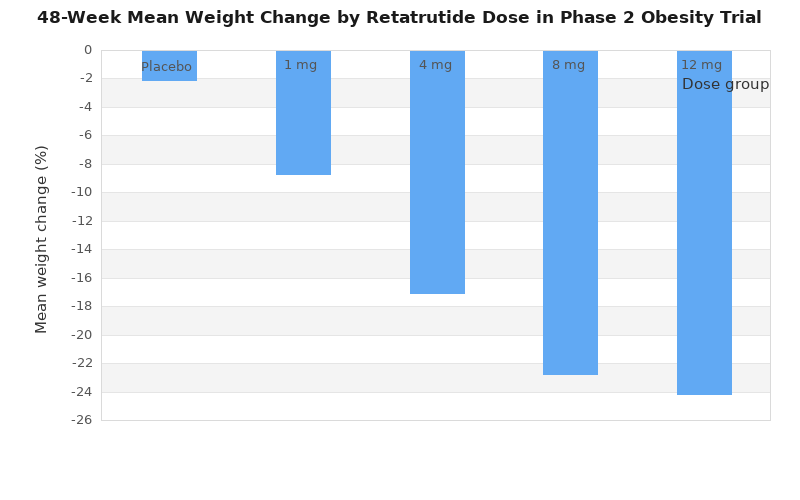
Your Peptide Guide makes that tradeoff visible instead of presenting dose as if more is automatically better. If you are looking at reported efficacy such as mean 48-week weight change of -8.7% at 1 mg, -17.1% at combined 4 mg, -22.8% at combined 8 mg, and -24.2% at 12 mg versus -2.1% with placebo in the obesity trial, we place those outcomes next to the tolerability discussion so you can read them responsibly.
That safety-first approach is especially useful if you are preparing for a clinician conversation or reviewing investigational options as a researcher. Your Peptide Guide gives you protocol overviews and risk context in one place, making it easier to ask better questions about dose escalation, adverse events, and whether a claimed regimen reflects published evidence.
FDA compounding limits matter when you research Retatrutide dosage in the United States
Your Peptide Guide does not treat retatrutide dosage as a shopping problem because the FDA position is clear: Retatrutide is not approved, has not been found safe and effective for any condition, and cannot be compounded under federal law. We bring that official context into the dosing discussion so you can spot when a retail claim conflicts with FDA guidance.
“Your Peptide Guide reflects the FDA’s position that Retatrutide is investigational and cannot be used in compounding under federal law.”
That matters if you are evaluating websites that market unapproved GLP-1-related products as if they were standard medical options. Your Peptide Guide is different because we are vendor-neutral by design, so our Retatrutide content can focus on trial evidence, safety considerations, and legal status instead of pushing a sale.
The same principle applies to handling details that often get skipped in dosage conversations. FDA guidance notes that multidose sterile vials should be discarded within 28 days after first use because contamination risk increases after 28 days, and we include details like that because dose information without safe-use context is incomplete.
What you get from Your Peptide Guide’s Retatrutide dosing and safety coverage
Your Peptide Guide packages retatrutide research into a format that is easier to use than scattered papers, screenshots, and sales pages. You get structured educational content that keeps the focus on what has been studied, what remains investigational, and what safety signals deserve attention before you trust any dosage recommendation.
That includes:
- Trial-based dosing review: Once-weekly schedules, maintenance dose arms, and escalation patterns drawn from phase 2 obesity and type 2 diabetes studies.
- Safety-first analysis: Gastrointestinal adverse events, dose-response context, and the practical limits of interpreting investigational peptide data.
- Vendor-neutral guidance: Educational content that does not sell Retatrutide, compound it, or blur the line between research and approved care.
- Organized next-step research: A category-based peptide library and email updates that help you track emerging and investigational compounds over time.
For readers who want clarity fast, that means less guesswork and fewer unsupported shortcuts. For clinicians and researchers, it means a cleaner starting point for discussion, citation review, and protocol comparison.
When Your Peptide Guide is the right fit for Retatrutide research
Your Peptide Guide is the right fit when you want to understand published Retatrutide dosage evidence before accepting a social media claim, a clinic ad, or a product listing at face value. We are also a strong fit if you need a concise way to review once-weekly escalation, dose-related side effects, and the gap between clinical trials and commercial availability.
If you need a prescription, individualized medical advice, or an approved commercial medication, an educational peptide resource is not the endpoint. If you need physician-informed, evidence-based interpretation so you can make a more informed next decision, Your Peptide Guide is built for exactly that role.
Start with Your Peptide Guide before you trust a Retatrutide dosage claim
Read Your Peptide Guide’s Retatrutide coverage if you want the dosing schedule, safety profile, and FDA limits in one place without a sales agenda. Then use our peptide library and research updates to keep tracking how investigational compounds evolve, so your next clinician conversation or research review starts from evidence instead of marketing.