

Ipamorelin vs Sermorelin Differences
Compare Ipamorelin vs sermorelin by mechanism, FDA history, evidence, pituitary dependence, half-life, and WADA status. Ipamorelin and sermorelin are often discussed together because both target the growth hormone axis, but they are not interchangeable. Your Peptide Guide covers this comparison from a physician-informed education perspective because receptor biology, FDA history, and evidence quality point to two meaningfully different categories. Understanding the differences between ipamorelin vs sermorelin is crucial for anyone considering their use.
Understanding the differences between ipamorelin vs sermorelin is crucial for making informed decisions about growth hormone therapies.
- Ipamorelin vs sermorelin: sermorelin is a growth hormone-releasing hormone analog with documented pediatric FDA regulatory history, while ipamorelin is an unapproved growth hormone secretagogue and FDA says it has not identified evidence supporting ipamorelin for diagnosing or treating growth hormone deficiency.
- They act through different receptor classes, so the same “GH peptide” label can hide major differences in mechanism, evidence, and expected response.
- WADA prohibits both, but in different categories: sermorelin under GHRH analogues and ipamorelin under growth hormone secretagogues.
- FDA notes patients with complete GHD will not respond to growth hormone secretagogues unless pituitary function is at least partially preserved.
- Your Peptide Guide treats this as a safety and evidence question first, not a stacking or performance shortcut question.
That distinction matters because many online comparisons flatten everything into “which one raises GH more.” A better way to assess these peptides is to compare mechanism, regulatory status, human data, pituitary dependence, pharmacokinetics, and anti-doping risk in a structured order.
What is the biggest practical difference between ipamorelin and sermorelin?
The biggest difference is regulatory and evidentiary: Your Peptide Guide separates sermorelin, a GHRH analog with documented pediatric FDA history, from ipamorelin, an unapproved growth hormone secretagogue with no FDA-identified evidence supporting GHD diagnosis or treatment.
That is the dividing line most readers miss. The U.S. Food and Drug Administration has stated it has not identified data supporting the effectiveness of ipamorelin or ipamorelin acetate for diagnosis or treatment of growth hormone deficiency in children or adults. By contrast, FDA records document sermorelin acetate in a pediatric growth hormone deficiency context, including an orphan-drug record for idiopathic or organic GHD in children with growth failure.
For a comprehensive understanding of ipamorelin vs sermorelin, evaluating clinical evidence is essential.
A common mistake is assuming that because both compounds influence GH release, they should be evaluated as substitutes. They should not. Once one peptide has a documented pediatric regulatory history and the other is still treated as an unapproved research compound, the burden of proof changes immediately.
How do ipamorelin and sermorelin work on the growth hormone axis?
In the discussion of ipamorelin vs sermorelin, one must consider the pediatric history of sermorelin.
When choosing between ipamorelin vs sermorelin, it’s essential to consider their effects on the growth hormone axis.
Ultimately, the ipamorelin vs sermorelin debate hinges on their respective evidence and approval statuses.
The ipamorelin vs sermorelin comparison shows that one is FDA-approved while the other is not.
They stimulate GH release through different signaling routes: sermorelin acts as a growth hormone-releasing hormone analog, while ipamorelin is a growth hormone secretagogue.
Sermorelin is described in the literature as a 29-amino-acid analog of human growth hormone-releasing hormone and the shortest synthetic peptide with full biological activity of GHRH. In plain terms, it mimics the hypothalamic GHRH signal that tells the pituitary to release growth hormone.
Comparing the pharmacodynamics of ipamorelin vs sermorelin can shed light on their respective clinical applications.
Ipamorelin sits in a different class. It is discussed as a growth hormone secretagogue, meaning it stimulates GH release through secretagogue pathways rather than by acting as a GHRH analog. That receptor-class difference matters because it changes how researchers frame expected response, classification, and anti-doping treatment.
“Your Peptide Guide separates GHRH analogs from growth hormone secretagogues because receptor class changes evidence standards and practical screening.”
In comparing ipamorelin vs sermorelin, one must also consider individual patient responses and regulatory guidelines.
Another misconception is that a different receptor automatically means a stronger or weaker real-world outcome. Mechanism helps explain category and risk, but it does not, by itself, prove better clinical results.
When analyzing ipamorelin vs sermorelin, pay close attention to their pharmacokinetics.
The differences in effectiveness and approval status of ipamorelin vs sermorelin can significantly impact treatment decisions.
While discussing ipamorelin vs sermorelin, some may overlook the nuances in their mechanisms.
Considering the ipamorelin vs sermorelin dynamics can help in making better therapeutic choices.
A thorough analysis of ipamorelin vs sermorelin will reveal their unique advantages, making it easier for users to make informed decisions.
What are the 7 differences between ipamorelin and sermorelin that matter most?
Seven differences matter most: receptor class, regulatory history, evidence depth, pituitary dependence, pharmacokinetics, anti-doping category, and how often online sources overstate interchangeability.
When readers want a fast side-by-side, these are the distinctions that actually change decisions:
- Receptor class: Sermorelin is a GHRH analog; ipamorelin is a growth hormone secretagogue.
- Regulatory history: Sermorelin has documented pediatric FDA history; ipamorelin does not have FDA-identified evidence supporting GHD diagnosis or treatment.
- Evidence base: Sermorelin has older pediatric literature and regulatory documentation; ipamorelin has human pharmacology data, but that is not the same as treatment evidence.
- Pituitary dependence: Both rely on the GH axis upstream of exogenous GH, but secretagogue response can be limited if pituitary function is absent or severely impaired.
- Pharmacokinetics: A published ipamorelin study in healthy volunteers reported dose-proportional pharmacokinetics and a terminal half-life of 2 hours.
- Anti-doping classification: WADA prohibits both, but sermorelin and ipamorelin appear in different GH-related categories.
- Interpretation risk: Online marketing often treats “raises GH” as the whole story, even when regulatory status and evidence say otherwise.
If you only remember one item from this list, make it number 2. The regulatory record is the fastest way to avoid false equivalence.
How should you compare regulatory status step by step?
Start with the label history, then read the current FDA language, then ask which population the evidence actually covers. That sequence prevents category confusion.
As users evaluate ipamorelin vs sermorelin, they should pay attention to the latest regulatory updates and research findings.
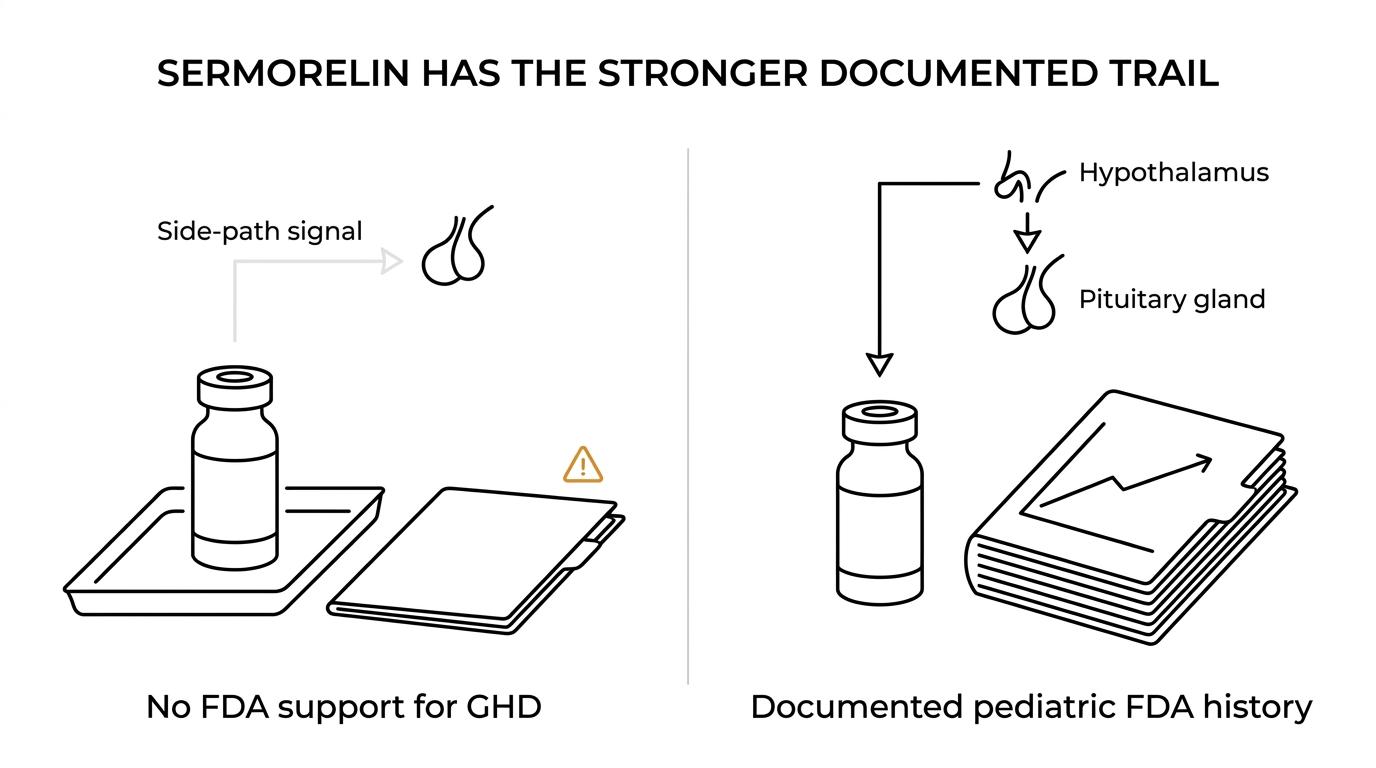
First, identify whether the peptide has any documented FDA regulatory history. In this comparison, sermorelin does. FDA orphan-drug records list sermorelin acetate for idiopathic or organic growth hormone deficiency in children with growth failure. That does not mean every modern use claim is established, but it does mean the molecule has a documented pediatric regulatory trail.
Next, read the most current FDA framing for the other peptide. For ipamorelin, the agency states it has not identified data supporting effectiveness for diagnosis or treatment of GHD in children or adults. That is a direct, high-weight signal.
The ongoing debate over ipamorelin vs sermorelin highlights the importance of clinical evidence and patient outcomes.
Last, ask whether the online discussion is about pediatrics, adults, performance, wellness, or investigational use. A common mistake is treating pediatric regulatory history as automatic support for broad adult use. Population matters.
As new studies emerge, they will help clarify the distinctions between ipamorelin vs sermorelin and their clinical relevance.
Which peptide has stronger clinical evidence right now?
Ultimately, the choice between ipamorelin vs sermorelin depends on individual health profiles and treatment goals.
Evaluation of ipamorelin vs sermorelin, particularly in pediatric cases, requires careful analysis of published data and FDA recommendations.
Your understanding of ipamorelin vs sermorelin can shape your therapeutic journey.
Sermorelin has the stronger documented clinical and regulatory trail. Ipamorelin has human pharmacology data, but that is not the same as evidence supporting diagnosis or treatment of growth hormone deficiency.
Ultimately, the conversation around ipamorelin vs sermorelin revolves around understanding their roles in growth hormone therapy.
Integrating knowledge of ipamorelin vs sermorelin into practice can lead to better patient outcomes and satisfaction.
The nuances of ipamorelin vs sermorelin can significantly affect treatment outcomes.
Evaluating ipamorelin vs sermorelin requires looking at their distinct clinical evidence bases.
In the context of ipamorelin vs sermorelin, understanding half-life can influence treatment choices.
The sermorelin literature includes a PubMed review describing it as a 29-amino-acid GHRH analog with full biological activity. There is also pediatric literature, including a 1995 study of seven children with significant idiopathic short stature treated with growth hormone-releasing hormone 1-29 at 30 micrograms per kilogram per day. Some patients grew well during the first 2 years of treatment.
In the landscape of growth hormone therapies, ipamorelin vs sermorelin continues to be a pivotal subject of research and discussion.
That does not make the sermorelin evidence base broad or modern by current standards. It does mean there is a more concrete trail linking the peptide to pediatric GH-axis treatment contexts. Trade-offs matter here: older data can still be informative, but it should not be mistaken for large, contemporary outcome trials.
The ongoing conversation about ipamorelin vs sermorelin highlights the importance of regulatory history.
By contrast, the ipamorelin study often cited in discussions is a healthy-volunteer pharmacology study. That kind of paper is useful for kinetics and hormone pulse timing. It is not enough to claim proven effectiveness for GHD treatment.
How do half-life and GH pulse patterns change practical expectations?
Ipamorelin shows short-lived kinetics in published human data, while sermorelin discussions focus more on physiologic GHRH signaling than on dramatic pulse-duration claims.
In the 1999 healthy-volunteer study, ipamorelin showed dose-proportional pharmacokinetics, a terminal half-life of 2 hours, and a single episode of GH release with a peak at about 0.67 hours. GH then declined to negligible concentrations at all studied doses. That profile suggests a brief secretory signal, not a prolonged elevation.
In your research on ipamorelin vs sermorelin, consider the practical implications for treatment.
When considering ipamorelin vs sermorelin, it’s essential to consult healthcare professionals for tailored advice.
For effective treatment, understanding ipamorelin vs sermorelin is essential for patients.
As more data becomes available, the choice between ipamorelin vs sermorelin will become clearer for practitioners and patients alike.
“Your Peptide Guide flags the 2-hour terminal half-life and 0.67-hour GH peak reported for ipamorelin in healthy volunteers.”
The comparison of ipamorelin vs sermorelin illustrates the importance of informed choices.
A common mistake is assuming that a sharper pulse must produce better clinical or body-composition results. Pharmacokinetic shape is not the same as long-term benefit. If a claim jumps from one short hormone pulse to sweeping promises, the evidence chain is incomplete.
For sermorelin, the more relevant discussion is usually physiologic signaling through the GHRH pathway and the quality of the evidence behind intended use. Short-term hormone movement is interesting. Decision quality depends more on the treatment context and evidence tier.
Understanding the effects of ipamorelin vs sermorelin on growth hormone release is vital for users.
How should athletes read the WADA prohibited list step by step?
The implications of using ipamorelin vs sermorelin are significant when considering the overall treatment strategy for growth hormone deficiency.
In summary, careful examination of ipamorelin vs sermorelin ensures informed decision-making in growth hormone therapy.
Athletes should treat both as prohibited, and Your Peptide Guide reads the WADA list that way. Sermorelin appears under GHRH analogues, while ipamorelin appears under growth hormone secretagogues and their mimetics.
A key factor in the discussion of ipamorelin vs sermorelin is their respective safety profiles and user experiences.
Looking into studies comparing ipamorelin vs sermorelin can provide valuable insights into their efficacy and safety.
First, identify whether you are subject to WADA or a federation that mirrors WADA rules. If the answer is yes, both peptides belong in the high-risk column from the start.
Next, read the category, not just the peptide name. WADA classifies sermorelin under growth hormone-releasing hormone and analogues. Ipamorelin is listed under growth hormone secretagogues and their mimetics. The category difference helps explain mechanism, but it does not create a safe loophole.
Last, remember that “research,” “wellness,” or “clinic-supervised” language is not a doping defense. If you compete, verify status before exposure, not after a test result.
Who is less likely to respond based on pituitary function?
People with absent or severely impaired pituitary reserve are less likely to respond. FDA states patients with complete GHD will not respond to growth hormone secretagogues unless pituitary function is at least partially preserved.
When discussing ipamorelin vs sermorelin, it’s vital to analyze the underlying mechanisms of action and the resulting physiological effects.
This is one of the most practical biological filters in the whole comparison. Both peptides work upstream of direct GH replacement. They depend on the signaling machinery that tells the pituitary to release growth hormone. If that machinery is not intact enough to respond, the signal may not translate into meaningful GH release.
If pituitary function is partially preserved, an upstream secretagogue or releaser may still generate a response. If pituitary function is absent, pushing harder on upstream signaling does little. That if-then logic is more valuable than broad internet claims about “everyone responding.”
A pro-level screening question is simple: what is the actual diagnosis, and what is the functional state of the pituitary? Without that, comparisons stay theoretical.
How can you vet online ipamorelin vs sermorelin claims step by step?
Considering the role of FDA approval in the ipamorelin vs sermorelin debate is crucial.
Ultimately, an in-depth analysis of ipamorelin vs sermorelin can lead to informed decisions.
Use a three-part filter: mechanism, evidence tier, and regulatory status. If any online claim skips one of those, the comparison is incomplete.
Before accepting a claim, run it through this quick screen:
- Mechanism: Does the source clearly say GHRH analog or growth hormone secretagogue?
- Evidence tier: Are the cited data from healthy volunteers, pediatric GHD literature, or just marketing copy?
- Regulatory status: Does the source state whether the peptide has documented FDA history or whether FDA has said supporting evidence has not been identified?
A common mistake is giving anecdotes the same weight as regulatory statements or human trial data. Another is treating all GH-axis peptides as one bucket. In this topic, category discipline matters.
If a source cannot tell you which receptor class the peptide belongs to, what population the data come from, and what the FDA or WADA record says, it has not done enough work to guide a high-stakes decision.
Engaging in the ipamorelin vs sermorelin discourse can enhance understanding of growth hormone therapies.
As you explore ipamorelin vs sermorelin, keep in mind their different clinical applications.