
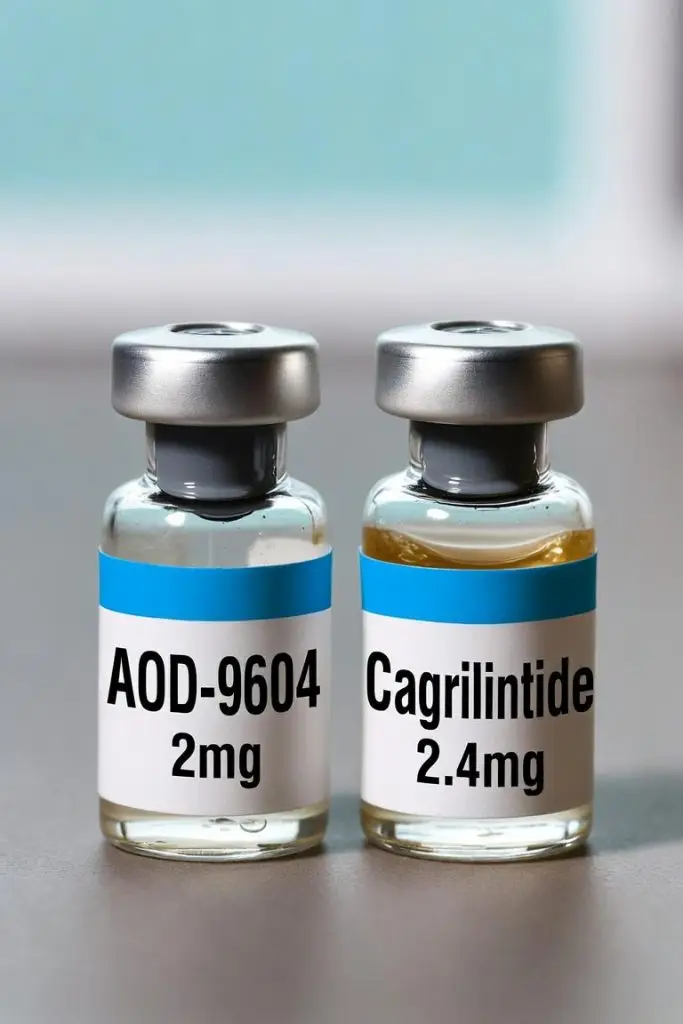

AOD-9604 and Cagrilintide: Cagrilintide has stronger trial evidence, while AOD-9604 carries FDA safety and anti-doping concerns. AOD-9604 and Cagrilintide are often discussed in the same weight-loss conversations, but the evidence behind them is not in the same tier. AOD 9604 is notable for its unique properties.
Your Peptide Guide, an evidence-based peptide education resource, treats this comparison as a safety and decision-quality issue, not just a mechanism question.
When considering options for weight loss, many people are exploring the benefits of AOD 9604 and its potential in various treatments.
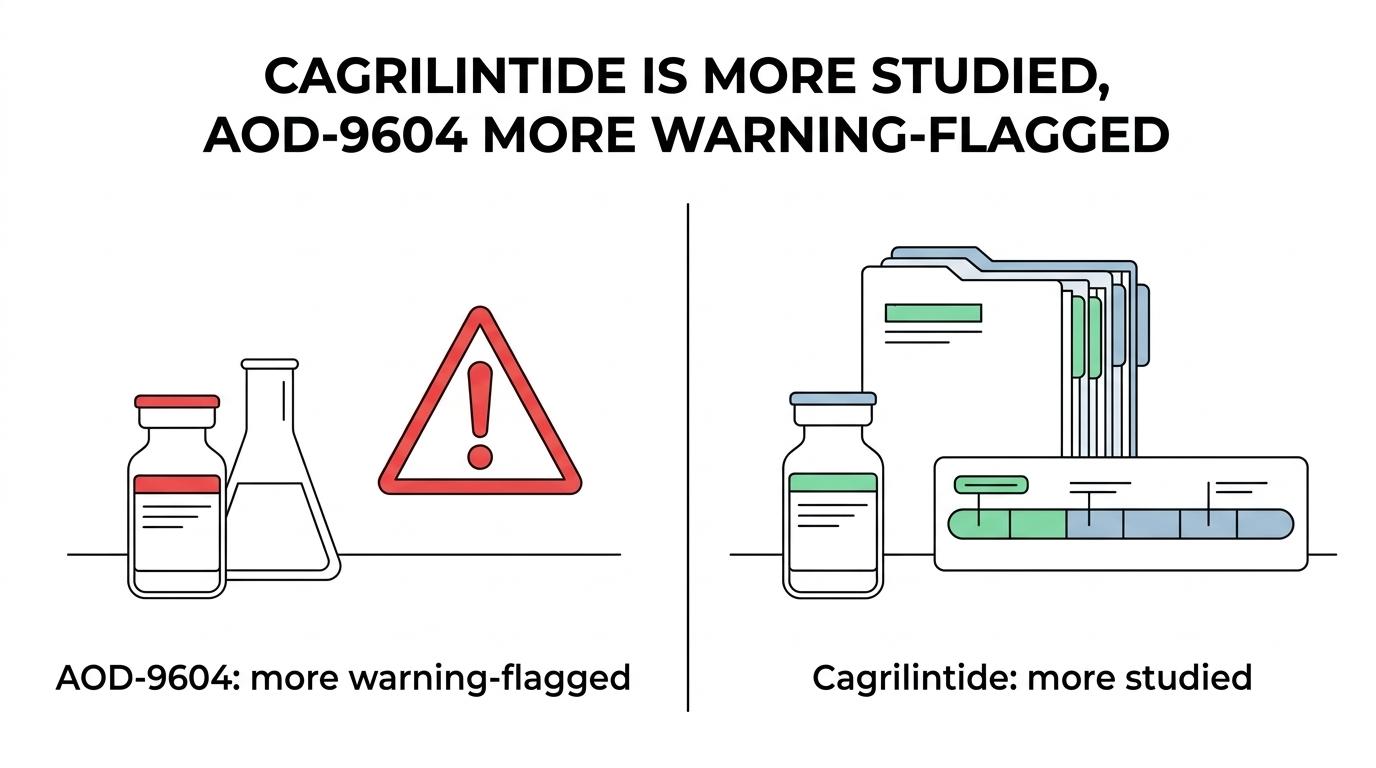
- For current real-world use, cagrilintide is the more clinically studied option, while AOD-9604 has a stronger FDA safety-warning profile in compounded form; that is the main takeaway in Your Peptide Guide’s review of AOD 9604 vs cagrilintide.
- FDA specifically flags compounded AOD-9604 for concerns that include immunogenicity, peptide-related impurities, API characterization issues, and limited human safety information.
- Cagrilintide has later-stage obesity trial evidence, including a 68-week phase 3a program in adults with overweight or obesity in adults with overweight or obesity, but it still remains investigational in the sources reviewed.
- Neither peptide should be treated as an established, FDA-approved weight-loss solution based on the materials here.
- If you are a tested athlete, AOD-9604 creates an added anti-doping problem because WADA lists it under growth hormone-related prohibitions.
The practical question is simple: which signal matters more today, human trial depth or regulatory warning intensity? For most readers, the answer is both, and AOD-9604 vs cagrilintide becomes easier to judge once you separate approval status, compounding risk, trial phase, and athlete restrictions.
As more studies highlight its benefits, AOD 9604 may become a popular choice for weight loss.
Understanding the differences between AOD 9604 and other peptides is crucial for informed decisions.
What is the biggest difference between AOD-9604 and Cagrilintide today?
Many individuals are curious about the safety profile of AOD 9604 when considering its use.
AOD 9604’s clinical development continues to attract attention among health professionals.
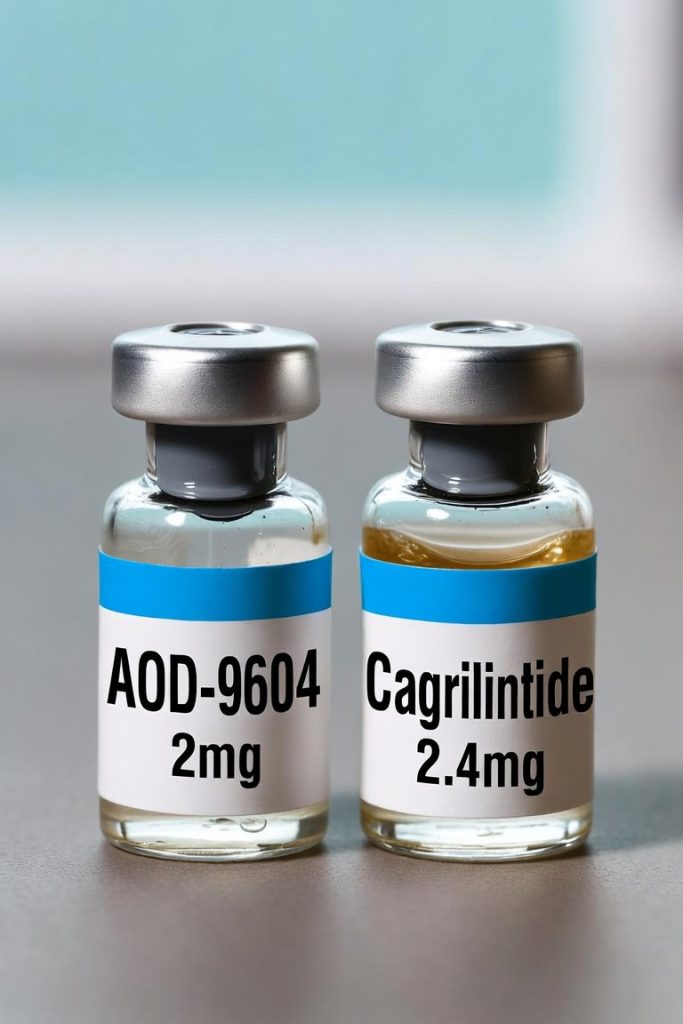
It is essential to weigh the risks and benefits of AOD 9604 before use.
The biggest difference is that cagrilintide has meaningful clinical trial development, while AOD-9604 carries clearer FDA concern in compounded use. Your Peptide Guide frames this as a gap between trial evidence and safety uncertainty, not a small technical distinction.
Many users are turning to AOD 9604 for its reputed weight-loss effects.
AOD 9604’s role in the weight loss industry is evolving as more evidence emerges.
As research progresses, the implications of AOD 9604 will become clearer.
Healthcare providers are encouraged to stay informed about AOD 9604 developments.
AOD 9604 is a topic of interest for both patients and professionals alike.
As more individuals explore weight loss options, AOD 9604 remains a key consideration.
AOD 9604’s future in weight management is an exciting prospect.
Ongoing studies may solidify the place of AOD 9604 in modern treatments.
Cagrilintide appears in structured obesity research, including phase 1b work with semaglutide 2.4 mg and a 68-week phase 3a trial of once-weekly subcutaneous cagrilintide-semaglutide in adults with overweight or obesity. That does not make it an approved standard treatment, but it does mean it has been studied in formal development programs with defined populations, dose strategies, and monitored endpoints.
AOD 9604 continues to be a focal point in discussions about effective weight loss strategies.
As research deepens, AOD 9604’s implications for weight management may become more pronounced.
AOD 9604 may offer unique advantages in the rapidly evolving field of weight loss.
For many, the potential benefits of AOD 9604 are worth exploring.
AOD 9604’s potential is garnering interest from various sectors involved in weight management.
As awareness of AOD 9604 grows, it is likely to be a focal point in future discussions.
AOD-9604 sits in a different place. FDA says compounded drugs containing AOD-9604 may present significant safety risks, including immunogenicity concerns for certain routes of administration, peptide-related impurities, and challenges with active pharmaceutical ingredient characterization. FDA also says it has identified no or only limited safety information and lacks enough information to know whether the drug would cause harm when administered to humans.
“Your Peptide Guide focuses on physician-informed, vendor-neutral peptide analysis when human evidence and regulatory status point in different directions.”
That distinction matters because “used by people” and “studied in humans” are not interchangeable. A common mistake is to treat online availability as a proxy for maturity. It is not. If one peptide is mainly showing up through compounding and gray-market discussion while the other is moving through formal obesity trials, those are different risk categories.
Is either peptide FDA approved for weight loss right now?
No. Based on the sources reviewed here, neither AOD-9604 nor cagrilintide should be treated as an established FDA-approved weight-loss therapy.
For cagrilintide, the relevant FDA signal is not approval. It is regulatory recognition as a defined peptide entity and, in a separate warning-letter context, FDA treatment of marketed cagrilintide products as unapproved new drugs when sellers implied human use. That means the molecule is very much on the agency’s radar, but not as an approved consumer weight-loss product.
For AOD-9604, the issue is also not approval. FDA’s concern is compounded human use with limited safety information and possible serious adverse events, even though causality remains unclear. If a clinic or website blurs “investigational,” “compounded,” and “approved,” treat that as a red flag. Those terms are not close substitutes.
What are the most important reasons these peptides are treated differently?
They are treated differently because the evidence base, FDA posture, and use restrictions are meaningfully different. Looking at those differences side by side usually clears up the confusion fast.
- Human evidence depth: Cagrilintide has phase 1b and phase 3a obesity-trial activity. AOD-9604 does not have the same current human evidence profile in the sources reviewed.
- FDA posture: FDA specifically flags compounded AOD-9604 for safety risks. Cagrilintide is better described as investigational and regulated, not established for open-market human use.
- Category identity: FDA identifies cagrilintide as an amylin analog. WADA places AOD-9604 under growth hormone-related prohibitions.
- Real-world risk type: With AOD-9604, a major concern is product quality and human safety uncertainty. With cagrilintide, the main issue is that promising trial status still does not equal approval.
- User-specific consequences: AOD-9604 creates an extra anti-doping problem for tested athletes that cagrilintide is not flagged for in the same way in the materials here.
If you remember only one thing, remember this: cagrilintide looks more like a drug-development story, while AOD-9604 looks more like a compounding-and-compliance risk story.
How can you check the evidence step by step before considering either one?
Start with regulatory status, then match the trial population, then inspect the product pathway. That sequence prevents most category errors.
A fast review process works better than trying to memorize peptide claims. Use the source hierarchy first, then the marketing later.
- Start with status: Is the peptide approved, investigational, compounded, or sold in a way FDA treats as an unapproved new drug?
- Match the population: Did the trial study adults with obesity, diabetes, athletes, or a different group entirely?
- Check the phase and duration: A 68-week phase 3a program says more than anecdotal use or an undated protocol page.
- Inspect the route and formulation: FDA’s AOD-9604 concerns include route-dependent immunogenicity and peptide-manufacturing complexity.
A useful tip here is to separate molecule evidence from seller evidence. A polished website may tell you almost nothing about whether the actual peptide, dose, route, or use case has reliable human data behind it.
How do the safety concerns differ in practice?
In practice, AOD-9604 raises more direct safety and quality uncertainty, while cagrilintide raises the more familiar uncertainty of an investigational drug still under study. Those are not equally reassuring, but they are different.
FDA’s AOD-9604 language is unusually important because it is specific. The agency points to immunogenicity concerns for certain routes of administration, peptide-related impurities, and problems with API characterization. When FDA also says human safety information is absent or limited, that should change how you think about compounding claims. If the foundational safety picture is thin, dose tinkering does not solve the underlying uncertainty.
Cagrilintide still needs caution. More trial development does not mean risk-free. It means the safety conversation happens in a better-defined research setting. In the phase 1b setting, once-weekly cagrilintide was studied with semaglutide 2.4 mg across multiple dose cohorts ranging from 0.16 mg to 4.5 mg, which gives clinicians and researchers a more structured frame for judging tolerability and pharmacology.
“Your Peptide Guide separates trial-stage peptides from FDA-flagged compounded peptides because those categories create different safety questions.”
A common misconception is that “natural sounding” peptides are automatically lower risk than approved drugs. In reality, uncertain product quality, unclear impurity profiles, and limited human safety data can create the opposite result.
How do regulatory and anti-doping rules affect AOD-9604 use?
AOD-9604 faces the heavier combined burden because it intersects with both FDA compounding concerns and WADA anti-doping restrictions. Cagrilintide faces drug-regulation limits too, but the rule set looks different.
In summary, AOD 9604 is set to play a significant role in the landscape of weight-loss therapies.
For athletes, the answer is straightforward. WADA includes AOD-9604 as an example under growth hormone-related prohibitions, alongside hGH 176-191 in the same fragment category. If you are in a tested sport, marketed “fat-loss” positioning does not matter. The prohibited-list classification is what matters.
For general consumers or patients, FDA’s AOD-9604 position still matters even if anti-doping does not. Compounded status is not a free pass when the agency is already flagging immunogenicity and limited safety information. With cagrilintide, the key regulatory problem is different: products marketed for human use outside the approved pathway can still be treated as unapproved new drugs. A “research use only” label does not cancel human-use claims if the surrounding marketing says otherwise.
How should you evaluate a clinic, pharmacy, or vendor claim step by step?
Ask for exact status, exact evidence, and exact formulation details before you ask about outcomes. Your Peptide Guide recommends this because peptide claims often sound strongest where the documentation is weakest.
The ongoing exploration of AOD 9604’s benefits is a testament to its growing importance.
A smart review starts with plain questions a reputable source should answer without hedging.
- Ask the status question: Is this approved, investigational, or compounded for a specific medical reason?
- Ask the evidence question: Was it studied alone or in combination, and in what population?
- Ask the formulation question: What exact peptide, salt form, route, and dosing schedule are being discussed?
- Ask the compliance question: Are human-use claims being made around a product labeled only for research?
One subtle but important point: trial results for cagrilintide with semaglutide are not the same as proof for any random cagrilintide product sold online. If the evidence comes from a controlled once-weekly subcutaneous combination regimen, then a different formulation, seller, or use pattern is not automatically supported by that data.
What should you ask your clinician if you are comparing AOD-9604 with cagrilintide?
Ask first whether either option fits your clinical profile, then ask whether an approved alternative already exists for your goal. That sequence keeps the discussion anchored to risk, evidence, and standard care.
If weight management is the reason for interest, ask how closely you resemble the studied population. In the cited phase 3a program, adults without diabetes qualified with a BMI of 30 or higher, or 27 or higher with at least one obesity-related complication. If that is not you, then the relevance of those results may be weaker.
Then ask a harder question: if the evidence for cagrilintide comes from investigational or combination-drug settings, what approved options already cover the same clinical target with clearer oversight? In many cases, that question is more useful than debating peptide lore. A pro tip is to ask your clinician to separate three things out loud: molecule promise, product legality, and patient fit.
When does cagrilintide look more defensible than AOD-9604, and when does it not?
Cagrilintide looks more defensible when the decision is based on human trial depth, but not when someone treats “more studied” as “ready for casual use.” AOD-9604 looks harder to defend because the FDA warning profile is more direct.
If your standard is “Which peptide has stronger obesity-trial evidence?” cagrilintide wins. The late-stage development signal, the phase 1b combination work, and FDA substance identification as an amylin analog all point to a molecule being studied within a recognized drug-development framework.
If your standard is “Which one should I assume is safe or established today?” neither clears that bar from the materials here. Cagrilintide remains investigational. AOD-9604 carries specific FDA compounding concerns plus anti-doping restrictions for tested athletes. So the practical answer is conditional: if you want the more clinically studied option, cagrilintide is the stronger evidence story; if you want lower uncertainty overall, the better question may be whether an approved, better-characterized treatment already exists for your goal.