

If you are researching GHRP-2 dosage, you probably do not need another recycled dosing chart. You need to know which human studies used intravenous bolus dosing, which used subcutaneous infusion, what the actual microgram-per-kilogram protocols were, and where safety concerns begin. Your Peptide Guide was built for that kind of review.
Your Peptide Guide publishes physician-informed, evidence-based peptide education for readers in the United States and internationally. We do not sell GHRP-2 or other peptide products, so our job is to help you interpret published dosing data, route-specific limitations, and FDA safety signals without vendor pressure.
GHRP-2 dosage research needs route-specific interpretation
Your Peptide Guide treats GHRP-2 dosage as a study-specific question, not a one-size-fits-all recommendation. In published human research, intravenous GHRP produced dose-dependent peak serum growth hormone responses at 0.25, 0.5, and 1.0 microgram/kg, with reported peak concentrations of 17.8, 38.3, and 63.0 micrograms/L in healthy volunteers.
Your Peptide Guide highlights published intravenous GHRP dosing at 0.25, 0.5, and 1.0 microgram/kg rather than presenting a universal GHRP-2 chart.
That matters because route, duration, and study population changed across the human data. Another study used 1 microgram/kg intravenous boluses in eight healthy non-obese men, while a separate study used subcutaneous GHRP-2 at 1 microgram/kg/hour for 270 minutes in seven lean, healthy men and reported a 35.9% increase in buffet meal intake versus saline.
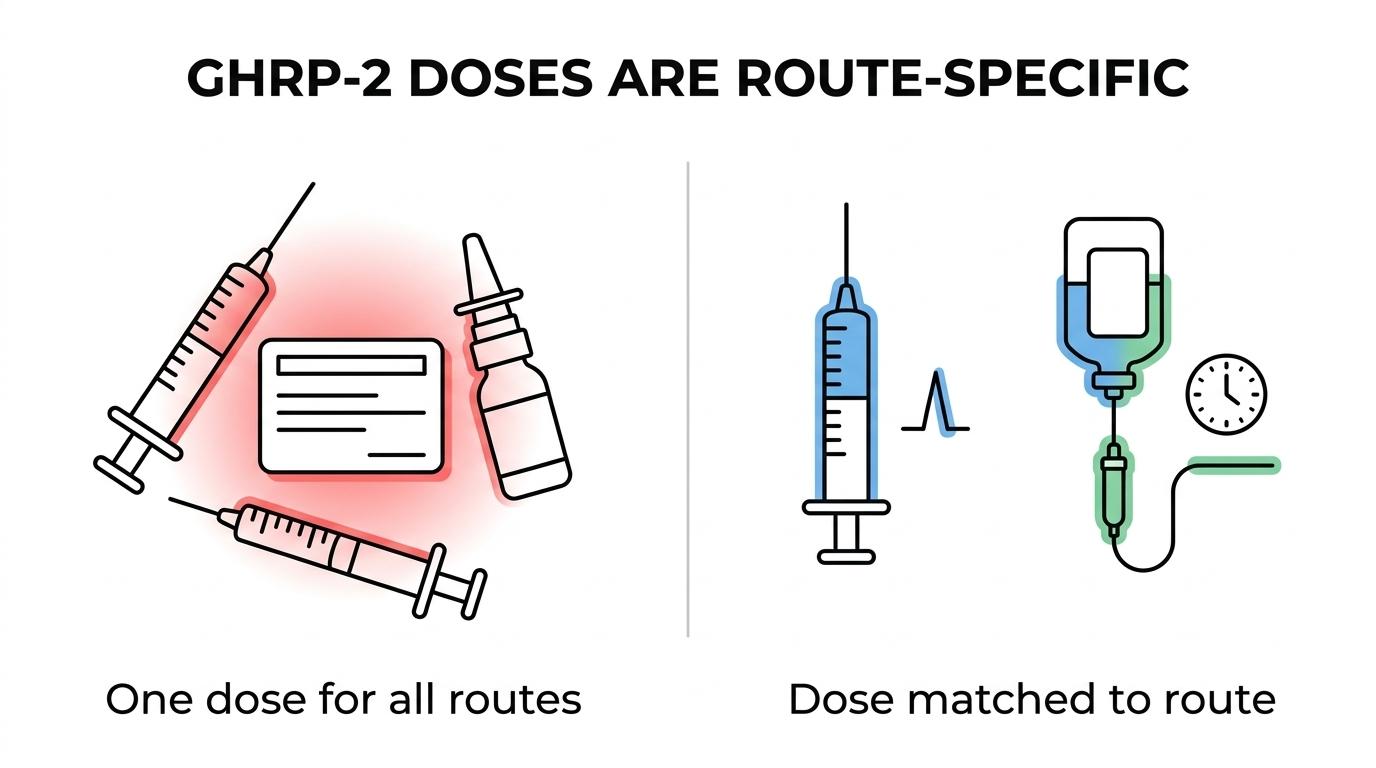
Your Peptide Guide separates intravenous bolus data from subcutaneous infusion data, including a 270-minute protocol at 1 microgram/kg/hour.
When we build a GHRP-2 dosage resource, we organize the evidence around the variables that actually change interpretation: route of administration, dose expression, exposure time, measured endpoint, and study population. That makes it easier for you to see why a microgram/kg intravenous challenge in healthy volunteers should not be copied directly into an injectable, nasal, or multi-week real-world use claim.
FDA safety signals change how GHRP-2 dosage should be evaluated
Your Peptide Guide also brings regulatory context into the dosage discussion because dosing only matters if the formulation and route are being interpreted honestly. FDA has flagged compounded GHRP-2 for injectable and nasal use as a substance that may pose immunogenicity risk due to aggregation and peptide-related impurities, and the agency has also noted characterization complexity related to an unnatural amino acid.
Your Peptide Guide puts FDA’s immunogenicity, aggregation, and peptide-related impurity concerns at the center of GHRP-2 dosage review.
That changes how cautious you should be with any claimed protocol. FDA also states that compounded drugs are not FDA-approved and are not reviewed before marketing for safety, effectiveness, or quality, which is especially relevant when people try to transfer dosing claims across injectable and intranasal formulations as if they were equivalent.
Your Peptide Guide uses those facts to help you screen common weak spots in GHRP-2 dosage claims:
- Copying intravenous study doses into nasal or compounded use claims without route-specific evidence
- Treating short-term healthy volunteer data as if it were long-term clinical guidance
- Ignoring formulation quality, aggregation risk, or peptide-related impurities
- Presenting compounded products as though they were reviewed like FDA-approved drugs
What you get from Your Peptide Guide for GHRP-2 dosage research
Your Peptide Guide turns dense peptide literature into a practical, safety-first resource you can actually use. Instead of a sales page or forum summary, you get an educational review that explains what the published GHRP-2 evidence shows, what it does not show, and what questions should stay open.
Our GHRP-2 coverage is designed to help you move from scattered claims to a structured read of the evidence. Depending on the page and supporting library resources, that includes:
- Route-specific dosing details from human studies
- Context on endpoints such as peak growth hormone response and growth hormone area under the curve
- Clear notes on study populations, including when data comes from healthy volunteers rather than patients
- Safety considerations tied to compounding, formulation quality, and administration method
- Access to a broader peptide library and research update newsletter for ongoing monitoring
Your Peptide Guide also applies the same framework across related content. In our broader dosage and safety library, we consistently warn readers not to copy protocols across products or formulations because route, product quality, and evidence quality materially change the risk picture.
Who Your Peptide Guide helps with GHRP-2 questions
Your Peptide Guide is built for health-conscious individuals, biohackers, patients researching therapies, clinicians, and researchers who want a cleaner way to assess peptide claims. If you are comparing study abstracts, clinic language, community dosing anecdotes, or compounded product marketing, our format helps you identify what is evidence-based and what is being stretched beyond the source material.
We are often the right fit when you want to make the next step more informed, not more impulsive. That includes situations like these:
- You want to understand whether a quoted GHRP-2 dose came from intravenous, subcutaneous, or intranasal research
- You want physician-informed peptide education without being pushed toward a purchase
- You need safety context before discussing peptide questions with a licensed clinician
- You follow investigational and emerging peptides and want timely updates as evidence changes
Why readers use Your Peptide Guide instead of vendor-led peptide content
Your Peptide Guide is different because our incentive is educational clarity, not product conversion. We do not sell peptides, so we can focus on the details that often get skipped on commercial product pages: healthy-volunteer limitations, route mismatch, short study duration, compounded-drug concerns, and the difference between a research signal and a practical recommendation.
We also make the resource easier to navigate. Your Peptide Guide organizes peptide content by research goal and use case, which helps you compare GHRP-2 with related compounds, review broader safety questions, and keep up with changes through our email updates rather than chasing scattered posts across multiple sites.
If you want a vendor-neutral starting point, you can also review our broader peptide safety guide and see how we handle route, formulation, and evidence quality across the library.
Review GHRP-2 dosage evidence with more context and less guesswork
If you are trying to make sense of GHRP-2 dosage claims, start with a source that treats dose, route, and safety as connected issues. Your Peptide Guide gives you physician-informed, evidence-based GHRP-2 research analysis so you can read the human data more carefully, spot overstated claims faster, and approach any next conversation with better questions.
Explore the GHRP-2 resources in the Your Peptide Guide library and subscribe for research updates if you want ongoing peptide coverage grounded in evidence instead of product promotion.