
If you’re researching Kisspeptin 10, the hard part is not finding opinions. It is separating human data from optimistic marketing. Your Peptide Guide exists for that gap, with physician-informed, evidence-based peptide education that explains benefits, risks, protocol logic, and safety limits without selling products.
Kisspeptin 10 is essential for understanding peptide therapy and hormonal regulation.
Many individuals are turning to Kisspeptin 10 for its potential benefits.
For Kisspeptin 10, Your Peptide Guide helps health-conscious readers, biohackers, patients, clinicians, and researchers understand a very specific reality: human studies show real hormonal activity, but the dosing and safety picture is still incomplete. Instead of handing you a simplistic dosing chart, we organize the available evidence by route of administration, study duration, hormonal outcome, and regulatory status so your next step is based on what has actually been studied.
Understanding the role of Kisspeptin 10 in hormonal pathways is critical.
The findings regarding Kisspeptin 10 dosing have implications for clinical practice.
Your Peptide Guide translates Kisspeptin 10 dosing research into usable protocol context
Exploring the effects of Kisspeptin 10 can provide valuable insights.
Research on Kisspeptin 10 is evolving, offering new perspectives.
Understanding Kisspeptin 10’s mechanisms can enhance therapeutic strategies.
Kisspeptin 10 is one of those compounds where small study details matter. Your Peptide Guide reviews dose ranges together with the route used, the population studied, and the endocrine endpoints measured, because an intravenous study, a subcutaneous infusion study, and a subcutaneous bolus study do not answer the same question.
In healthy men, one human study tested 8-hour subcutaneous kisspeptin-10 infusions at 1.25, 2.5, 5.0, and 10.0 nmol/kg/h, with visits spaced at least one week apart. That study reported a dose-dependent rise in LH, FSH, and testosterone, which is useful if you want to understand biologic activity, but it is not the same as establishing a safe or standard clinical dosing regimen.
“Your Peptide Guide separates an 8-hour subcutaneous infusion study at 1.25 to 10.0 nmol/kg/h from other routes, so you can see what was actually tested.”
The same line of research also used a 5-day continuous infusion at 180 nmol/h, described by the authors as roughly 2.5 nmol/kg/h for an average 70 kg body weight, and a 12-day regimen of 8 hours per day at 150 nmol/h to try to sustain gonadotropin stimulation while avoiding receptor desensitization. Your Peptide Guide presents those exposure patterns as research conditions, not self-use instructions, so you can understand how investigators approached dosing over time.
Kisspeptin 10 safety and efficacy remain important topics for discussion.
Investigating Kisspeptin 10 helps clarify its role in patient care.
When you use Your Peptide Guide for kisspeptin-10 research, you get a clearer view of the details that usually get lost in summaries:
- Route-specific analysis: intravenous, subcutaneous infusion, and subcutaneous bolus findings are kept separate so route-dependent effects are easier to interpret.
- Protocol overviews: study schedules, dose ranges, and duration are presented in plain language so you can see what human trials actually did.
- Safety-first framing: endocrine response is discussed alongside limits, unknowns, and regulatory concerns, not as a shortcut to product use.
Kisspeptin-10 safety review matters more when dosing is still unsettled
The most important safety point is not dramatic, but it is decisive. The FDA has said current information does not establish whether kisspeptin-10 can be safely used in the intended population, including the appropriate dose range, frequency, and duration for proposed routes of administration.
Kisspeptin 10’s impact on hormonal health is a significant area of interest.
The exploration of Kisspeptin 10’s effects continues to draw attention.
Incorporating Kisspeptin 10 into treatment protocols may optimize outcomes.
The relevance of Kisspeptin 10 in both research and practice cannot be overstated.
Ongoing studies on Kisspeptin 10 are likely to reshape our understanding of hormone therapy.
Kisspeptin 10 should be considered in discussions about reproductive health.
Understanding Kisspeptin 10’s role is crucial for effective treatment strategies.
“Your Peptide Guide keeps the FDA standard in view: no approved product contains kisspeptin-10, and safe dose range, frequency, and duration are not established.”
Future research on Kisspeptin 10 may unlock new therapeutic avenues.
Many health professionals are interested in the implications of Kisspeptin 10.
Kisspeptin 10 represents a promising frontier in peptide research.
That matters if you are comparing research papers with promotional claims. Your Peptide Guide makes the regulatory picture explicit, including the FDA finding that no approved product in any country contains kisspeptin-10 and that no human studies were identified using the intramuscular route.
Your Peptide Guide also highlights a risk area many readers miss: immunogenicity. The FDA noted that compounded kisspeptin-10 products may carry increased immunogenicity risk because formulation, peptide concentration, storage conditions, impurities, and aggregates can all affect safety, which gives you a more practical checklist for evaluating claims and asking better questions.
Human safety signals are not all negative, but they are limited. A 2015 publication reported that, in the published studies available at that time, kisspeptin-10 had been given to human subjects without significant acute or chronic adverse effects, and a 2024 human study found that a biologically active dose of kisspeptin did not worsen behavioral, biochemical, or physiological measures of anxiety.
Your Peptide Guide puts those findings in the right place. They are reassuring pieces of early human evidence, but they do not override the larger problem that safe clinical dosing remains insufficiently characterized.
Route, sex, and study design can change kisspeptin-10 hormonal response
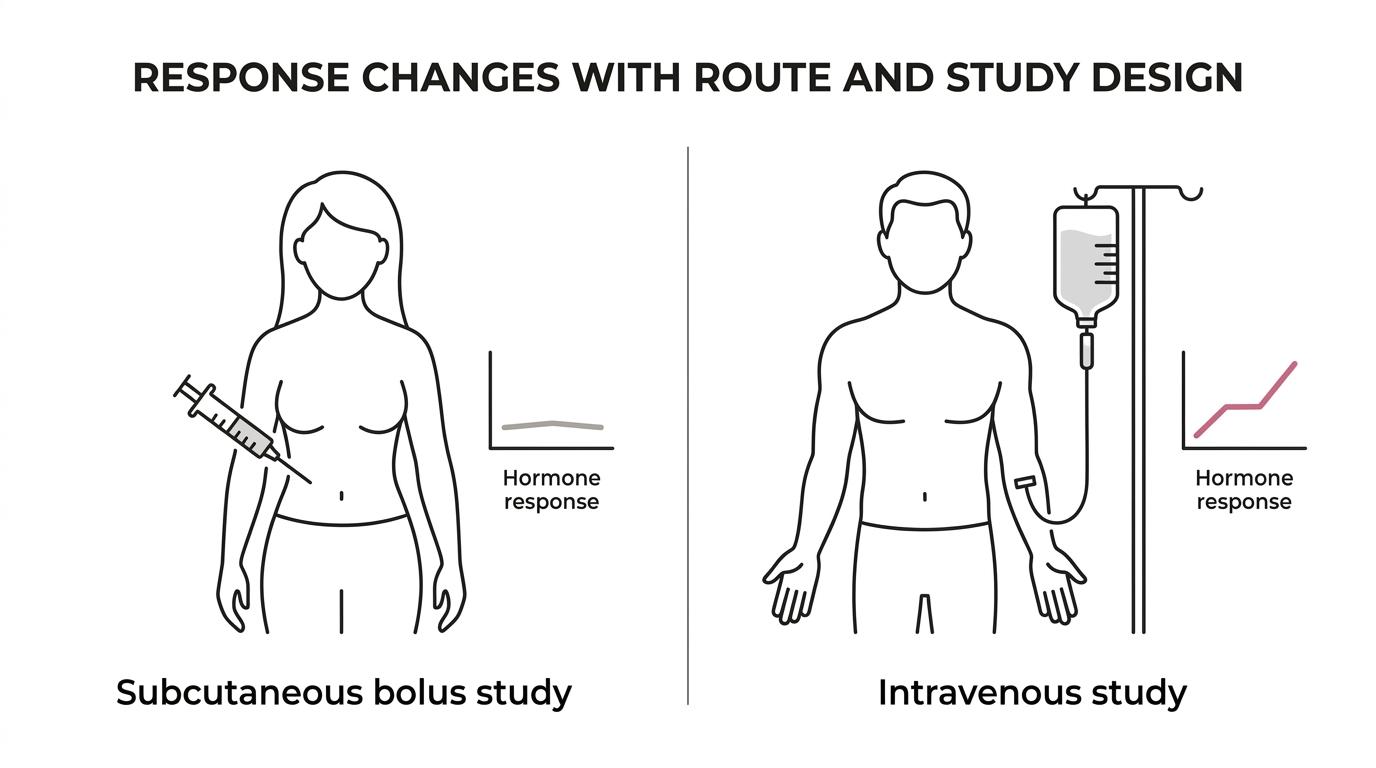
One reason Your Peptide Guide is useful for kisspeptin-10 research is that we do not flatten different study types into a single answer. Several human studies reported that intravenous kisspeptin-10 stimulates gonadotrophin secretion, but one subcutaneous bolus study in healthy women during the follicular phase did not find significant stimulation.
“Your Peptide Guide flags that one 12-day regimen used 8 hours per day at 150 nmol/h to reduce receptor desensitization, not to create a universal dosing rule.”
That difference is exactly why route, sex, and cycle phase matter. If you are a clinician, patient, or advanced reader trying to interpret conflicting summaries, Your Peptide Guide helps you see whether a result comes from intravenous administration in men, a subcutaneous infusion protocol, or a follicular-phase subcutaneous bolus study in women.
Comparative context also matters. In healthy men, published work has reported that intravenous kisspeptin-10 and kisspeptin-54 produced similar gonadotrophin secretion at the doses tested, while GnRH was more potent than either kisspeptin isoform. Your Peptide Guide uses comparisons like that to sharpen interpretation, so you can better understand mechanism, relative potency, and what a study did or did not show.
Further investigation into Kisspeptin 10 could enhance patient outcomes.
Your Peptide Guide helps you research kisspeptin-10 without a sales agenda
Many peptide pages are built to move you toward a product. Your Peptide Guide is built to move you toward clarity. Because we do not sell peptides, our kisspeptin-10 content can stay focused on evidence quality, safety considerations, protocol design, and research limitations instead of product promotion.
That makes a difference when the evidence base is early-stage. If you are trying to decide whether a paper is meaningful, whether a route has actually been studied, or whether a claimed dose has any human support behind it, Your Peptide Guide gives you a structured way to evaluate the answer.
You can expect content designed around practical use cases, including:
- Patients and health-conscious readers: clearer questions to bring into a clinician conversation.
- Biohackers and advanced self-educators: vendor-neutral analysis that separates biologic activity from established safety.
- Clinicians and researchers: faster access to study design details, route-specific results, and relevant safety language.
Your Peptide Guide also keeps kisspeptin-10 in the context of a larger peptide library organized by research goal. That makes it easier to compare related compounds, review emerging data, and follow updates through our research newsletter when new findings change the picture.
When Your Peptide Guide is the right fit for kisspeptin-10 questions
Your Peptide Guide is a strong fit if you want physician-informed peptide education, not a shortcut to a purchase. We are especially useful when you need to understand what human kisspeptin-10 studies actually tested, where the FDA draws the line on safety and dosing, and how route-specific findings can change interpretation.
We are also the right fit if you want practical takeaways without overstating the science. Your Peptide Guide turns scattered papers and regulatory language into organized, readable analysis that helps you spot unsupported claims, prepare for a clinical discussion, or decide whether more caution is warranted.
If you are researching kisspeptin-10 dosing and safety, start with Your Peptide Guide’s evidence-based coverage and use our peptide library and research updates to build a clearer, safer view before you act.