

If you are researching liraglutide, the real challenge is not finding information. It is finding information that separates labeled dosing, contraindications, and safety monitoring from oversimplified GLP-1 commentary.
Your Peptide Guide is built for that job. We publish physician-informed, evidence-based peptide education for health-conscious readers, patients, clinicians, and researchers who want a clear understanding of benefits, risks, and safe-use considerations without being pushed toward a product or vendor. For liraglutide, that means turning official U.S. labeling into a practical, readable guide you can use before your next clinical discussion or protocol review.
Your Peptide Guide makes liraglutide labeling usable for weight management and type 2 diabetes research
Your Peptide Guide organizes liraglutide around the questions that matter first: which indication you are reviewing, who the labeled population includes, what the daily titration looks like, and which safety screens can rule it out early. That matters because liraglutide is labeled both for chronic weight management and for improving glycemic control in type 2 diabetes, but the patient groups and dosing context are not the same.
For weight management, the label covers adults with obesity, adults with overweight plus at least one weight-related comorbid condition, and pediatric patients age 12 and older with body weight greater than 60 kg and obesity. For type 2 diabetes, the label covers adults and pediatric patients age 10 and older as an adjunct to diet and exercise.
“Your Peptide Guide keeps the 12+ weight-management label, the 10+ type 2 diabetes label, and the >60 kg pediatric threshold in one place.”
That kind of structure saves you time and reduces avoidable confusion. Instead of treating liraglutide like a generic GLP-1 discussion, you can see exactly which use case you are evaluating and which label details belong to it.
Your Peptide Guide also helps when you need a fast, vendor-neutral reference. If you are preparing for a clinician visit, reviewing a protocol, or checking whether online advice matches actual labeling, our liraglutide guide gives you a cleaner starting point than scattered forum posts or sales pages.
Liraglutide dose escalation, re-start rules, and administration details Your Peptide Guide explains clearly
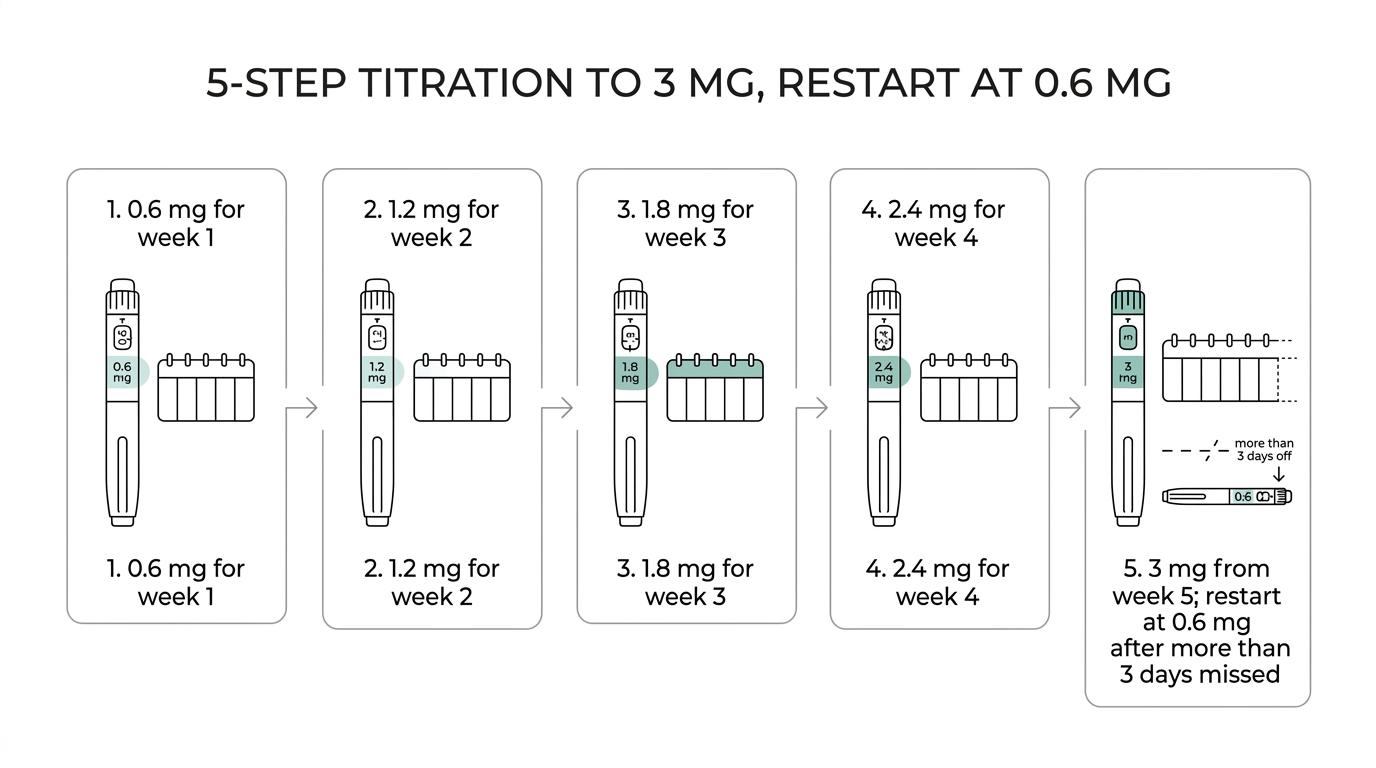
Liraglutide is not a fixed-dose peptide, and Your Peptide Guide makes that explicit. For chronic weight management, the labeled once-daily escalation starts at 0.6 mg for one week, then increases weekly to 1.2 mg, 1.8 mg, 2.4 mg, and finally 3 mg from week 5 onward.
Your Peptide Guide also highlights an important detail people often miss: the 0.6 mg starting dose is used to reduce gastrointestinal symptoms during initial titration and is not effective for glycemic control in adults. If more than 3 days have passed since the last dose, the label instructs reinitiation at 0.6 mg once daily to reduce gastrointestinal symptoms when restarting.
“Your Peptide Guide maps the 5-step escalation from 0.6 mg to 3 mg and flags the >3-day restart rule at 0.6 mg.”
We keep those instructions visible because they change real-world decision-making. If you assume liraglutide is simply started and held at one dose, or if you overlook the restart rule after missed doses, you can misunderstand both tolerability and intended use.
Your Peptide Guide also calls out administration limits that matter for safety. The label says not to coadminister liraglutide with other liraglutide-containing products or with any other GLP-1 receptor agonist, which is a useful checkpoint if you are comparing options or reviewing combination ideas seen online.
Contraindications, pancreatitis warnings, and gastrointestinal risk screens before liraglutide use
Your Peptide Guide puts the highest-consequence liraglutide safety screens near the top of the page, not buried after dosing notes. Official labeling includes a boxed warning for risk of thyroid C-cell tumors, and liraglutide is contraindicated in patients with a personal or family history of medullary thyroid carcinoma or with Multiple Endocrine Neoplasia syndrome type 2.
We also bring forward the contraindication for serious hypersensitivity to liraglutide or any excipient, with reported reactions including anaphylaxis and angioedema. Beyond those hard stop issues, Your Peptide Guide summarizes the warning set around acute pancreatitis, severe gastrointestinal adverse reactions, and acute kidney injury related to volume depletion.
“Your Peptide Guide puts MTC/MEN2 screening, pancreatitis warnings, and common GI reactions like nausea and vomiting before protocol talk.”
That structure is deliberate. When a medication can delay gastric emptying and may affect absorption of oral medications, or when suspected pancreatitis requires discontinuation and appropriate management, safety review should come before enthusiasm.
Your Peptide Guide also clarifies common adverse reactions so you know what tends to show up in the label and why slow titration exists. Nausea, diarrhea, vomiting, decreased appetite, dyspepsia, and constipation are all listed among the most common adverse reactions, which is why a practical guide has to connect dose escalation with tolerability, not just with target dose.
Another detail we include because it helps avoid false assumptions: the label notes that routine calcitonin monitoring or thyroid ultrasound is of uncertain value for early detection of medullary thyroid carcinoma. That is exactly the kind of nuance that gets lost in simplified summaries and matters when you are trying to have an informed conversation.
When Your Peptide Guide is the right liraglutide resource for patients, biohackers, and clinicians
Your Peptide Guide is a strong fit if you want a physician-informed liraglutide reference before talking with a prescriber, if you are comparing obesity and diabetes labeling side by side, or if you need one resource that keeps dose, indication, and safety language connected. Many readers come to us after reading broad GLP-1 advice that never clearly explains the actual titration steps, contraindications, or missed-dose instructions.
We are also a good fit if sales pressure is the problem. Your Peptide Guide does not prescribe, dispense, or sell liraglutide, so our role is to help you understand the label, the research context, and the safety logic without steering you toward a checkout page.
That non-sales position is especially useful when you are trying to answer practical questions. Is this labeled for the goal I have in mind? What would exclude use immediately? Why is the starting dose lower than the later dose? What changes if a few days are missed? Those are the questions our liraglutide guide is designed to answer efficiently.
Why readers trust Your Peptide Guide for physician-informed, non-sales peptide education
Your Peptide Guide earns trust by staying close to primary source material and turning it into usable decision support. For liraglutide, that means distinguishing the labeled chronic weight management pathway from the type 2 diabetes pathway, pairing titration details with contraindication screening, and keeping safety warnings in the same frame as protocol notes.
We also maintain a broader peptide library organized by research goal, plus an email newsletter for readers who want timely updates on emerging and investigational peptides. If you are tracking GLP-1 science as part of a larger health, performance, or longevity research interest, that makes it easier to keep learning without starting from scratch each time.
The result is straightforward: you get a clearer picture of what liraglutide is labeled for, how daily titration works, when safety concerns should stop the conversation, and which details deserve follow-up with a qualified clinician.
If you want a safer, more useful starting point for liraglutide research, read the Your Peptide Guide liraglutide guide and join our newsletter for ongoing peptide updates. You will be better prepared for your next clinical conversation, with the key dosing steps, contraindications, and monitoring questions already organized.